Economic Pulse Net | Sources: World Bank World Development Indicators, Government Sources | 2026
🇦🇫 Afghanistan 2026 — An Economy Rebuilt in the Shadows
Key Takeaways
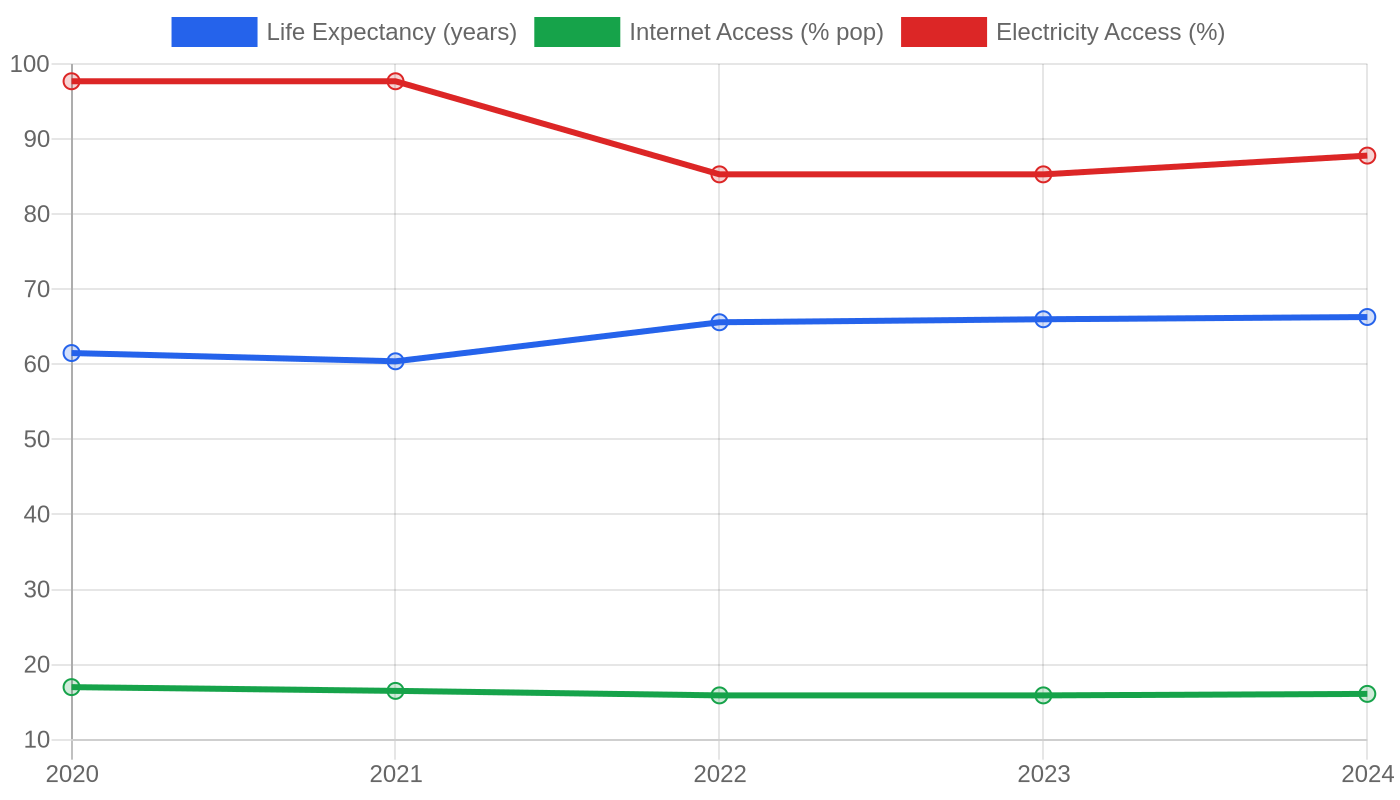
– Afghanistan remains one of the world’s most closed and least transparent economies, with the World Bank listing core indicators — GDP growth, inflation, unemployment, GDP per capita, and even population — as unavailable, underscoring how completely the country’s statistical infrastructure has broken down since 2021.
– The Taliban’s Islamic Emirate, declared after the collapse of the Islamic Republic during the 2021 offensive, is recognized as the de jure government by only one country: the Russian Federation, as of July 2025.
– The formal corporate landscape is a holdover from the pre-2021 era — telecoms, banking, airlines, and media companies that still carry recognizable names but operate under radically altered conditions.
– Afghanistan ranks among the very lowest tiers of global democracy indices, classified as a “closed autocracy” and placed at 176th and 177th out of 179 countries in the V-Dem Democracy Indices.
– With no reliable crime, safety, or cost-of-living data available, anyone assessing the country is effectively flying blind — which is itself the defining economic story.
An Economy Without a Scoreboard
The single most striking feature of Afghanistan’s economy in 2026 is how little of it can be measured. The World Bank’s headline indicators for the country — GDP growth, inflation, unemployment, total GDP, GDP per capita on a purchasing-power-parity basis, GNI per capita, and population — are all listed as not available. This is not a technical footnote; it is the story.
When a country’s statistical apparatus stops producing basic numbers, it means the institutions that collect, verify, and publish them have either collapsed, been dismantled, or lost the international partners who once helped fund the work.
For readers accustomed to judging economies by quarterly growth figures, Afghanistan requires a different lens. The absence of data does not mean the absence of activity. Bazaars still trade, telecom towers still transmit, and banks still process transactions.
But it does mean that policymakers, investors, and aid organizations are operating without a scoreboard — unable to say with confidence whether the economy is shrinking or growing, whether prices are rising or falling, or how many Afghans are working and how many are not.
The main industries that historically anchored the formal economy — agriculture, textiles, carpets, minerals, and small-scale manufacturing — have not disappeared, but their contribution can no longer be tracked through official channels. What remains visible is a corporate sector dominated by a handful of long-established names, most of them rooted in the pre-2021 era.
Without reliable national accounts, the honest conclusion is that Afghanistan’s economy in 2026 is best understood not through numbers but through institutions: who controls them, who funds them, and who is allowed to operate.
Cost of Living: The Data Blackout Nobody Can Afford
On paper, there is nothing to report on Afghan housing costs, rent-versus-buy calculations, or daily expenses: the cost-of-living data provided is simply absent. But the absence of a price index is not the same as the absence of prices. In a country where the World Bank cannot publish an inflation rate, households still confront the daily arithmetic of bread, fuel, and rent — they simply do so without any official measure to compare against, negotiate with, or protest.
This matters enormously for anyone trying to understand Afghan welfare. Inflation data is the tool that tells a government whether its currency is holding, whether salaries are keeping pace, and whether the poorest are being squeezed. Without it, there is no early-warning system. A spike in food prices can go unrecorded until it becomes a humanitarian emergency rather than an economic statistic.
The comparison to regional averages, which journalists would normally draw to contextualize Afghan costs, is impossible here — not because Afghanistan is uniquely expensive or cheap, but because the baseline data does not exist. What can be said with confidence is that a country with no functioning consumer price index is a country where economic hardship is invisible until it becomes visible in other ways: migration flows, malnutrition, and the informal economy’s expansion.
Investment and Business Climate: Familiar Names, Unfamiliar Rules
Afghanistan’s top-company list reads like a time capsule from the Islamic Republic era. Afghan Telecom, Afghan Wireless, and Ariana Afghan Airlines are joined by financial institutions such as Afghanistan International Bank and Azizi Bank, media outlets including Ariana TV and the Bakhtar News Agency, and industrial players like AZ Corporation and Afghan Film. These are the recognizable pillars of the formal economy — and their continued presence on any list is itself notable.
For investors, the business climate presents a paradox. The companies exist, the sectors — telecommunications, financials, consumer services, industrials — are legible, and there is an obvious need for capital across all of them.
Yet the broader environment is defined by the political reality: a government recognized by only one foreign state, a “closed autocracy” ranking in the V-Dem Democracy Indices, and international sanctions architecture that makes ordinary cross-border banking extraordinarily difficult.
That combination means the companies on this list operate in a kind of economic limbo. They are not shut down, but they are largely cut off from the international financial system that would allow them to grow, borrow, or attract foreign partners. Sectors to watch — telecoms and banking especially — are precisely the ones most exposed to sanctions and least able to function normally under them.
Safety, Politics and Quality of Life: A Closed Autocracy
Afghanistan’s political landscape is the clearest thing about it. Following the effective collapse of the Islamic Republic during the 2021 Taliban offensive, the Taliban declared the country an Islamic Emirate and announced a caretaker government on 7 September of that year. As of July 2025, only the Russian Federation has recognized the Islamic Emirate as the de jure government of Afghanistan. That single fact shapes everything else: diplomacy, trade, aid, and the daily lives of Afghans.
The democracy picture is equally stark. In the V-Dem Democracy Indices, Afghanistan ranks amongst the lowest as a “closed autocracy,” placing at 176th and 177th out of 179 countries. That is not a marginal ranking — it places Afghanistan at the very bottom of the global distribution of political openness.
On crime and safety, the indices are not available, which leaves a gap that is itself revealing. In most countries, crime statistics are imperfect but present; in Afghanistan, the measurement infrastructure has fallen away alongside the statistical system more broadly. Quality-of-life assessments, happiness rankings, and safety indices all depend on the same data-collection capacity that has gone dark — meaning that the lived experience of ordinary Afghans is, from a quantitative standpoint, largely undocumented.
What’s Happening Now: A Government the World Mostly Won’t Call a Government
The most consequential current fact about Afghanistan is diplomatic rather than economic: as of July 2025, only the Russian Federation has recognized the Islamic Emirate of Afghanistan as the de jure government. This is not a minor technicality. De jure recognition determines whether a government can sign treaties, access international institutions, unfreeze assets, and participate in the global financial system on normal terms.
With a single recognizer, Afghanistan remains in a category almost no other country occupies.
The caretaker government announced on 7 September 2021 continues to function as the country’s governing authority, but its international standing has not broadened meaningfully in the years since. That isolation feeds directly into the economic data blackout: international statistical agencies, including the World Bank, depend on partner institutions inside a country to gather and validate data. When those partnerships are severed, the numbers stop — and they have.
For businesses, the practical effect is that even the well-known companies on Afghanistan’s corporate roster — Afghan Telecom, Azizi Bank, Ariana Afghan Airlines — operate in an environment where normal international transactions are fraught. The sectors that would naturally lead a recovery, telecoms and finance, are the ones most constrained by the recognition gap.
What to watch next is whether the circle of recognizing states widens beyond Russia. Every additional recognition would not transform the economy overnight, but it would begin to reopen the channels — banking, trade finance, statistical cooperation — through which an economy becomes measurable again. Until then, Afghanistan’s most important economic indicator is a diplomatic one.
The Bottom Line
Afghanistan is the rare economy where the most important fact is not a number but an absence: no GDP growth figure, no inflation rate, no unemployment rate, no population count. For investors, the country is effectively uninvestable at scale until recognition and sanctions conditions change — the corporate names exist, but the plumbing does not.
For humanitarian organizations, journalists, and policymakers, Afghanistan in 2026 is a case study in what happens when a country’s statistical and political life are severed at the same time. Watch the recognition column, not the growth column — because right now, only one of them has anything in it.
Sources & Methodology
This article is authored by Economic Pulse Net for informational and research purposes. Economic Pulse Net sources its data from multilateral institutions, national statistics bureaus, and proprietary databases. All data is believed to be current as of the date of publication.
Published: September 23, 2026 | Category: Research — Afghanistan
Use these signals in your own platform
Economic Pulse publishes its live signal feed through a documented, read-only API. Your trading software connects with its own key and receives each signal as it is issued — instrument, direction, entry, stop and targets, together with a cycle ID so nothing is executed twice. The feed is independent of this website and cannot change it.
Signals are informational only and are not financial advice.