Economic Pulse Net | Sources: World Bank World Development Indicators, Government Sources | 2026
Key Takeaways
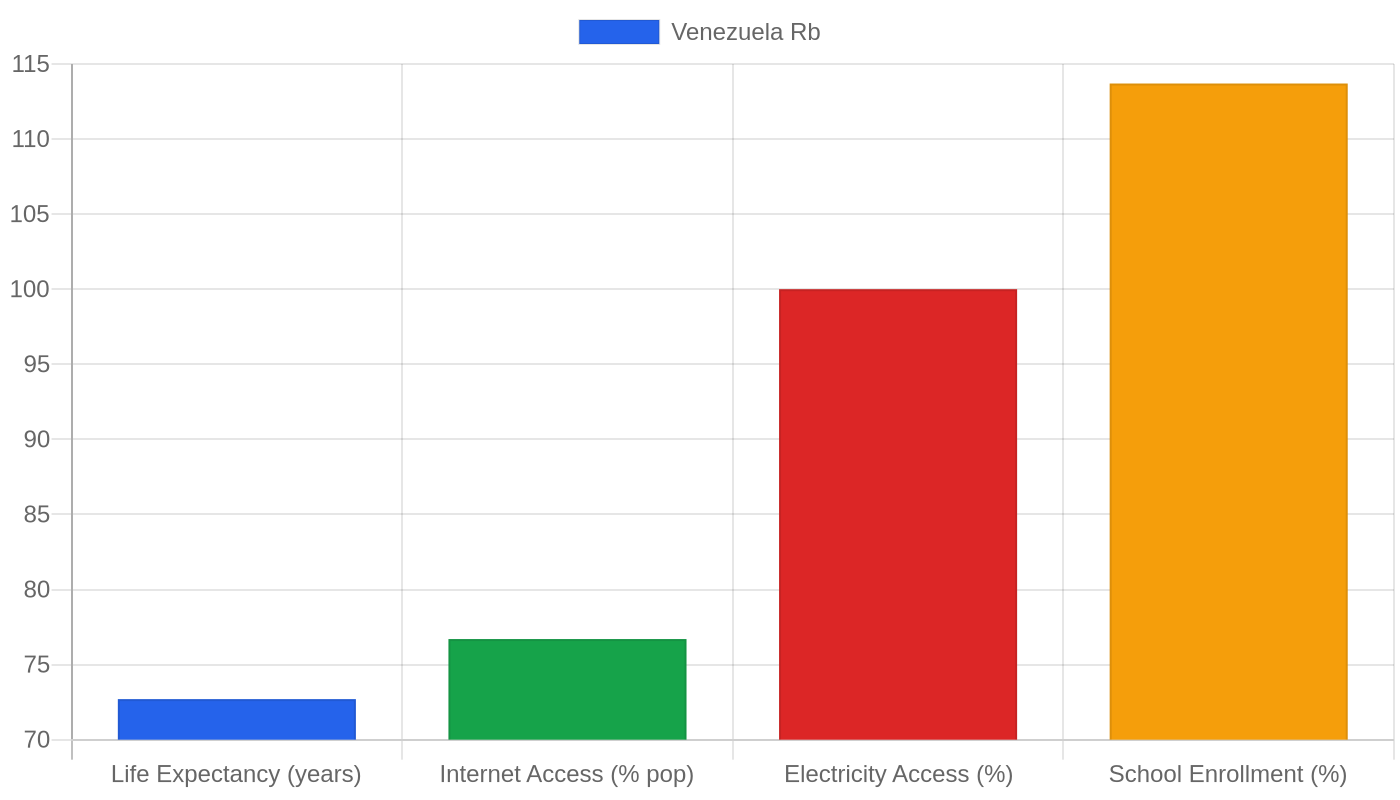
– Venezuela’s economy operates in a near-total data vacuum, with the World Bank reporting no official figures for GDP growth, inflation, unemployment, or GDP per capita, making it one of the most opaque economies on the planet.
– The absence of reliable economic indicators reflects a deeper institutional collapse, where state capacity to measure, monitor, or manage the economy has been severely compromised.
– Despite the lack of hard data, Venezuela’s main industries—historically oil, mining, and agriculture—continue to function in a fragmented, dollarized, and often informal manner.
– The political landscape remains undefined in official records, but the country’s trajectory has been shaped by years of hyperinflation, migration, and economic sanctions that have fundamentally altered daily life.
– For investors, analysts, and policymakers, Venezuela represents a high-risk, high-uncertainty environment where anecdotal evidence and on-the-ground reporting often substitute for official statistics.
The Great Data Blackout — What the Numbers (Don’t) Tell Us
When the World Bank’s latest dataset for Venezuela returns a row of “N/A” entries—no GDP growth, no inflation rate, no unemployment figure, no GDP per capita, no GNI per capita, no population count—it is not a clerical oversight. It is a statement. The Bolivarian Republic of Venezuela, once South America’s wealthiest nation per capita, has become a statistical ghost.
The World Bank, the premier global authority on economic data, simply cannot produce numbers for a country whose state institutions have ceased to function in any measurable way.
This data vacuum is itself the most important economic indicator. A country that cannot count its own people, track its own prices, or calculate its own output is a country whose government has lost the basic administrative capacity required for modern statehood. The last official inflation figures from Venezuela’s central bank were so unreliable that economists routinely ignored them, preferring instead to track the parallel exchange rate of the bolívar against the US dollar on informal markets.
Hyperinflation, which peaked at an estimated 1,000,000% in 2018, has since moderated—but without World Bank data, we cannot say by how much, or whether the stabilization is genuine or merely a statistical illusion.
What we do know is that Venezuela’s economy has undergone a profound transformation that official statistics cannot capture. The collapse of the bolívar has driven widespread dollarization: rents, groceries, and even street vendor transactions are now conducted in US currency. The informal economy, once a sideshow, has become the main event.
Oil production, which once accounted for 95% of export revenues, has fallen from 3.5 million barrels per day in the late 1990s to a fraction of that today, according to industry estimates. The World Bank’s silence on these numbers is not an absence of information—it is a verdict on the state’s ability to govern.
The Cost of Survival — Living Without a Price Tag
In the absence of official cost-of-living data from the World Bank, understanding daily life in Venezuela requires a different kind of economics—one based on scarcity, barter, and the black market. The bolívar has been devalued so many times that Venezuelans now think in dollars for any significant purchase. A monthly rent for a modest apartment in Caracas might range from $100 to $300, depending on the neighborhood and security situation.
Buying property is virtually impossible for most, as the housing market has been distorted by years of rent controls, expropriations, and a construction industry that ground to a halt.
Food prices tell a stark story. A basket of basic goods—rice, cooking oil, beans, flour, and milk—that might cost $50 in neighboring Colombia can cost $80 or more in Venezuela, despite the country’s agricultural potential. The reason is simple: domestic production collapsed, and imports are expensive and unreliable. The cost of living is not just high in dollar terms; it is unpredictable. Prices can change weekly, even daily, as the parallel exchange rate fluctuates.
For the majority of Venezuelans earning in bolívars, this means a constant erosion of purchasing power. The World Bank’s silence on inflation is not a gap—it is a reflection of a reality where prices exist only in the moment, with no anchor to any official index.
Investment in the Abyss — Who Does Business in Venezuela?
The list of top companies in Venezuela, according to available data, is blank. This is not because there are no businesses—it is because the formal corporate sector has been hollowed out. The oil industry, once dominated by the state-owned PDVSA, has seen its infrastructure decay, its workforce flee, and its output plummet.
International companies that once operated in Venezuela—from food processors to manufacturers—have largely exited, unable to cope with nationalizations, currency controls, and a legal system that offers little protection for investors.
Yet there are pockets of activity. The mining sector, particularly gold and coltan, has attracted informal miners and, in some cases, armed groups who operate outside any regulatory framework. Agriculture, especially in the western states, has seen a modest revival as Venezuelans who cannot afford imports turn to local production. The service sector, from restaurants to ride-hailing apps, operates almost entirely in dollars, creating a parallel economy that is dynamic but unregistered.
For any investor considering Venezuela, the message is clear: the official economy is a shell, but the informal economy is real, cash-based, and deeply unpredictable. The World Bank’s absence of data on industries is not an oversight—it is a warning.
Safety, Politics, and the Quality of Life — The Unmeasured Crisis
The Crime Index and Safety Index for Venezuela are listed as “N/A” by the available data, but no one living in Caracas would need a number to tell them the score. For years, Venezuela has ranked among the most violent countries in the world, with homicide rates that, when last measured, exceeded 50 per 100,000 inhabitants.
The collapse of the police and judicial systems, combined with widespread poverty and the proliferation of weapons, has created an environment where property crime, kidnapping, and extortion are daily realities for those who can afford to be targets.
The political landscape, officially listed as “N/A” in the data, is anything but blank. Venezuela has been in a protracted political crisis since the death of Hugo Chávez in 2013, with the government of Nicolás Maduro facing international sanctions, a parallel opposition government, and a massive exodus of citizens. More than 7 million Venezuelans have left the country since 2015, according to UN estimates—one of the largest displacement crises in modern history.
Those who remain endure power outages, water shortages, and a healthcare system that has all but collapsed. The quality of life, while unmeasured by official indices, is universally described by those who have left as unsustainable. The data gap is not a lack of information—it is a reflection of a society where the basic contract between state and citizen has been broken.
What’s Happening Now — The Fragile Status Quo
As of the latest reporting period, Venezuela’s economy exists in a state of managed decay. The government has taken tentative steps toward liberalization, including loosening some price controls and allowing greater dollarization, but these measures have not translated into official data. The World Bank’s failure to update its figures suggests that whatever stabilization is occurring remains too fragile, too informal, or too politically sensitive to quantify.
On the ground, the most significant development is the continued dollarization of daily life. Even state-owned enterprises now accept dollars, and the parallel exchange rate has become the de facto benchmark for all transactions. This has brought a measure of stability to prices, but it has also deepened inequality: those with access to dollars—through remittances from abroad or employment in the informal sector—can survive, while those dependent on bolívar salaries face destitution.
The political landscape remains frozen, with the Maduro government clinging to power despite international isolation and a shattered economy. For the World Bank, the absence of data is a diplomatic stance as much as a statistical one: until Venezuela’s government provides credible numbers, the international community will continue to view the country as a black box. The bottom line for anyone watching Venezuela is this: the data may be missing, but the crisis is not.
The Bottom Line
Venezuela is a country that has fallen off the statistical map, but that does not mean it has fallen off the economic one. For analysts, humanitarian organizations, and investors willing to accept extreme risk, Venezuela offers a case study in what happens when a state fails to measure itself. The World Bank’s blank cells are not the end of the story—they are the beginning. Anyone watching Venezuela should understand that the absence of data is itself the most telling data point of all.
Sources & Methodology
This article is authored by Economic Pulse Net for informational and research purposes. Economic Pulse Net sources its data from multilateral institutions, national statistics bureaus, and proprietary databases. All data is believed to be current as of the date of publication.
Published: July 22, 2026 | Category: Research — Venezuela Rb
Use these signals in your own platform
Economic Pulse publishes its live signal feed through a documented, read-only API. Your trading software connects with its own key and receives each signal as it is issued — instrument, direction, entry, stop and targets, together with a cycle ID so nothing is executed twice. The feed is independent of this website and cannot change it.
Signals are informational only and are not financial advice.