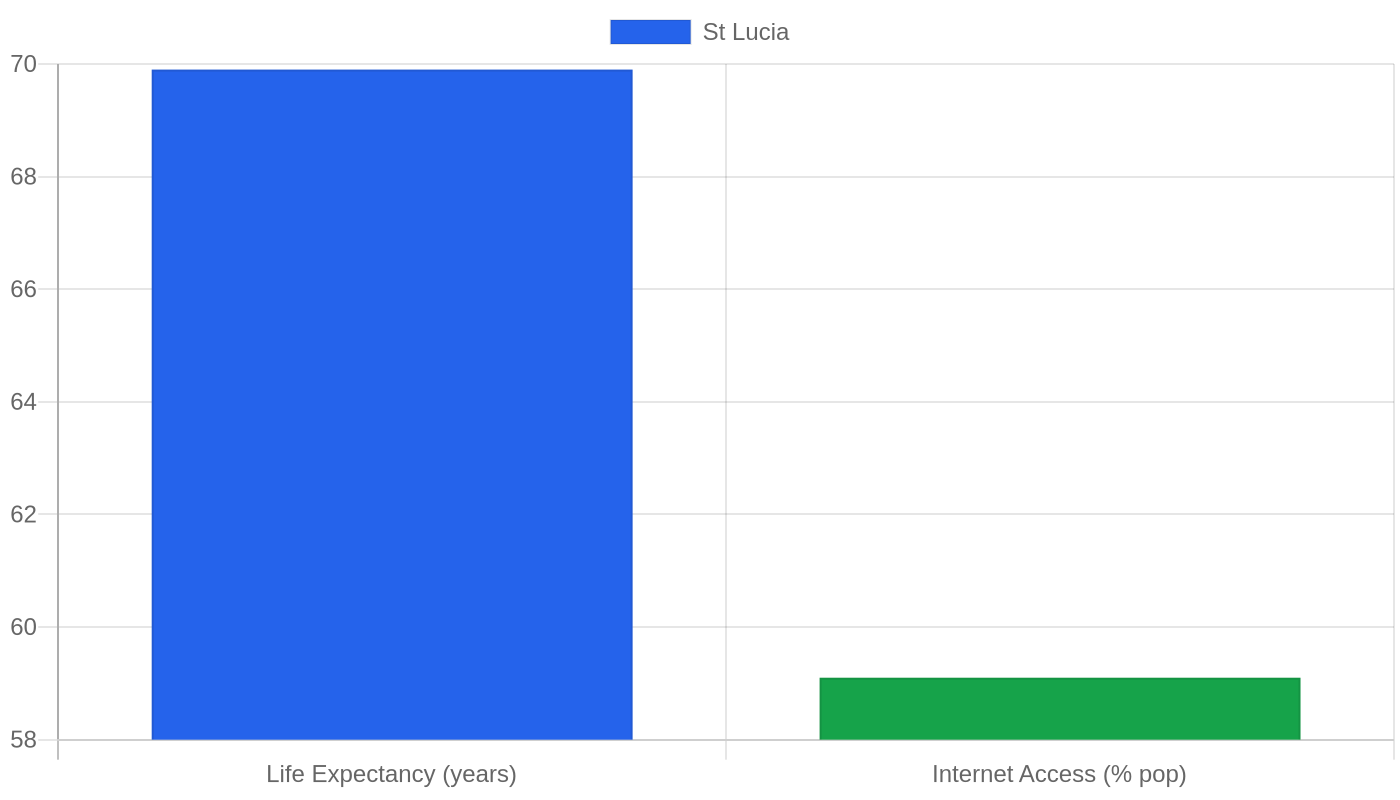
Economic Pulse Net | Sources: World Bank World Development Indicators, Government Sources | 2026
Key Takeaways
– Saint Lucia operates as a stable parliamentary democracy within the Commonwealth, with Prime Minister Philip J. Pierre currently leading the government and King Charles III as head of state.
– The island’s economy is heavily dependent on tourism and agriculture, though comprehensive World Bank macroeconomic data is not currently available.
– As a small island developing state, Saint Lucia faces structural challenges common to the Caribbean region, including vulnerability to external shocks and limited economic diversification.
– The political system features a 17-seat House of Assembly, with members elected through a plurality voting system that shapes the country’s governance and policy direction.
– Investors and observers should monitor Saint Lucia’s ongoing economic development within its constitutional framework, which provides institutional stability.
The Economic Landscape: Navigating Uncertainty in Paradise
Saint Lucia’s economic narrative is one of potential awaiting full realization, with the World Bank currently reporting no comprehensive figures for GDP growth, inflation, unemployment, or per capita income.
This data gap itself tells a story — the challenges of economic measurement in small island states are well documented, and Saint Lucia’s position as a middle-income Caribbean nation places it in a category where international financial institutions often struggle to maintain up-to-date statistics.
The absence of hard numbers does not diminish the island’s economic significance; rather, it highlights the need for enhanced data collection and reporting mechanisms that would benefit both policymakers and potential investors.
The main industries that drive Saint Lucia’s economy include tourism, which has long served as the primary engine of growth and employment, along with agriculture — particularly banana production, which has historically been a crucial export commodity. These sectors face distinct pressures: tourism remains vulnerable to global economic conditions and weather-related disruptions, while agricultural producers contend with international competition and the ongoing challenges of climate change.
The service sector, anchored by tourism-related activities, likely accounts for the largest share of economic output, though precise World Bank data is not available to confirm the exact distribution.
The structural characteristics of small island economies mean that Saint Lucia’s economic performance is closely tied to external factors beyond its control. Changes in global travel patterns, shifts in commodity prices, and the economic health of major source markets all have outsized effects on the domestic economy. The country’s economic resilience will depend on its ability to diversify beyond traditional sectors while strengthening the institutional frameworks that support sustainable growth.
The parliamentary system, with its democratic accountability mechanisms, provides a foundation for policy continuity that investors typically value.
Housing and Living Costs: The Price of Island Life
Saint Lucia’s cost of living reflects its status as a popular tourist destination and import-dependent economy, though specific World Bank data on housing costs and daily expenses is not available. The island’s real estate market operates on two distinct tracks: high-end properties catering to the luxury tourism market and expatriate buyers, and more modest housing for the local population.
This bifurcation creates challenges for affordability, as international demand for Caribbean properties often drives up prices in desirable coastal areas beyond what local incomes can support.
The rental market in Saint Lucia typically offers a range of options, from vacation rentals to long-term residential leases, with prices varying significantly based on location and proximity to tourist centers. Daily expenses for groceries and household goods tend to run higher than regional averages due to the island’s reliance on imports for many essential items, a common characteristic of Caribbean economies with limited domestic manufacturing capacity.
Utilities, particularly electricity, represent a significant monthly expense, reflecting the challenges of energy generation on small islands.
For residents and those considering relocation, the cost of living in Saint Lucia must be weighed against the quality of life benefits that the island offers. The trade-off between higher expenses and the natural beauty, climate, and lifestyle that have made the island a favored destination is a calculation that many residents and investors make daily.
Without specific World Bank data on regional comparisons, prospective residents should approach cost planning with careful research and realistic expectations about the premium associated with island living.
Business Climate and Investment Opportunities
The investment landscape in Saint Lucia is shaped by its political stability and legal framework rooted in the Westminster parliamentary tradition. The country’s status as a Commonwealth realm provides institutional continuity and a familiar legal environment for investors from other common law jurisdictions. The main industries of tourism and agriculture present both opportunities and challenges for business development, with the hospitality sector offering the most established investment pathway.
The government’s focus on economic diversification has opened discussion around sectors such as information technology services, renewable energy, and value-added agricultural processing. The citizenship by investment program, common to several Eastern Caribbean nations, has brought foreign capital into the country, though the broader economic impact of such programs continues to be debated among policymakers and economists. The presence of a stable parliamentary system under Prime Minister Philip J.
Pierre’s leadership provides a degree of predictability that businesses typically seek.
However, potential investors must contend with the structural constraints of a small domestic market and the logistical challenges of island geography. The 17-seat House of Assembly, operating under a plurality electoral system, ensures competitive politics but can also result in policy shifts following elections. The business environment in Saint Lucia rewards patient investors who understand the rhythms of Caribbean commerce and who bring genuine commitment to sustainable development rather than quick returns.
Safety, Governance, and Quality of Life
Saint Lucia’s political system combines the ceremonial role of the monarch, represented by Governor-General Errol Charles, with the executive authority of Prime Minister Philip J. Pierre and the cabinet. This constitutional arrangement, shared with other Commonwealth realms, provides a stable governance framework that has weathered numerous transitions of power.
The House of Assembly’s 17 elected members represent constituencies across the island, ensuring geographic diversity in political representation.
While specific safety and crime statistics are not available, Saint Lucia generally presents a quality of life profile typical of Eastern Caribbean nations — a blend of strong community ties, natural beauty, and relaxed pace of life balanced against the economic pressures common to small island states.
The country’s social indicators, while not fully documented in the available data, reflect the broader patterns of middle-income Caribbean nations that have made significant progress in education and health outcomes.
The quality of life in Saint Lucia is inseparable from its environmental assets — the Pitons, rainforests, and beaches that draw visitors from around the world. These natural resources represent both an economic foundation and a responsibility for environmental stewardship. The relationship between political stability, social cohesion, and environmental preservation forms the backdrop against which the island’s development trajectory will unfold.
For those who call Saint Lucia home, the balance of these factors determines whether the island remains a place where communities thrive or merely a pretty backdrop for tourism.
Current Affairs: Navigating the Present Moment
Saint Lucia currently operates under the government of Prime Minister Philip J. Pierre, whose administration faces the ongoing task of steering the island through a period of global economic uncertainty. The parliamentary framework, with its 17-seat House of Assembly elected through plurality voting, continues to function as the primary arena for political contestation and policy formation.
The constitutional arrangement with King Charles III as monarch and Governor-General Errol Charles as his representative on the island maintains the continuity of governance structures that have characterized Saint Lucian politics since independence.
The current political landscape reflects the broader regional dynamics of the Caribbean, where governments must balance development aspirations against fiscal constraints and external economic pressures. The Pierre administration’s approach to economic management, while not detailed in available data, occurs within the context of a country seeking to modernize its economy while preserving the social fabric that defines Saint Lucian identity.
Tourism continues to dominate economic activity, making the island’s fortunes closely tied to the health of the global travel industry.
Looking ahead, Saint Lucia’s immediate priorities likely include strengthening economic resilience, addressing infrastructure needs, and navigating the complex challenges of climate change adaptation. The government’s capacity to deliver on these priorities will shape both domestic confidence and international perceptions of the island as a destination for investment and partnership.
The coming period represents a test of whether Saint Lucia’s political institutions can translate stability into meaningful progress on the economic front.
The Bottom Line
Saint Lucia deserves the attention of investors, policymakers, and observers interested in the trajectory of small island developing states within the Commonwealth framework. The island’s combination of political stability, natural assets, and strategic position in the Caribbean makes it a meaningful case study in the possibilities and limitations of small-state economic development. While comprehensive economic data remains limited, the institutional foundations for growth and investment are in place.
Those watching Saint Lucia should focus on the government’s ability to diversify the economy, manage the pressures of tourism development, and create opportunities for the island’s population. The story of Saint Lucia is the story of the modern Caribbean — beautiful, resilient, and navigating an uncertain economic future with the tools of democratic governance and cultural strength.
Sources & Methodology
This article is authored by Economic Pulse Net for informational and research purposes. Economic Pulse Net sources its data from multilateral institutions, national statistics bureaus, and proprietary databases. All data is believed to be current as of the date of publication.
Published: August 07, 2026 | Category: Research — St Lucia
Use these signals in your own platform
Economic Pulse publishes its live signal feed through a documented, read-only API. Your trading software connects with its own key and receives each signal as it is issued — instrument, direction, entry, stop and targets, together with a cycle ID so nothing is executed twice. The feed is independent of this website and cannot change it.
Signals are informational only and are not financial advice.