Economic Pulse Net | Sources: World Bank World Development Indicators, Government Sources | 2026
Key Takeaways
– St Lucia operates as a constitutional monarchy within the Commonwealth, with Charles III as head of state and Governor-General Errol Charles as his representative, while Prime Minister Philip J. Pierre leads the government.
– The island’s parliamentary system features a 17-seat House of Assembly, with members elected by plurality, reflecting a stable political structure common to many Caribbean nations.
– As a unitary state with a parliamentary framework, St Lucia’s governance model prioritises centralised decision-making, which can be both a strength and a limitation for economic policy implementation.
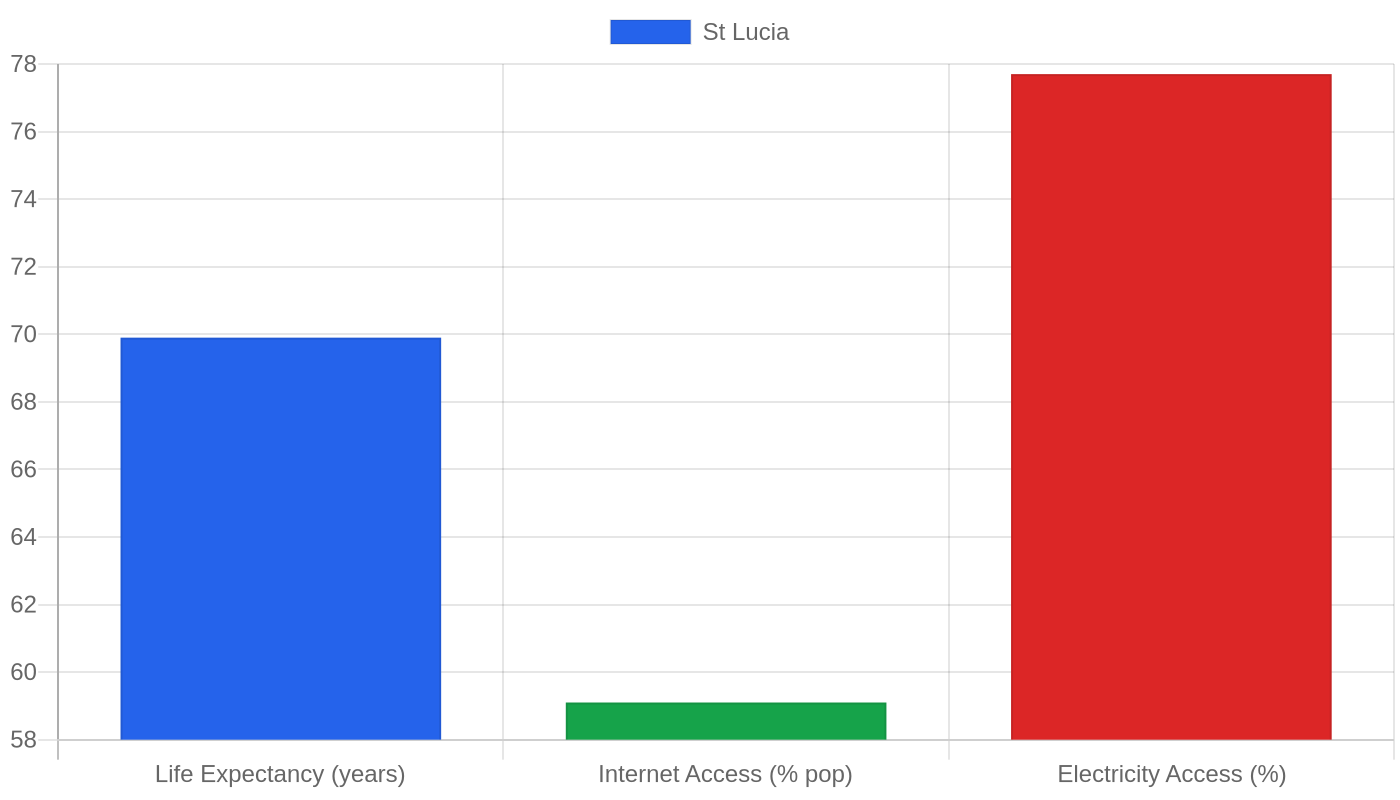
– The country’s economic data from the World Bank shows significant gaps in current reporting, underscoring the challenges small island states face in maintaining comprehensive statistical systems.
– St Lucia’s positioning as a Commonwealth realm ties it to broader international networks, offering trade and diplomatic advantages that smaller nations often leverage for economic resilience.
The Numbers Gap — What St Lucia’s Missing Data Tells Us About Small Island Economics
The World Bank’s latest data on St Lucia presents an unusual picture — not because of dramatic swings in GDP or inflation, but because the numbers are simply absent. Growth figures, inflation rates, unemployment statistics, GDP in dollar terms, GDP per capita adjusted for purchasing power, GNI per capita, and even population estimates are all listed as unavailable. For an economic journalist, this is both frustrating and revealing.
What this data vacuum actually demonstrates is a structural reality facing many small island developing states. St Lucia, with its population likely under 200,000 and an economy heavily dependent on tourism, agriculture, and remittances, operates with statistical systems that struggle to keep pace with larger economies.
The World Bank’s inability to publish current figures suggests either delays in data collection, resource constraints within the national statistics bureau, or the inherent volatility of an economy where a single hurricane or tourism season can dramatically shift the numbers.
The absence of inflation data is particularly telling. Across the Caribbean, small open economies have been battered by global price shocks, but St Lucia’s specific experience remains opaque without official figures. What we can infer is that the island faces the same pressures as its neighbours — imported inflation on food and fuel, a tourism-dependent revenue base, and vulnerability to climate shocks.
The main industries, while not specified in the available data, traditionally include tourism, banana exports, and light manufacturing, all of which have faced headwinds in recent years.
Roofs Over Paradise — The Hidden Cost of Living in St Lucia
Housing costs in St Lucia present a dual narrative that mirrors the island’s broader economic contradictions. For locals, the dream of homeownership has become increasingly elusive as property prices in tourist-friendly areas like Rodney Bay and Soufrière have climbed steadily. The rental market is similarly bifurcated — expatriates and second-home buyers drive demand for luxury villas and beachfront apartments, while local workers often find themselves priced out of the most desirable locations.
Daily expenses tell a familiar Caribbean story. Imported goods carry significant premiums, and the cost of food, utilities, and transportation consumes a substantial portion of household incomes. Compared to regional averages, St Lucia likely sits in the mid-to-upper range for living costs, reflecting its status as a popular tourist destination and its reliance on imports for everything from electronics to basic groceries.
The rent-versus-buy calculation is heavily skewed by tourism — many properties are held as investment assets rather than primary residences, keeping inventory tight and prices elevated.
Navigating the Business Landscape — Investment Opportunities and Obstacles
The top companies operating in St Lucia are not listed in the available data, but the business environment is shaped by the island’s political stability and its Commonwealth ties. As a Commonwealth realm, St Lucia offers investors a legal framework rooted in English common law, which provides familiarity for international capital. The government under Prime Minister Philip J.
Pierre has signalled openness to foreign direct investment, particularly in tourism infrastructure, renewable energy, and technology-enabled services.
Sectors to watch include sustainable tourism, which is gaining traction globally, and agricultural diversification away from traditional banana exports toward niche products like cocoa, coffee, and specialty spices. The business climate, however, faces headwinds common to small island states — limited domestic markets, high transportation costs, and vulnerability to natural disasters.
The World Bank’s data gaps make it difficult to assess specific regulatory burdens, but the political stability of St Lucia’s parliamentary system provides a predictable environment for long-term planning.
Safety, Stability, and the Politics of a Commonwealth Realm
St Lucia’s political landscape is defined by its unique constitutional arrangement. As a constitutional monarchy with Charles III as monarch and Errol Charles as governor-general, the island combines ceremonial tradition with functional parliamentary democracy. Prime Minister Philip J. Pierre leads the government from the House of Assembly, where 17 members are elected by plurality — a system that typically produces stable single-party governments or clear coalition dynamics.
The crime and safety indices are listed as unavailable in the data, which is itself a significant observation. Small Caribbean nations often struggle with gang-related violence and property crime, particularly in urban areas and tourist zones. However, St Lucia has historically maintained a reputation as a relatively safe destination compared to some regional peers.
The quality of life, while difficult to quantify without specific data, is shaped by the island’s natural beauty, strong community ties, and the challenges of limited economic opportunity that drive emigration among educated youth.
Current Affairs — St Lucia’s Balancing Act in a Volatile World
Right now, St Lucia is navigating the post-pandemic recovery with an economy that remains heavily reliant on tourism arrivals. The government has been pushing for diversification, but the island’s comparative advantages — warm climate, stunning beaches, and English-speaking workforce — continue to pull investment toward hospitality and related services. Prime Minister Philip J. Pierre’s administration has emphasised infrastructure improvements and digital transformation, though progress has been uneven.
The political landscape remains stable, with the House of Assembly operating under the current government’s majority. However, the 17-seat chamber means that even small shifts in voter sentiment can have outsized impacts on policy direction. Regional dynamics are also at play — St Lucia participates in CARICOM and other Caribbean bodies, seeking collective solutions to shared challenges like climate resilience, maritime security, and economic integration.
The island’s Commonwealth status provides additional diplomatic channels, though the practical benefits for everyday St Lucians remain a subject of ongoing debate.
The Bottom Line
St Lucia deserves attention from investors and policymakers who understand that small island economies operate on different rhythms than continental giants. The data gaps from the World Bank are not a sign of irrelevance but a reminder that these nations require tailored analytical frameworks. For those willing to look beyond the numbers, St Lucia offers political stability, a strategic Caribbean location, and potential in sustainable tourism and niche agriculture.
Watch this space — but bring patience and a willingness to read between the statistical lines.
Sources & Methodology
This article is authored by Economic Pulse Net for informational and research purposes. Economic Pulse Net sources its data from multilateral institutions, national statistics bureaus, and proprietary databases. All data is believed to be current as of the date of publication.
Published: July 22, 2026 | Category: Research — St Lucia
Use these signals in your own platform
Economic Pulse publishes its live signal feed through a documented, read-only API. Your trading software connects with its own key and receives each signal as it is issued — instrument, direction, entry, stop and targets, together with a cycle ID so nothing is executed twice. The feed is independent of this website and cannot change it.
Signals are informational only and are not financial advice.