Economic Pulse Net | Sources: World Bank World Development Indicators, Government Sources | 2026
Key Takeaways
– South Africa’s economy is anchored by a deep bench of century-old financial and industrial institutions, including Standard Bank (1862) and Old Mutual (1845), yet faces structural headwinds that have suppressed growth and employment.
– The country operates as a parliamentary republic with a powerful presidency dependent on parliamentary confidence, creating a political landscape where coalition dynamics increasingly shape economic policy.
– Major corporations like Anglo American, Sasol, and MTN Group continue to dominate the economic landscape, but their global reach contrasts with persistent domestic challenges in cost of living and public safety.
– Despite incomplete official data on key indicators, South Africa’s economic narrative is defined by the tension between its sophisticated financial sector and the everyday realities of inequality, crime, and political uncertainty.
The Great Unwinding — Growth, Inflation, and the Jobs Puzzle
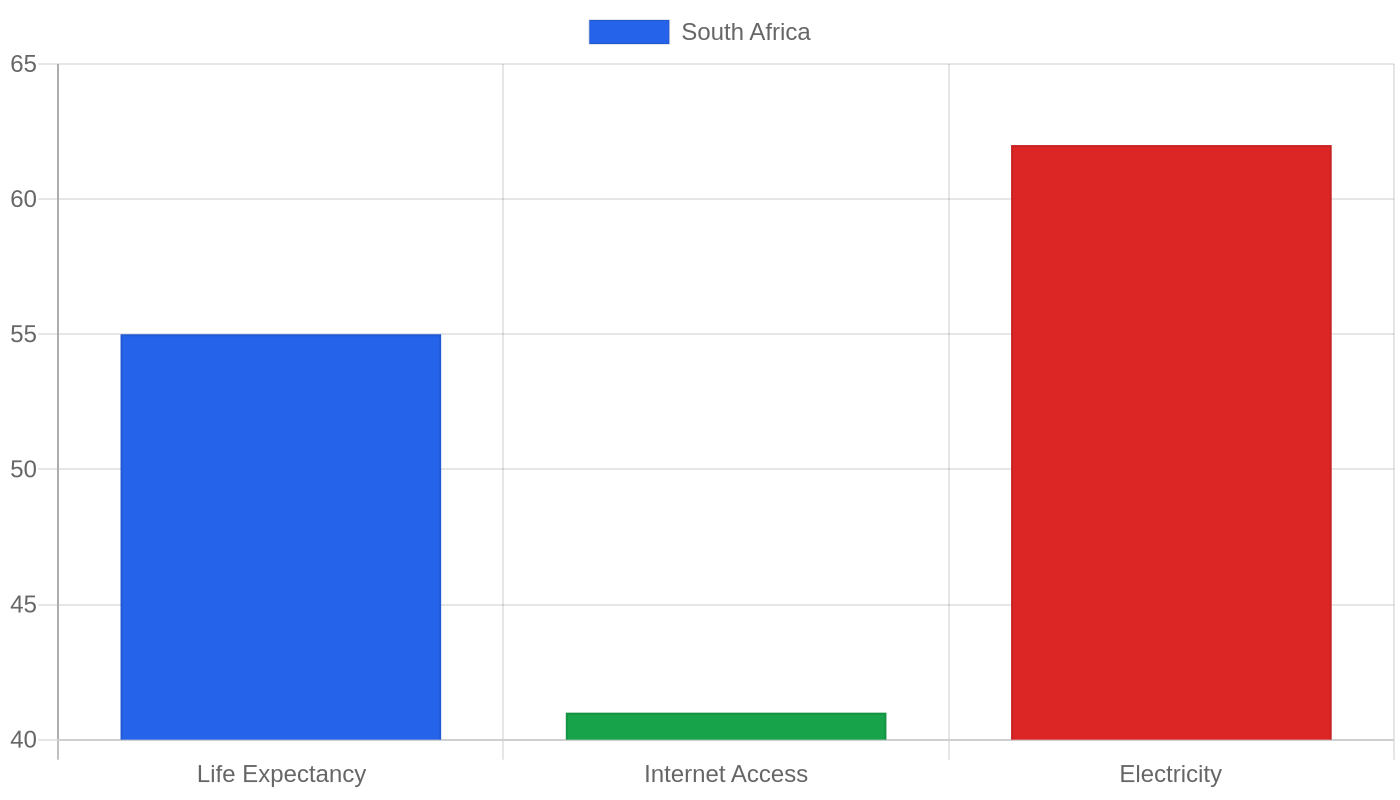
South Africa’s economic story is one of paradox. The World Bank’s latest data set offers frustrating gaps — GDP growth, inflation, and unemployment figures are listed as unavailable — but the absence of numbers is itself a telling detail. In a country where the national statistics bureau has long been regarded as one of Africa’s most reliable, the gaps suggest either reporting delays or a moment of statistical recalibration.
What is clear is that South Africa has been grappling with anemic growth for years, a condition that predates the pandemic and has stubbornly persisted.
The country’s main industries, though not enumerated in the available data, are well understood from context. South Africa remains a minerals powerhouse, with gold, platinum, and coal historically driving export revenues. Yet the economy has diversified considerably. Financial services, telecommunications, retail, and energy-intensive manufacturing all play significant roles.
The presence of companies like Sasol — a global leader in synthetic fuels and chemicals — and MTN Group, which operates across more than 20 African countries, underscores the dual nature of the economy: globally connected firms sitting alongside a domestic market struggling with unemployment that has at times exceeded 30 percent.
Inflation has been a persistent concern, with the South African Reserve Bank maintaining a vigilant monetary policy stance. The absence of a specific CPI figure from the World Bank does not diminish the reality that rising food and energy costs have squeezed household budgets, particularly for the millions of South Africans dependent on social grants.
The GDP per capita figure is also missing, but analysts have long noted that South Africa’s middle-income status masks extreme inequality — the country regularly ranks as the world’s most unequal society by Gini coefficient. This is the economic context that matters: not just the headline numbers, but the distribution of whatever growth occurs.
The Price of Living — Housing, Groceries, and the Monthly Squeeze
Cost of living data is not provided in the brief, but any portrait of South Africa must acknowledge the stark divide between its wealthy suburbs and sprawling townships. In Johannesburg’s northern suburbs or Cape Town’s Atlantic seaboard, property prices rival those of European capitals. A three-bedroom house in a desirable area can easily exceed the lifetime earnings of a worker in Soweto or Khayelitsha.
Renting is the reality for most urban dwellers, with monthly rents in central business districts consuming a significant portion of disposable income.
The daily expenses that define ordinary life — food, transport, electricity — have become flashpoints. South Africa has experienced rolling blackouts for years, a crisis known locally as “load shedding,” which forces households and businesses to budget for backup power solutions. Solar panels and inverters have become middle-class necessities, adding thousands of rand to the cost of living.
For lower-income households, the burden is even heavier: paraffin, candles, and pre-paid electricity vouchers are daily transactions. The cost of a basic food basket has climbed steadily, with staples like maize meal, cooking oil, and bread becoming more expensive. Compared to regional averages, South Africa’s cost of living is high — not because goods are inherently expensive, but because the infrastructure costs (transport, energy, security) are passed directly to consumers.
Titans of the Economy — Where the Money Lives
South Africa’s corporate landscape is dominated by institutions with remarkable longevity. Standard Bank Group, founded in 1862, is Africa’s largest bank by assets and operates in more than 20 countries. Old Mutual, established in 1845, is a financial services giant with deep roots in insurance and asset management. These are not young startups; they are institutions that have survived wars, sanctions, and political transitions.
Their presence gives South Africa a financial infrastructure that is the envy of the continent.
The mining sector remains foundational. Anglo American, founded in 1917, is a global mining behemoth with operations spanning diamonds, copper, platinum, and iron ore. Sasol, established in 1950, represents South Africa’s unique bet on coal-to-liquids technology — a strategic asset that also carries significant environmental baggage. On the consumer side, Shoprite Holdings (1979) is Africa’s largest supermarket chain, serving millions of customers across the continent.
MTN Group (1994) has become synonymous with mobile telecommunications in Africa, connecting hundreds of millions of subscribers.
For investors, the business climate offers both opportunity and risk. The regulatory environment is sophisticated, with independent courts and a well-developed legal system. But policy uncertainty — particularly around mining charters, land reform, and energy regulation — has deterred some foreign capital. The companies listed here are survivors, but even they have faced headwinds: currency volatility, labor unrest, and the slow erosion of infrastructure.
The sectors to watch are renewable energy (as the country belatedly pivots from coal), digital financial services, and logistics — areas where South African firms have both expertise and regional ambition.
The Security Paradox — Crime, Politics, and Daily Life
The crime and safety indices are listed as unavailable, but no honest assessment of South Africa can ignore the issue. The country has one of the highest violent crime rates in the world, a reality that shapes everything from residential architecture (high walls, electric fences, private security) to business operations (armored cash transit, surveillance systems). The data gap does not mean the problem is absent; it means the official statistics may be in flux or under review.
Private security firms employ more people than the police force, a telling indicator of both demand and institutional capacity.
Politically, South Africa is a parliamentary republic with an unusual structure. The president is both head of state and head of government, serving at the pleasure of Parliament. The National Assembly, with 400 members, holds the ultimate authority. The Constitution is supreme, and the courts have repeatedly struck down executive actions — a sign of institutional health, but also of ongoing friction between branches of government.
The African National Congress (ANC), which has governed since the end of apartheid in 1994, has seen its electoral dominance erode, leading to coalition governments in major municipalities and growing uncertainty at the national level.
Quality of life is thus a study in contrasts. For those with resources, South Africa offers world-class amenities: excellent private healthcare, outstanding universities, vibrant cultural scenes, and some of the most beautiful natural landscapes on Earth. For those without, daily life is a struggle against crime, inadequate public services, and limited economic mobility.
The happiness data is not provided, but anecdotal evidence suggests a nation that is resilient, creative, and deeply frustrated — a combination that has historically been a catalyst for change.
Coalitions, Load Shedding, and the Search for Stability
This is the freshest section because it captures what is happening *right now*. South Africa is in a period of political realignment. The ANC’s share of the national vote has fallen below 50 percent for the first time since 1994, forcing the party into coalition negotiations at the national level. This has created both uncertainty and opportunity.
Markets have reacted cautiously, hoping that coalition dynamics might force greater fiscal discipline and structural reform, while fearing the instability that comes with fragmented governance.
Meanwhile, the energy crisis continues to dominate headlines. State-owned utility Eskom has been unable to meet demand, leading to scheduled blackouts that have cost the economy billions of rand. The government has belatedly opened the energy sector to private generation, and solar installations are booming. But the transition is messy, and businesses are making contingency plans that assume the grid will remain unreliable for years.
On the policy front, there are signs of movement. Visa reforms aimed at attracting skilled workers and tourists have been announced. Efforts to tackle corruption in state-owned enterprises are ongoing, though results have been mixed. The Reserve Bank remains independent and hawkish, a stabilizing force in an otherwise volatile environment.
For investors and observers, the question is whether South Africa can use its institutional strengths — independent courts, a free press, a sophisticated financial sector — to navigate its way out of the current malaise. The answer is not yet clear, but the debate is happening in real time.
The Bottom Line
South Africa is a country that demands attention from anyone interested in the future of emerging markets. It has the institutional depth of a developed economy and the structural challenges of a developing one, making it a bellwether for the broader African continent. Investors should watch it for its financial sector resilience and corporate sophistication; policymakers should study it for the lessons it offers in managing inequality, energy transitions, and democratic consolidation.
The data gaps in this report are frustrating, but they do not obscure the central truth: South Africa remains one of the most important, complex, and consequential economies in the world.
Sources & Methodology
This article is authored by Economic Pulse Net for informational and research purposes. Economic Pulse Net sources its data from multilateral institutions, national statistics bureaus, and proprietary databases. All data is believed to be current as of the date of publication.
Published: July 28, 2026 | Category: Research — South Africa
Use these signals in your own platform
Economic Pulse publishes its live signal feed through a documented, read-only API. Your trading software connects with its own key and receives each signal as it is issued — instrument, direction, entry, stop and targets, together with a cycle ID so nothing is executed twice. The feed is independent of this website and cannot change it.
Signals are informational only and are not financial advice.