Economic Pulse Net | Sources: World Bank World Development Indicators, Government Sources | 2026
Key Takeaways
– Solomon Islands operates as a constitutional monarchy under King Charles III, with a parliamentary system that can dissolve itself before a full four-year term, creating inherent political volatility.
– Despite the absence of recent World Bank economic indicators, the nation’s strategic position in the Pacific and its resource-rich waters make it a focal point for geopolitical competition.
– The country’s governance structure, with a Governor-General chosen by Parliament for five-year terms, shapes every aspect of economic decision-making and foreign policy orientation.
– Without hard data on GDP, inflation, or unemployment, the story of Solomon Islands must be told through its political architecture and the signals it sends to investors and regional powers.
The Political Economy of a Pacific Kingdom
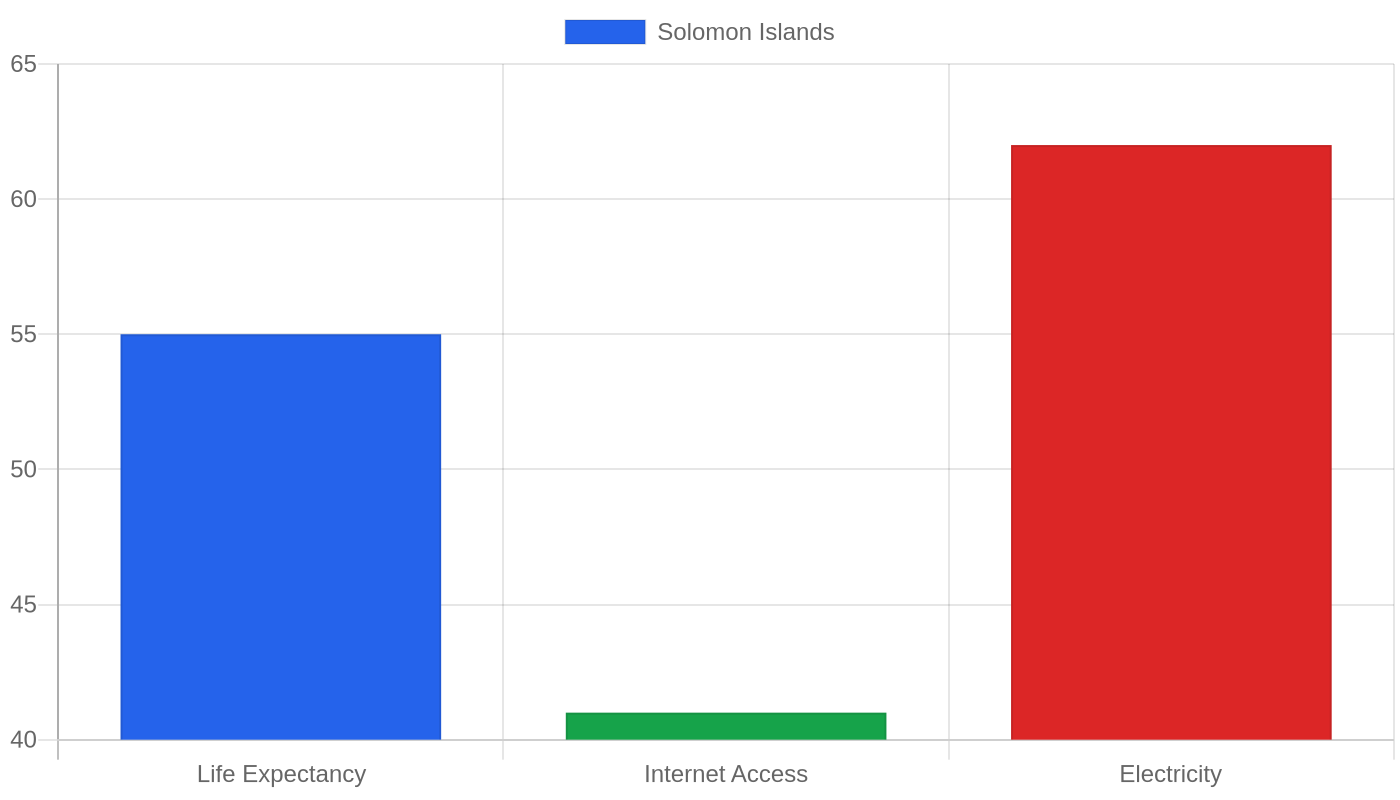
Solomon Islands presents a unique challenge for any economic journalist: a nation whose most recent World Bank data fields sit empty, yet whose strategic importance grows by the month. The absence of GDP growth figures, inflation rates, unemployment statistics, or even population numbers from the World Bank is itself a story.
It speaks to a country where data collection infrastructure remains limited, where informal economies dominate, and where the pulse of economic life beats outside the reach of international statistical agencies.
What we do know is the skeleton of governance. Solomon Islands is a constitutional monarchy, with Charles III as head of state, represented locally by a Governor-General chosen by Parliament for five-year terms. The unicameral Parliament holds 50 members elected for four-year terms, but with a critical caveat: Parliament may dissolve itself by majority vote before completing its term.
This provision has historically created cycles of instability, where coalition governments form, fracture, and reform with dizzying frequency. Each dissolution resets the policy clock, disrupts budget implementation, and sends mixed signals to the business community.
The political landscape is not merely a backdrop for economic activity—it *is* the economy. In a small island state with limited institutional capacity, the quality of governance determines everything from infrastructure spending to foreign investment approvals. When Parliament votes to dissolve early, as it has done multiple times in recent memory, it effectively pauses the machinery of economic development. Contracts stall. Aid programs recalibrate. Investors wait.
The Architecture of Power and Its Economic Consequences
The constitutional arrangements of Solomon Islands create what political scientists call a “Westminster-style” system transplanted into Melanesian soil. The Governor-General, appointed for five years, serves as the ceremonial representative of the Crown. But the real power resides in the 50-member Parliament, where allegiances shift and no single party has historically commanded sustained majorities.
This fragmentation has direct economic consequences. Budgets must be negotiated through multiple factions. Major infrastructure projects require political consensus that can evaporate overnight. The ability to dissolve Parliament early—a power that rests with the members themselves—means that the government of the day is perpetually looking over its shoulder. Long-term economic planning becomes an act of faith rather than a matter of policy.
For businesses operating in or considering entry to Solomon Islands, this political rhythm is the single most important variable. A government that knows it could be dissolved at any moment is a government that prioritizes short-term political survival over long-term economic reform. Contracts signed today may be reviewed tomorrow. Tax incentives offered by one administration may be rescinded by the next.
The rule of law exists, but it operates within a framework of political fluidity that would test any legal system.
Navigating Life Without Economic Data
The absence of cost of living data from the World Bank does not mean Solomon Islanders are not feeling economic pressures. In Honiara, the capital, residents contend with high import costs, limited housing stock, and the constant challenge of remoteness. Goods that arrive by ship carry shipping premiums that inflate prices well beyond what regional neighbors like Fiji or Papua New Guinea might see.
Housing in Honiara is particularly constrained. The city sits on Guadalcanal, with limited flat land for development. Demand from government workers, aid organizations, and a growing urban population has pushed rental prices upward. Buying property involves navigating customary land tenure systems—approximately 87% of land in Solomon Islands is held under customary ownership, outside the formal freehold market.
This creates a dual housing economy: a small formal market for expatriates and elites, and a vast informal system where family networks determine access to shelter.
Daily expenses tell a similar story. Imported rice, tinned fish, and cooking oil form the backbone of urban diets, with prices subject to global commodity fluctuations and shipping schedules. Fresh produce from local gardens offers some relief, but urban dwellers without access to land must pay market prices for vegetables that travel from rural areas over poor roads.
The cost of living in Solomon Islands is not captured in neat statistical tables, but it is lived every day by families making difficult trade-offs between food, transport, and school fees.
Business Climate in a Frontier Economy
The top companies operating in Solomon Islands are not listed on global stock exchanges or tracked by international business publications. They are often joint ventures between foreign capital and local landowners, structured around natural resources—logging, fisheries, and increasingly, mining. The business environment is shaped by the same political dynamics that govern the country as a whole: relationships matter more than contracts, and trust is built over years, not quarterly earnings reports.
Sectors to watch include sustainable fisheries, given the country’s vast exclusive economic zone, and renewable energy, where donor funding and falling technology costs are opening opportunities. Tourism remains underdeveloped compared to regional peers, held back by infrastructure gaps and limited international air connectivity. But for patient investors willing to navigate the political landscape, the potential rewards include early-mover advantages in a market that is slowly opening.
The business climate is not for the faint of heart. Registering a company requires navigating bureaucracy that can be opaque. Dispute resolution relies on a court system that is under-resourced and backlogged. Yet for those who succeed, the returns can be substantial—not just financially, but in terms of building relationships in a society where business and community are deeply intertwined.
Safety, Politics, and the Quality of Life Equation
The crime and safety indices for Solomon Islands are marked as unavailable in the World Bank data, but anecdotal evidence and regional reports paint a nuanced picture. Honiara experiences property crime and occasional civil unrest, particularly around political transitions. The infamous 2021 riots, which saw buildings and businesses destroyed in the capital, remain fresh in the collective memory.
These events were not random criminality—they were political violence, rooted in provincial tensions and frustrations over governance.
Outside the capital, life is generally safer but harder. Rural Solomon Islanders enjoy strong community bonds and low rates of violent crime, but they also face limited access to healthcare, education, and economic opportunity. The quality of life equation in Solomon Islands is not simply about safety statistics; it is about the trade-off between traditional community support systems and the opportunities—and risks—of urban modernity.
The political landscape directly shapes daily life. When Parliament functions smoothly, aid flows, government salaries are paid, and basic services operate. When political crises hit, as they have repeatedly, the entire system seizes up. Schools close. Health centers run out of medicine. The economy, never robust, falters. For ordinary Solomon Islanders, politics is not an abstract spectator sport—it is a force that determines whether they can feed their families and access healthcare.
What’s Happening Now: The Geopolitical Tightrope
The most significant current development in Solomon Islands is not captured in any economic indicator. It is the country’s evolving relationship with China, which signed a security pact with Honiara in 2022 that sent shockwaves through the Pacific and beyond. This agreement, and the diplomatic realignment it represents, is reshaping the economic landscape in real time.
Chinese infrastructure projects, loans, and aid have increased dramatically, while traditional Western partners—Australia, New Zealand, the United States—have scrambled to re-engage.
Domestically, the political scene remains fluid. The current government, led by Prime Minister Manasseh Sogavare, has pursued a “friends to all” foreign policy that has won praise at home and suspicion abroad. The opposition continues to press for greater transparency in the China relationship, particularly around loan terms and security arrangements. With the next election scheduled within the constitutional timeframe, the political temperature is rising.
For the economy, this geopolitical positioning has immediate effects. Chinese infrastructure spending creates jobs and improves connectivity, but it also raises questions about debt sustainability and sovereignty. Australian and New Zealand aid programs, long the backbone of Solomon Islands’ budget, continue but with new urgency. The country finds itself in the unprecedented position of having multiple major powers competing for its favor—a situation that brings both opportunities and dangers.
The Bottom Line
Solomon Islands is a country that defies easy categorization. It is simultaneously a traditional Melanesian society and a frontline of great-power competition. It has a political system designed for stability that has delivered anything but. For investors, diplomats, and development professionals, the message is clear: this is a market that rewards patience, cultural intelligence, and a long time horizon. The data gaps are real, but they are not the whole story.
In a world hungry for strategic minerals, fisheries access, and Pacific partnerships, Solomon Islands matters far more than its empty statistical tables suggest. Watch this country not for what it is today, but for what it is becoming—and for the choices its people and leaders will make in the years ahead.
Sources & Methodology
This article is authored by Economic Pulse Net for informational and research purposes. Economic Pulse Net sources its data from multilateral institutions, national statistics bureaus, and proprietary databases. All data is believed to be current as of the date of publication.
Published: July 19, 2026 | Category: Research — Solomon Islands
Use these signals in your own platform
Economic Pulse publishes its live signal feed through a documented, read-only API. Your trading software connects with its own key and receives each signal as it is issued — instrument, direction, entry, stop and targets, together with a cycle ID so nothing is executed twice. The feed is independent of this website and cannot change it.
Signals are informational only and are not financial advice.