Economic Pulse Net | Sources: World Bank World Development Indicators, Government Sources | 2026
🇪🇭 Western Sahara 2026 — The Economics of an Unresolved Sovereignty
Key Takeaways
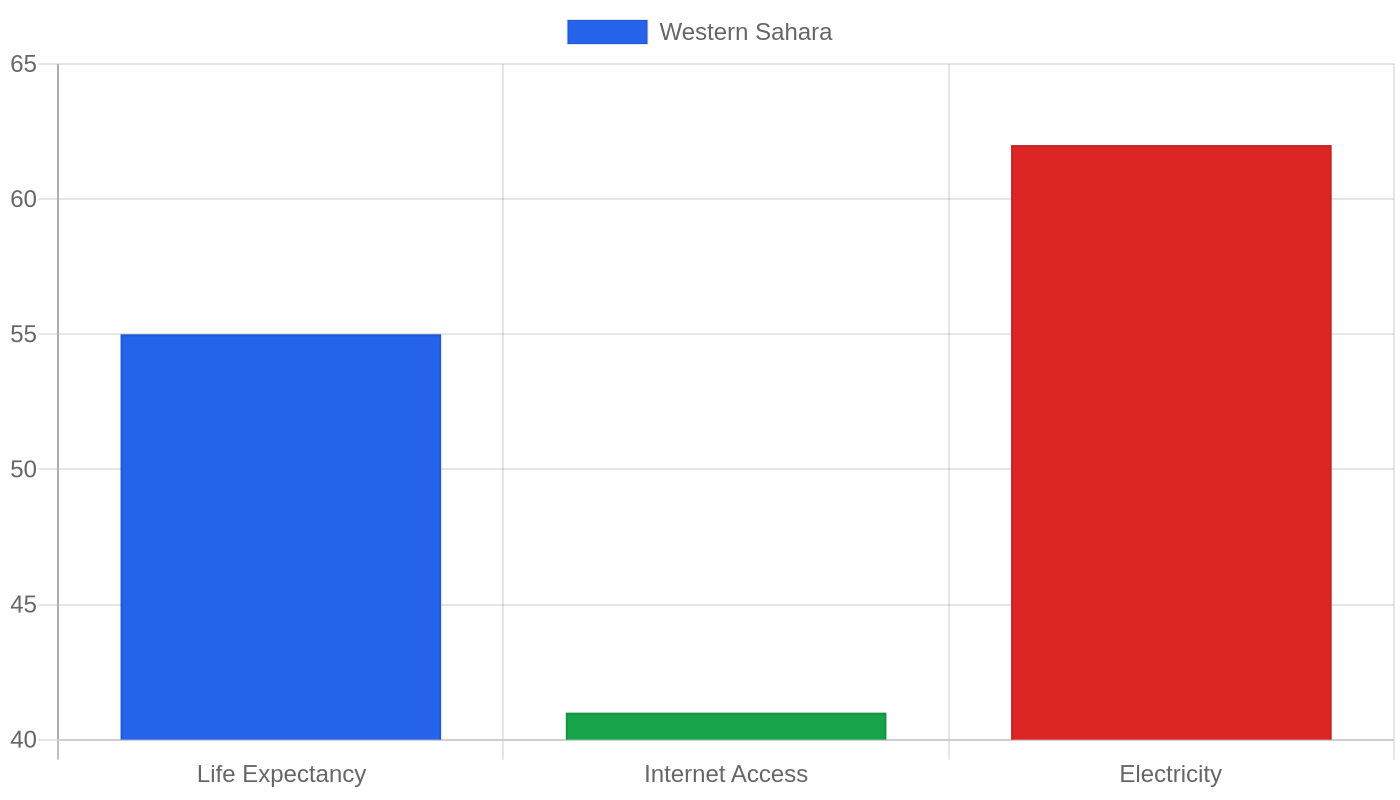
* Data Vacuum: Standard macroeconomic indicators such as GDP, inflation, and unemployment are officially listed as “N/A,” reflecting the territory’s unique status outside standard international statistical frameworks.
Political Stalemate: The sovereignty dispute between Morocco and the Polisario Front keeps the legal status unresolved, directly impacting economic integration and foreign investment flows.
UN Classification: The United Nations categorizes Western Sahara as a “non-self-governing territory,” which dictates how international organizations engage with its economy.
Information Scarcity: Comprehensive data on cost of living, top companies, and safety indices is currently unavailable, making traditional market analysis nearly impossible for external observers.
The Macroeconomic Void
The economic landscape of Western Sahara presents a rare challenge for global analysts: a territory where the fundamental metrics of modern capitalism are effectively invisible. According to the World Bank, key indicators including GDP growth, inflation CPI, and unemployment rates are recorded as “N/A.” This absence of data is not merely a statistical gap but a reflection of the region’s complex political reality.
Without a unified national government recognized by all parties, there is no central bank or statistical agency producing reliable, standardized economic reports. Consequently, figures for GDP in USD, GDP per capita (PPP), and GNI per capita remain unreported. This lack of transparency makes it difficult for investors to assess the true size of the local economy or the purchasing power of its residents.
For economists, this represents a blind spot in global trade data, as the territory’s resources—particularly fisheries and phosphates—are often integrated into neighboring Moroccan markets without clear attribution. The “N/A” status forces researchers to look beyond official statistics and rely on indirect indicators, such as trade volumes with neighboring countries, to gauge economic activity.
Ultimately, the missing numbers signal that the economy operates in a shadow zone, influenced heavily by geopolitical tensions rather than pure market forces.
Living Costs and Daily Expenses
For those navigating daily life in Western Sahara, the absence of official cost-of-living data creates significant uncertainty for expatriates and businesses alike. There are currently no verified figures available regarding housing costs, rental yields, or the price differential between buying and owning property. Similarly, general expense indices for food, utilities, and transportation are listed as “N/A,” leaving residents and visitors without a benchmark for budgeting.
This scarcity of information complicates financial planning for anyone considering relocation or commercial expansion in the region. Unlike established markets where inflation trends guide spending habits, the lack of Consumer Price Index (CPI) data means that price fluctuations are not systematically tracked or published. While one might infer higher costs due to import dependencies, the lack of concrete data prevents any meaningful comparison to regional averages.
This opacity can deter potential residents who require predictable living expenses, highlighting a significant barrier to stable population growth and consumer-driven economic development.
Investment Climate and Corporate Landscape
The business environment in Western Sahara is defined less by corporate giants and more by the constraints of its political status. No major domestic companies are currently listed in available records, and the “Top Companies” section remains empty in current datasets. This void suggests that large-scale, locally headquartered multinational corporations do not exist within the formal registered economy, or at least are not publicly documented in accessible international databases.
For investors, the primary risk factor is not market competition but legal ambiguity. The contested sovereignty means that contracts signed with entities operating in the territory may face future legal challenges depending on the resolution of the conflict. Sectors such as fishing, agriculture, and mining are traditionally significant, but specific corporate players and their market shares are undocumented.
This lack of identifiable business leaders makes due diligence extremely difficult for foreign firms seeking partnerships. The investment climate is therefore characterized by high geopolitical risk rather than traditional market risks like supply chain disruptions or currency volatility.
Safety, Politics, and Quality of Life
Quality of life in Western Sahara is inextricably linked to the ongoing political dispute over its future. The crime index and safety index are both reported as “N/A,” indicating that comprehensive security data is either not collected or not made public. This absence of safety metrics makes it challenging for individuals to assess personal security risks when traveling or residing in the area.
The core issue remains the unresolved sovereignty between Morocco and the Polisario Front, which continues to cast a long shadow over daily life. The United Nations’ classification of the territory as “non-self-governing” underscores the lack of full self-determination, affecting everything from civil liberties to economic rights. Happiness data and other quality-of-life indices are similarly unavailable, leaving little insight into the social well-being of the population.
The political tension creates an environment where stability is fragile, and any escalation in hostilities could immediately impact safety conditions. For the average resident, the political landscape is not just a headline but a constant backdrop to everyday existence.
Current Affairs and Regional Dynamics
The most pressing dynamic in Western Sahara today is the persistence of the diplomatic stalemate. Recent news highlights indicate that the legal status of the territory remains a focal point of international diplomacy, with the UN continuing to monitor the situation closely. There are no recent reports of major economic reforms, elections, or policy shifts specifically originating from a Western Saharan governing body, largely because such institutions are fragmented or disputed.
Business developments in the region are often driven by external actors, particularly those involved in resource extraction and infrastructure projects supported by neighboring states. Inflation trends and monetary policy changes are not independently tracked, meaning any economic shifts are absorbed into the broader economic policies of administering authorities.
The lack of fresh, localized news suggests that the region’s economic narrative is largely dictated by geopolitical negotiations rather than domestic initiatives. For observers, the “live” indicator here is the continued international attention on the peace process, which remains the primary driver of any potential economic change.
The Bottom Line
Western Sahara remains a unique case study in economics where data scarcity is the defining feature. Investors and policymakers should watch this region primarily for geopolitical signals rather than traditional market indicators. The unresolved sovereignty ensures that any economic progress is contingent upon political breakthroughs. Until clearer data emerges, the territory will remain an opaque market, best approached through indirect channels and cautious diplomatic engagement.
Sources & Methodology
This article is authored by Economic Pulse Net for informational and research purposes. Economic Pulse Net sources its data from multilateral institutions, national statistics bureaus, and proprietary databases. All data is believed to be current as of the date of publication.
Published: October 24, 2026 | Category: Research — Western Sahara
Use these signals in your own platform
Economic Pulse publishes its live signal feed through a documented, read-only API. Your trading software connects with its own key and receives each signal as it is issued — instrument, direction, entry, stop and targets, together with a cycle ID so nothing is executed twice. The feed is independent of this website and cannot change it.
Signals are informational only and are not financial advice.