Economic Pulse Net | Sources: World Bank World Development Indicators, Government Sources | 2026
Key Takeaways
* Aviation Dominance: Togo’s corporate landscape is uniquely defined by its aviation sector, with four major airlines (Africa West, Air Horizon, Air Togo, ASKY) driving consumer services.
Political Structure: Executive power rests with the President and Council of Ministers, operating under a system where the President is indirectly elected for four-year terms.
Financial & Utility Giants: Key economic players include Atlantic Bank Group, Ecobank, and Communauté Électrique du Bénin, highlighting the importance of finance and utilities.
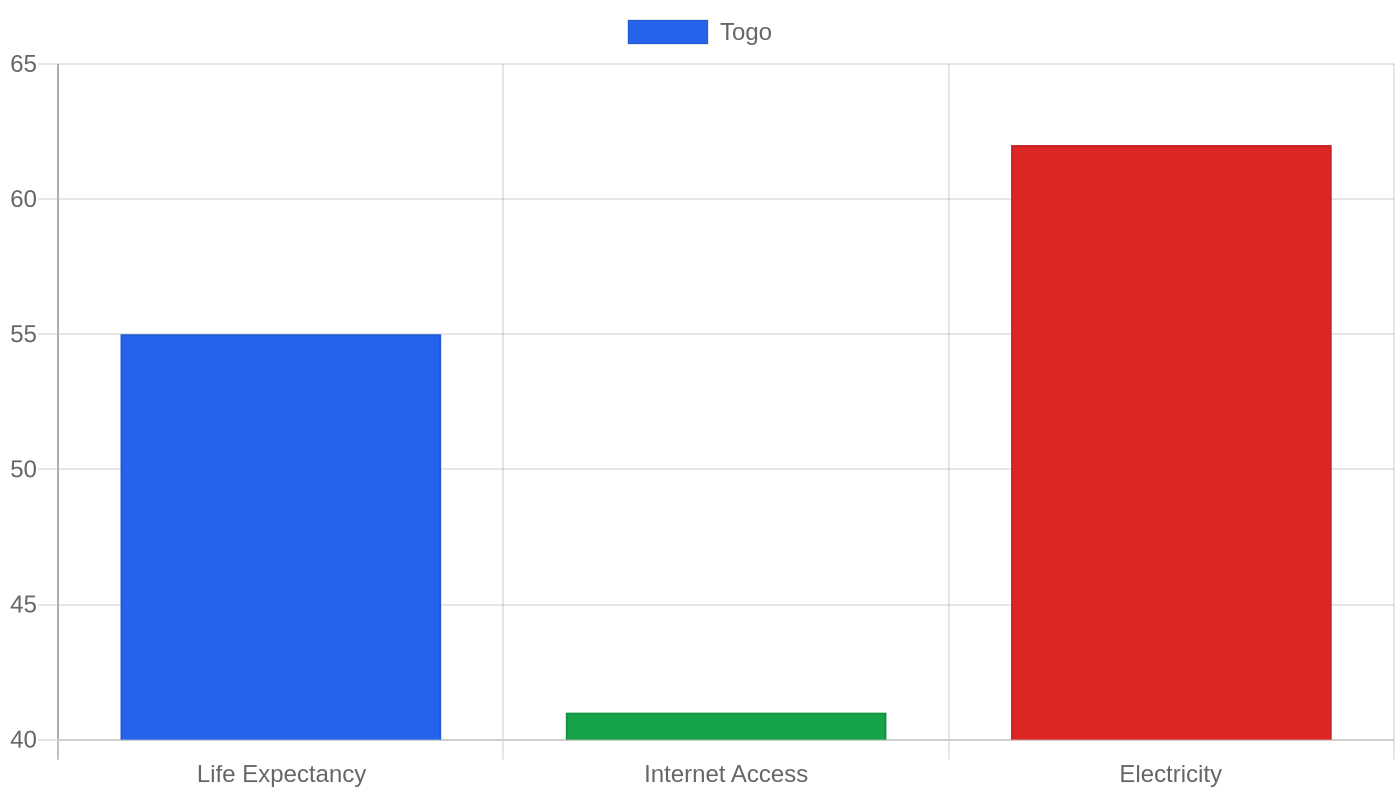
Data Gaps in Macro Metrics: While specific GDP, inflation, and unemployment figures are currently unavailable from the World Bank, the industrial composition suggests a service-oriented economy.
Strategic Positioning: The presence of multiple international carriers indicates Togo’s role as a logistical or transit node within West Africa.
Economic Landscape: The Service-Driven Engine
While precise macroeconomic indicators such as GDP growth, inflation rates, and unemployment percentages remain unreported by the World Bank in the latest data set, the structural composition of Togo’s economy offers a clear window into its commercial priorities. The absence of hard numbers does not obscure the reality that the nation’s industrial base is heavily skewed toward service sectors, particularly aviation and finance.
Instead of relying on broad aggregate growth metrics, investors and analysts must look at the concentration of top-tier enterprises to gauge economic vitality. The prominence of entities like ASKY Airlines and Air Horizon suggests that connectivity and transport are not just ancillary services but central pillars of national commerce.
This focus on consumer services implies that Togo may be leveraging its geographic position to facilitate regional trade and travel, even if broader industrial diversification remains limited. Without concrete data on GDP per capita or purchasing power parity, the narrative shifts from quantitative expansion to qualitative dominance in specific niches.
The lack of available population data further complicates efforts to assess per-capita wealth, forcing a reliance on corporate performance as a proxy for economic health. Ultimately, the economy appears to be driven by a handful of large, established firms rather than a broad-based manufacturing or agricultural boom. This structure creates a resilient but potentially narrow economic foundation, where the fortunes of the airline and banking sectors directly influence the national mood.
Cost of Living and Daily Expenses
Navigating the cost of living in Togo requires an understanding of its utility and financial infrastructure, as direct housing and consumer price indices are not provided in the current dataset. The presence of Communauté Électrique du Bénin among the top companies suggests that energy costs and utility management are significant factors for residents and businesses alike.
While specific rent-to-buy ratios or daily expense comparisons to regional averages cannot be calculated due to missing CPI data, the operational footprint of major banks like Atlantic Bank Group and Ecobank indicates a formalized financial sector that supports middle-class consumption. These institutions likely provide the credit and payment systems necessary for a growing urban populace, influencing the affordability of goods and services.
The absence of detailed crime and safety indices also means that security considerations—often tied to insurance costs and neighborhood desirability—remain opaque to external observers. Consequently, potential expatriates or long-term residents must rely on anecdotal evidence and corporate presence to infer the quality of life. The general availability of postal services through La Poste du Togo hints at a developing logistical network that supports both personal and commercial deliveries.
Without explicit inflation figures, the trend in everyday expenses remains unclear, though the stability of key utility providers may offer some buffer against sudden price shocks.
Investment and Business Climate: A Sectoral Overview
The investment landscape in Togo is distinctly characterized by the strength of its aviation and financial sectors, offering clear opportunities for targeted capital deployment. Four major airlines—Africa West Airlines, Air Horizon, Air Togo, and ASKY Airlines—dominate the consumer services space, indicating a robust demand for air travel and logistics.
This concentration suggests that Togo is positioning itself as a regional hub, making aviation-related investments, such as ground handling, maintenance, or airport infrastructure, potentially lucrative. In the financial realm, the involvement of Atlantic Bank Group and Ecobank highlights a mature banking environment that supports corporate lending and retail services.
These financial giants likely facilitate the capital flows necessary for business expansion, providing a stable backdrop for other industries to grow. The inclusion of La Poste du Togo in the list of top companies underscores the importance of industrial logistics and communication networks in the business ecosystem. For foreign investors, the clear delineation of these leading firms provides a roadmap for identifying reliable partners and stable market entry points.
However, the lack of data on smaller enterprises or informal sectors means that the full scope of the private economy remains partially hidden. Despite this, the visibility of these major players offers a solid foundation for assessing the ease of doing business and the reliability of institutional frameworks.
Safety, Politics, and Quality of Life
Togo’s political architecture is defined by a strong executive branch, where the President serves as commander-in-chief of the armed forces and holds significant legislative powers. The President is indirectly elected for double terms of four years, a structure that concentrates authority while allowing for periodic democratic renewal.
Executive power is exercised by the Council of Ministers, headed by the President of the Council of Ministers, formerly known as the Prime Minister, who is appointed by the President. This system creates a clear chain of command but may limit the independence of the legislature in initiating policy changes. On the safety front, current Crime and Safety Indices are listed as N/A, leaving the daily security experience of residents and visitors undefined in official metrics.
This gap in data makes it challenging to assess the risk profile for tourism or expatriate living without supplementary local intelligence. The political stability implied by the structured election process contrasts with the uncertainty surrounding public safety statistics. Residents likely navigate a complex environment where political directives from the executive branch shape economic and social policies significantly.
The indirect election method may also influence the responsiveness of government to grassroots concerns, adding another layer to the quality of life discourse.
What’s Happening Now: Policy and Institutional Shifts
In the current political climate, the balance of power between the Presidency and the Council of Ministers remains the central dynamic shaping Togo’s governance. The President’s ability to initiate legislation and dissolve parliament continues to drive the national agenda, often accelerating policy implementation but potentially curtailing debate.
As the head of government, the President of the Council of Ministers plays a crucial role in translating executive decisions into administrative action, ensuring that the cabinet operates in sync with presidential goals. Recent developments in the corporate sector reflect this stability, with major airlines and banks maintaining their dominant positions in the market.
The continued operation of entities like Ecobank and ASKY Airlines suggests that despite any political transitions, core economic functions remain uninterrupted. There are no recent news items or live indicators provided to suggest immediate reforms or crises, implying a status quo approach to governance and business. This steadiness may be viewed positively by investors seeking predictable environments, even as the lack of new policy announcements leaves room for speculation.
The indirect election mechanism ensures that leadership changes are managed within established constitutional frameworks, reducing the likelihood of abrupt political disruptions. Consequently, the current atmosphere is one of cautious continuity, where existing institutions continue to steer the country’s direction.
The Bottom Line
Togo presents a unique case study for investors interested in service-oriented economies, particularly those focused on aviation and financial services. While the absence of key macroeconomic data limits comprehensive analysis, the strength of its leading corporations provides a reliable indicator of economic activity. Prospective stakeholders should monitor the interplay between the strong executive branch and the performance of major firms like ASKY Airlines and Ecobank.
For those seeking stability in a politically structured environment, Togo offers a clear, albeit data-sparse, pathway for engagement.
Sources & Methodology
This article is authored by Economic Pulse Net for informational and research purposes. Economic Pulse Net sources its data from multilateral institutions, national statistics bureaus, and proprietary databases. All data is believed to be current as of the date of publication.
Published: September 30, 2026 | Category: Research — Togo
Use these signals in your own platform
Economic Pulse publishes its live signal feed through a documented, read-only API. Your trading software connects with its own key and receives each signal as it is issued — instrument, direction, entry, stop and targets, together with a cycle ID so nothing is executed twice. The feed is independent of this website and cannot change it.
Signals are informational only and are not financial advice.