Economic Pulse Net | Sources: World Bank World Development Indicators, Government Sources | 2026
Key Takeaways
– Togo’s economic narrative is increasingly defined by its role as a regional aviation and financial services gateway, anchored by carriers like ASKY Airlines and pan-African banking giant Ecobank.
– The country’s political system features a president indirectly elected for a double four-year term, with executive power shared between the head of state and a Council of Ministers led by a president who was formerly known as the prime minister.
– Togo’s corporate landscape is dominated by the consumer services, financials, and utilities sectors, with a notable concentration of airlines headquartered in the country.
– Despite gaps in headline economic data, the structure of Togo’s top companies suggests a strategy focused on regional connectivity and cross-border banking rather than heavy industry.
– The presence of regional infrastructure players like Communauté Électrique du Bénin indicates that energy cooperation with neighboring countries remains a critical pillar of the economy.
A Gateway Economy in the Making
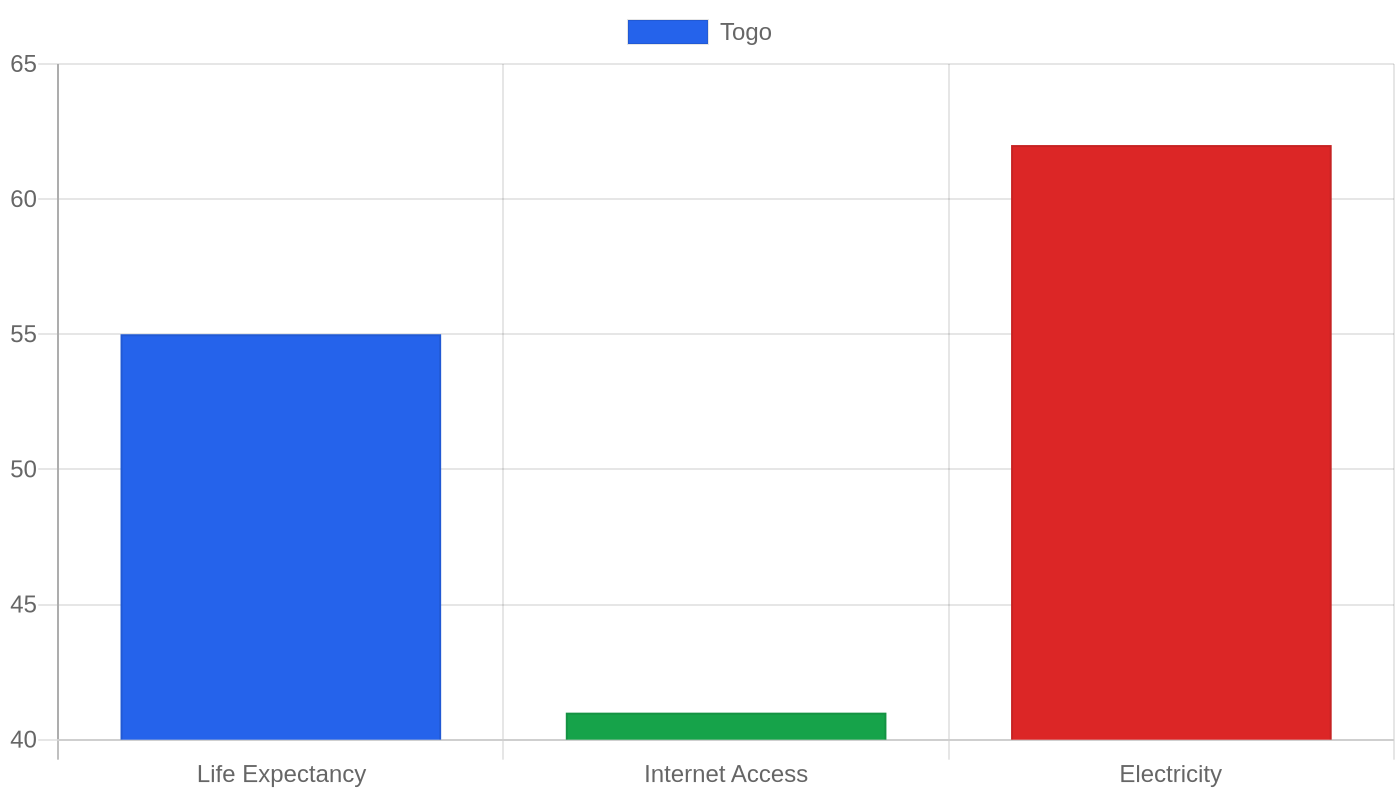
The World Bank’s latest data release for Togo leaves several headline indicators blank — no GDP growth figure, no inflation rate, no unemployment number. In many countries, that absence would be a footnote. For Togo, it is a prompt to look deeper at the structure of the economy rather than the latest quarterly print.
What emerges from the available data is a picture of a small West African nation that has positioned itself not as a manufacturing powerhouse or commodity exporter, but as a connective tissue for the region — a place where airlines land, banks clear cross-border payments, and electricity flows across national boundaries.
The list of Togo’s top companies tells this story more vividly than any single statistic could. Africa West Airlines, Air Horizon, Air Togo, and ASKY Airlines all call the country home, making aviation the most concentrated industrial sector in the corporate registry. Alongside them sits Ecobank, one of the most recognizable pan-African financial institutions on the continent, and Atlantic Bank Group, another regional financial player. This is not the profile of a closed, landlocked economy.
It is the profile of a country that has bet on movement — of people, capital, and power.
The political structure reinforces this outward-looking orientation. According to the available data, the president is indirectly elected for a double term of four years and serves as commander-in-chief of the armed forces, with the right to initiate legislation and dissolve parliament. Executive power, however, is exercised by the Council of Ministers and its president — a role formerly known as the prime minister — who is appointed by the head of state.
This hybrid system concentrates significant authority in the presidency while maintaining a layer of ministerial governance that can respond to the day-to-day demands of running an open, service-oriented economy.
The Cost of Living Question — What the Numbers Don’t Say
For a country whose economic model depends on regional integration, the cost of living in Togo’s commercial capital, Lomé, is a subject of considerable interest to investors and expatriates alike. The available data does not include a specific cost-of-living index, and no housing price figures are provided.
What can be inferred from the corporate landscape, however, is that Togo’s economy is oriented toward middle-class service employment — airline staff, bankers, logistics coordinators, and utility engineers — which typically commands wage premiums that ripple into local housing and consumer markets.
The presence of multiple airlines headquartered in Togo suggests a steady flow of international staff, regional business travelers, and diplomatic personnel who require mid-range to upscale accommodation. In similar West African gateway cities, this dynamic tends to push rental prices in prime neighborhoods well above the national average, creating a two-tier housing market: one for the local workforce and another for the expatriate and regional elite.
The absence of hard data makes precise comparisons to regional averages impossible, but the structural indicators point toward a city where housing demand is driven less by population growth and more by the rhythms of regional commerce.
Daily expenses in Lomé are likely shaped by the same forces — imported goods arriving through the port, fuel prices influenced by regional supply chains, and food costs tied to both local agriculture and cross-border trade. Without a CPI figure, the direction of prices is unclear, but the composition of Togo’s top companies — heavy on services, light on manufacturing — suggests that many consumer goods are imported, which typically exposes households to external price shocks.
Investment & Business Climate — Banking on Connectivity
For investors scanning West Africa for opportunities, Togo offers something that is surprisingly rare in the region: a corporate ecosystem built around connectivity rather than extraction. The financial sector is particularly noteworthy. Ecobank’s presence in Togo is not incidental — the bank’s pan-African reach makes Lomé a meaningful node in the continent’s payment and lending infrastructure.
Atlantic Bank Group adds a second layer of financial depth, giving the country two major banking institutions that operate well beyond its borders.
The aviation cluster is equally distinctive. Four airlines — Africa West Airlines, Air Horizon, Air Togo, and ASKY Airlines — are listed among the country’s top companies, a concentration that is unusual for a nation of Togo’s size. This suggests that the government has deliberately cultivated a regulatory environment friendly to regional carriers, positioning Lomé as a hub for West African air travel.
ASKY Airlines, in particular, has historically been associated with efforts to link West and Central African capitals, a strategy that aligns with Togo’s broader ambition to serve as the region’s crossroads.
The utilities sector adds a third pillar, with Communauté Électrique du Bénin representing a cross-border energy arrangement between Togo and its neighbor. This is a reminder that Togo’s economic strategy is not purely about private enterprise — it also involves critical infrastructure cooperation that requires political trust and long-term planning.
For investors, this mix of private banking, commercial aviation, and public utilities creates a diversified portfolio of opportunities, though each sector carries its own regulatory and political risks.
Safety, Politics & Quality of Life — Stability as a Selling Point
The crime and safety indices for Togo are listed as unavailable, which means any assessment of personal security must be inferred from the broader political and economic context. What is known is that Togo’s political system, while centralized, has maintained a degree of continuity that is not universal in the region.
The president’s ability to dissolve parliament and initiate legislation provides the executive with significant latitude, but the existence of a Council of Ministers led by a separate president — the former prime minister — suggests an institutional mechanism for sharing executive responsibility.
For the business community, this political structure cuts both ways. On one hand, the concentration of power can enable swift decision-making on large infrastructure projects, a factor that likely appeals to investors in the aviation and energy sectors. On the other hand, the indirect election of the president and the limited number of terms — a double mandate of four years — may raise questions about succession and long-term policy continuity.
The available data does not include happiness or quality-of-life metrics, so conclusions about daily life must be drawn cautiously from the economic structure.
What can be said with reasonable confidence is that Togo’s quality of life is closely tied to its role as a regional hub. The presence of international airlines, pan-African banks, and cross-border utilities implies a level of professional opportunity that is concentrated in Lomé and a few other urban centers.
For those employed in these sectors, the quality of life may be comparable to other West African commercial capitals — a mix of opportunity, congestion, and the persistent challenges of infrastructure maintenance that characterize the region.
What’s Happening Now — The Regional Hub Strategy in Motion
The most current signal from the data is not a number but a pattern: Togo’s corporate landscape is consolidating around a regional hub strategy. The continued presence of four airlines among the country’s top companies indicates that aviation remains a strategic priority, even as the global industry faces headwinds from fuel costs and competition.
ASKY Airlines’ role as a connector of West and Central African capitals is particularly significant, as it positions Togo to benefit from any increase in intra-African trade and travel under continental integration initiatives.
In the financial sector, Ecobank’s ongoing prominence suggests that Lomé remains a relevant center for pan-African banking, even as other West African cities compete for fintech and banking headquarters. The inclusion of La Poste du Togo among the top industrials is a reminder that the country is also investing in physical and logistical infrastructure — postal networks, delivery systems, and the kind of back-end services that support both e-commerce and traditional trade.
The utilities partnership with Bénin through Communauté Électrique du Bénin points to a pragmatic approach to energy security, acknowledging that no single West African nation can power its own development alone. This cross-border cooperation model could become more important as the region’s economies grow and energy demand rises. For now, Togo appears to be doubling down on its strengths: aviation connectivity, financial intermediation, and regional energy cooperation.
The absence of fresh macroeconomic data makes it difficult to assess the immediate temperature of the economy, but the structural signals suggest a country that knows what it wants to be and is steadily building the corporate and political architecture to get there.
The Bottom Line
Togo is not a country that will dominate headlines with blockbuster GDP numbers or dramatic policy pivots. Its story is quieter and more structural — a West African nation using its geographic position to become a hub for regional aviation, cross-border banking, and energy cooperation. Investors and analysts should watch Togo for the same reason they watch any gateway economy: not for what it produces, but for what passes through it.
For those focused on West African integration, financial services, and the aviation sector, Togo offers a case study in how a small country can punch above its weight through connectivity. The data gaps are real, but they are also an invitation to look beyond the numbers and understand the architecture of the economy itself.
Sources & Methodology
This article is authored by Economic Pulse Net for informational and research purposes. Economic Pulse Net sources its data from multilateral institutions, national statistics bureaus, and proprietary databases. All data is believed to be current as of the date of publication.
Published: August 24, 2026 | Category: Research — Togo
Use these signals in your own platform
Economic Pulse publishes its live signal feed through a documented, read-only API. Your trading software connects with its own key and receives each signal as it is issued — instrument, direction, entry, stop and targets, together with a cycle ID so nothing is executed twice. The feed is independent of this website and cannot change it.
Signals are informational only and are not financial advice.