Economic Pulse Net | Sources: World Bank World Development Indicators, Government Sources | 2026
Key Takeaways
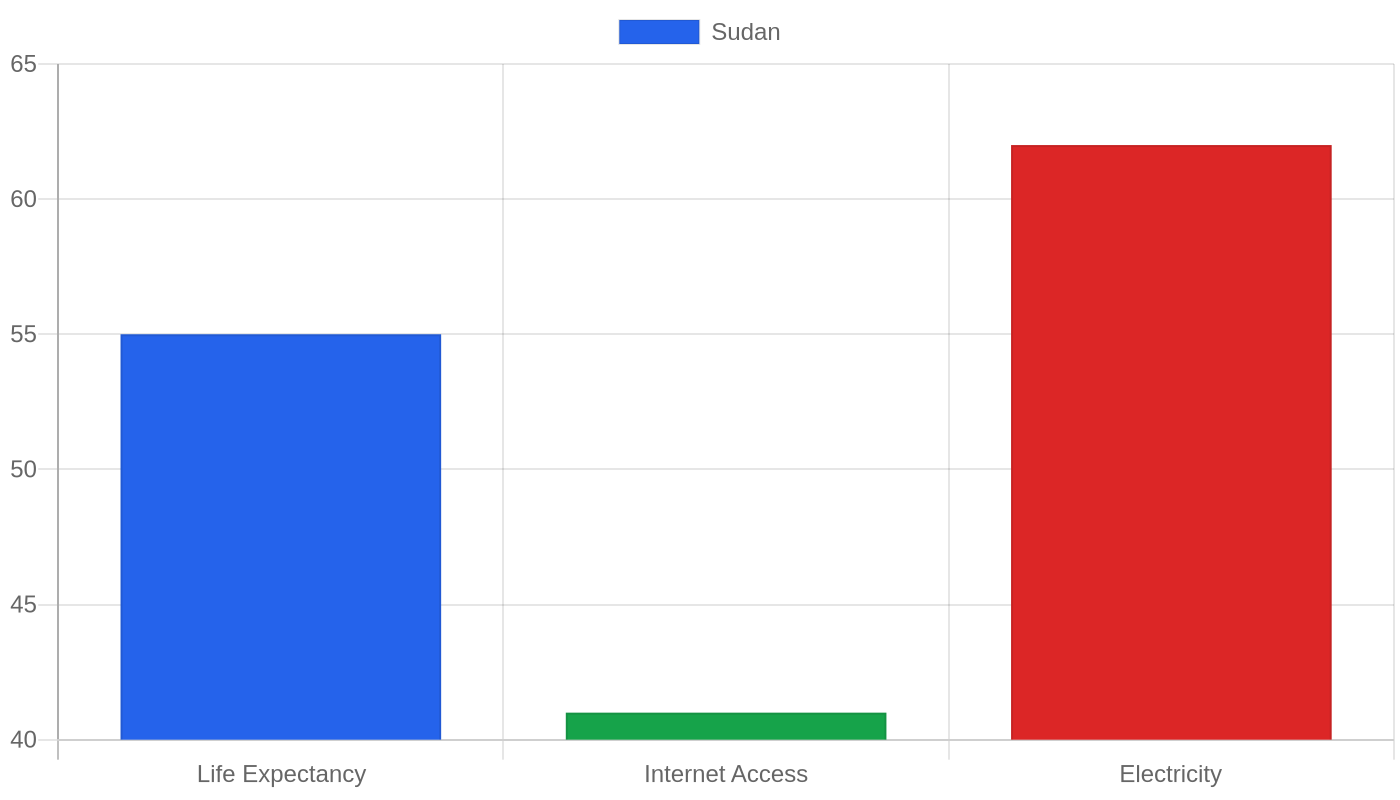
– Sudan’s economy is operating without reliable baseline data, with the World Bank reporting no current figures for GDP growth, inflation, or unemployment — a sign of deep statistical fragmentation amid ongoing conflict.
– The country remains in political flux following the 2019 military overthrow of Omar al-Bashir, with the Transitional Military Council having suspended the constitution and dissolved parliament.
– Sudan’s corporate landscape is dominated by aviation and financial services, including Bank of Khartoum, Bank of Sudan, and multiple airlines — suggesting pockets of private sector resilience.
– The absence of cost-of-living and crime index data points to a country where formal economic measurement has collapsed, making investment decisions exceptionally difficult.
– Despite the chaos, the existence of functioning companies across oil, banking, and transport suggests that economic life continues in some form.
The Vanishing Economic Mirror — What We Don’t Know Tells Us Everything
When the World Bank cannot provide a GDP growth figure for a country of Sudan’s strategic importance, that absence is itself the headline. The latest data shows no recorded inflation rate, no unemployment statistics, and no GDP per capita. For economists, this is not a blank space — it is a diagnostic signal. A country that cannot measure its own economic activity has either lost the institutional capacity to collect data or is operating in conditions where such collection is physically impossible.
The last verifiable economic framework for Sudan was built around its status as a federal authoritarian Islamic republic, a system that formally existed until April 2019. That month, President Omar al-Bashir was overthrown in a military coup led by Vice President Ahmed Awad Ibn Auf, who established the Transitional Military Council to manage internal affairs. The constitution was suspended, and the National Legislature was dissolved.
For an economy, this is the equivalent of pulling out the foundation stones while the building is still occupied.
Sudan’s main industries have historically revolved around agriculture, oil, and livestock, though the data provided does not detail current output levels. The Greater Nile Petroleum Operating Company remains a significant player in the oil and gas sector, suggesting that hydrocarbon extraction continues to function, at least partially. But without inflation data, we cannot assess whether the currency is holding value, whether wages are keeping pace with prices, or whether basic goods remain affordable.
The absence of unemployment figures means we cannot gauge the scale of job losses or the pressure on urban labour markets.
What we can infer is that Sudan’s economy is in a state of managed collapse — not total disintegration, but a condition where formal systems have retreated and informal mechanisms have taken over. For businesses operating in this environment, the lack of reliable data is not an academic inconvenience; it is a daily operational hazard. Contracts, pricing, wage negotiations, and investment decisions all become speculative exercises when the statistical ground beneath them has shifted.
Cost of Living and Housing — The Price of Survival in a Data Vacuum
No housing cost data, no rental indices, no daily expense benchmarks — the World Bank’s silence on Sudan’s cost of living is deafening. In most countries, housing costs are among the most tracked economic indicators because they reflect the intersection of income, credit availability, and population pressure. Sudan offers no such visibility. We cannot compare Khartoum’s rents to regional averages, nor can we assess whether homeownership is accessible to the middle class.
What we know from the corporate data is that Sudan has a functioning banking sector, including Al Shamal Islamic Bank and Bank of Khartoum. This implies that some form of credit exists, that savings are being mobilised, and that financial intermediation is occurring. In a conflict-affected economy, the banking sector often becomes a lifeline — a place where remittances are received, where salaries are cashed, and where whatever remains of formal economic life is conducted.
For ordinary Sudanese citizens, the cost of living is likely being shaped by currency depreciation, fuel prices, and the availability of imported goods — though specific figures are unavailable. The absence of data should not be read as the absence of hardship; rather, it reflects a situation where hardship has become so acute that measuring it has become secondary to surviving it.
Regional comparisons are impossible without baseline numbers, but the broader context of political instability and institutional suspension suggests that housing security is precarious.
Investment and Business Climate — Aviation, Banking, and the Resilience of the Private Sector
The list of Sudan’s top companies paints a fascinating picture of where economic activity persists. Air West, Badr Airlines, Blue Bird Aviation, Green Flag Airlines, and Juba Air Cargo dominate the consumer services and industrials categories. This is remarkable — an aviation-heavy corporate sector in a country where the formal economy has been suspended suggests that movement, logistics, and transport remain critical functions.
Whether this reflects humanitarian operations, regional trade, or the movement of people and goods within Sudan, the aviation sector’s prominence indicates that physical connectivity is still valued.
The financial sector is equally notable, with Bank of Sudan serving as the central bank, Bank of Khartoum as a major commercial player, and Al Shamal Islamic Bank providing sharia-compliant services. The presence of Islamic banking is significant — it aligns with Sudan’s religious framework and suggests that financial services have adapted to local norms.
For investors, this creates a specific landscape: one where conventional Western investment models may not apply directly, but where Islamic finance structures offer alternative pathways.
The Greater Nile Petroleum Operating Company anchors the oil and gas sector, though the data does not indicate current production levels or export volumes. For potential investors, Sudan represents a high-risk, potentially high-reward environment. The institutional framework is fragile, the political situation is unresolved, and the data environment is opaque. However, the continued operation of these companies suggests that determined businesses can still function.
The key question is whether the transition process will eventually produce a stable legal and regulatory environment that allows investment to flow.
Safety, Politics, and Quality of Life — Living in the Space Between Regimes
Sudan’s political landscape is defined by its unfinished transition. The 2015 general election was the last one held, occurring under the framework of the federal authoritarian Islamic republic. The April 2019 coup brought the Transitional Military Council to power, with Ibn Auf suspending the constitution and dissolving parliament. This is a country that has formally moved from one political system to another without fully arriving at a destination.
The implications for safety and quality of life are profound.
No crime index or safety index data is available, which is itself telling. In countries where the state has weakened, crime statistics often become unreliable because reporting mechanisms break down and trust in authorities erodes. The lack of happiness or quality-of-life data compounds the picture. We cannot quantify how Sudanese citizens feel about their lives, their safety, or their futures.
But the political trajectory — from authoritarian rule to military council — suggests that the transition has not yet delivered the democratic dividends that many had hoped for.
The suspension of the constitution is particularly significant for quality of life. Constitutional order provides the framework for property rights, legal recourse, and the rule of law. Without it, citizens and businesses operate in a legal grey zone where protections are uncertain and disputes are resolved through informal mechanisms. For ordinary people, this means that daily life is shaped by uncertainty — about land tenure, about contracts, about personal security, and about the future direction of the country.
The Transition in Limbo — Where Sudan Stands Right Now
The most current reality of Sudan is one of suspended animation. The Transitional Military Council remains the governing authority, having suspended the constitution and dissolved the National Legislature. No new election has been held since 2015, and the data provided does not indicate a clear roadmap for the restoration of civilian governance.
This political vacuum has direct economic consequences: without a legitimate government, there is no credible authority to negotiate debt relief, secure international investment, or implement economic reforms.
The continued operation of companies like Azza Transport, Juba Air Cargo, and the various airlines suggests that economic activity is ongoing, but the absence of fresh data makes it impossible to assess whether this activity is growing, contracting, or merely surviving. The Bank of Sudan’s continued functioning as a central bank implies that monetary policy is being conducted in some form, though we cannot know whether inflation is being managed or spiralling.
For the region, Sudan’s instability has broader implications. The country sits at a strategic crossroads between North and East Africa, and its fate affects migration patterns, trade routes, and regional security. The international community’s engagement with Sudan — through humanitarian aid, diplomatic pressure, or economic assistance — is likely to be shaped by the transition process.
But with no clear timeline for elections and no visible progress toward constitutional restoration, the current moment is best described as a waiting period. The question is what comes next, and whether the transition can be completed before the economy’s remaining formal structures deteriorate further.
The Bottom Line
Sudan is a country that investors, policymakers, and regional analysts cannot afford to ignore, but they must approach it with clear eyes. The absence of baseline economic data is not a data problem — it is a reflection of a political transition that remains incomplete. The aviation and banking sectors show that private enterprise continues to function, offering potential entry points for those willing to accept significant risk.
But without a restored constitution, a credible election timeline, and reliable economic measurement, Sudan remains a speculative prospect rather than a concrete investment destination. Watch this country for its strategic importance and its potential for reinvention — but understand that the path from here is uncertain, and the data vacuum is part of the story.
Sources & Methodology
This article is authored by Economic Pulse Net for informational and research purposes. Economic Pulse Net sources its data from multilateral institutions, national statistics bureaus, and proprietary databases. All data is believed to be current as of the date of publication.
Published: August 12, 2026 | Category: Research — Sudan
Use these signals in your own platform
Economic Pulse publishes its live signal feed through a documented, read-only API. Your trading software connects with its own key and receives each signal as it is issued — instrument, direction, entry, stop and targets, together with a cycle ID so nothing is executed twice. The feed is independent of this website and cannot change it.
Signals are informational only and are not financial advice.