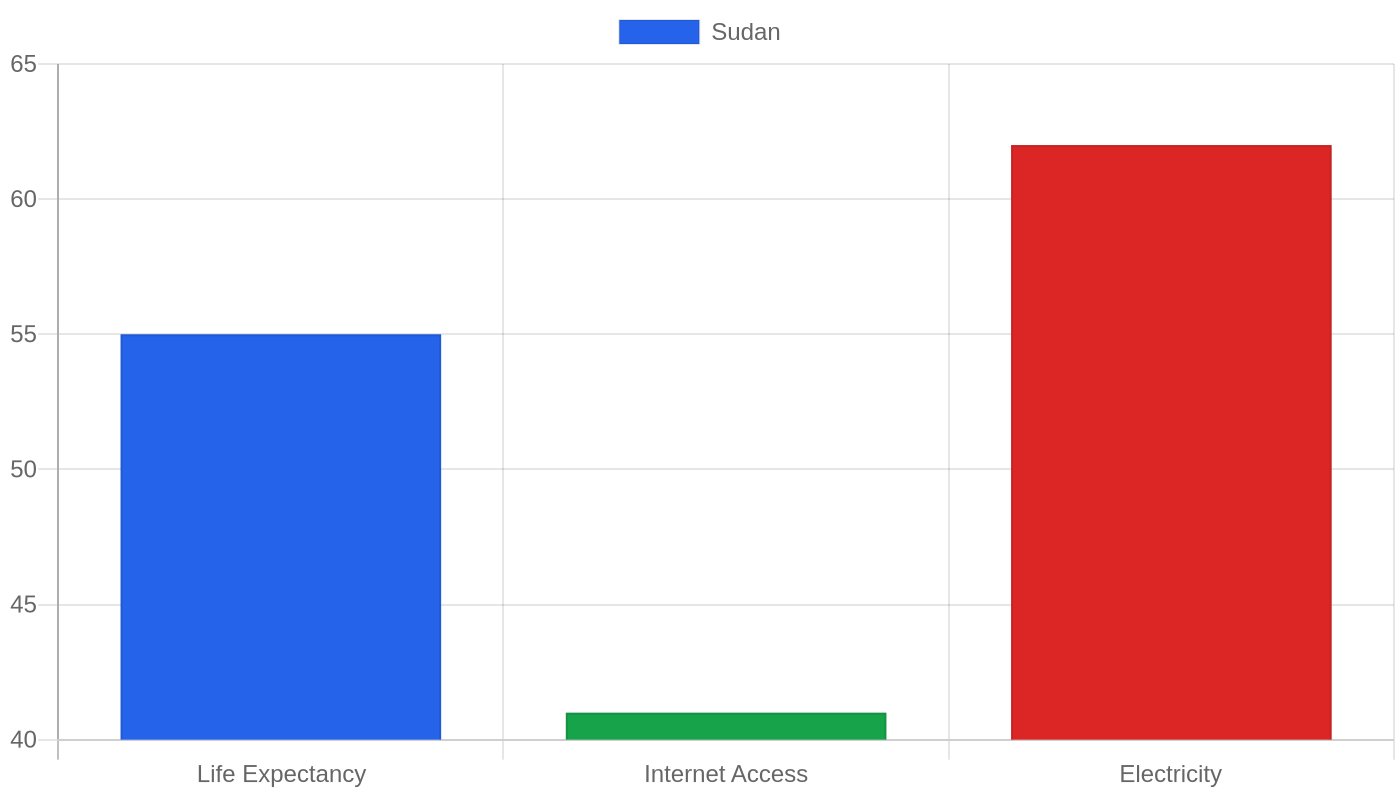
Economic Pulse Net | Sources: World Bank World Development Indicators, Government Sources | 2026
Key Takeaways
* Political Volatility: The political landscape remains defined by the aftermath of the 2019 military coup that ousted President Omar al-Bashir, leaving the nation in a transitional phase under a Transitional Military Council.
Data Gaps Mask Reality: Comprehensive macroeconomic indicators such as GDP growth, inflation rates, and unemployment figures are currently unavailable, suggesting significant challenges in data collection and reporting amidst instability.
Sectoral Concentration: The business environment is heavily concentrated in consumer services, financials, and oil & gas, with major players like Greater Nile Petroleum Operating Company and Bank of Khartoum dominating key sectors.
Safety Concerns: Specific crime and safety indices are not currently reported, highlighting potential risks for investors and expatriates navigating the region.
Historical Context: The country’s governance structure has shifted from a federal authoritarian Islamic republic to an uncertain transitional framework following the suspension of the constitution and dissolution of the bicameral parliament.
Economic Landscape: Navigating the Unknown
The economic narrative of Sudan is currently obscured by a significant lack of recent macroeconomic data, presenting a complex challenge for analysts and investors alike. According to the World Bank, critical metrics such as GDP growth, inflation CPI, and unemployment rates are listed as N/A, indicating either a breakdown in statistical infrastructure or a period of profound disruption where reliable data cannot be gathered.
This absence of hard numbers does not imply stability; rather, it often signals an economy under stress where traditional forecasting models fail due to ongoing conflict or administrative paralysis. Without a clear GDP figure or per capita income data in PPP terms, assessing the standard of living or overall economic health becomes an exercise in inference rather than precise measurement. However, the existence of specific industries provides a window into the structural backbone of the nation.
The presence of entities like the Greater Nile Petroleum Operating Company suggests that the oil and gas sector remains a vital, albeit potentially volatile, component of the national economy. Meanwhile, the concentration of top companies in consumer services and financials indicates that despite broader economic uncertainties, basic services and banking operations continue to function, serving as essential lifelines for the population.
The lack of unemployment data further complicates the picture, making it difficult to gauge the social impact of any economic downturns. Ultimately, the “N/A” designations serve as a stark reminder of the informational void surrounding Sudan’s current economic performance, requiring observers to rely on qualitative assessments and sector-specific developments rather than aggregate statistics.
Cost of Living: A High-Risk Environment
Assessing the cost of living in Sudan requires caution, as specific housing costs, rent-to-buy ratios, and daily expense indices are not provided in the available data. In environments where macroeconomic indicators are missing, inflationary pressures can erode purchasing power rapidly, making the actual cost of goods and services highly unpredictable for residents and visitors.
Typically, in nations undergoing political transitions, the informal economy often plays a larger role, leading to price disparities that official statistics may miss. Without comparative regional averages, it is difficult to determine if Sudan’s expenses are high relative to its neighbors, but the general context of political instability often correlates with higher logistical and security-related costs.
For businesses operating in the country, these unknowns translate into heightened risk premiums, as supply chain disruptions and currency fluctuations can drive up operational expenses unexpectedly. The absence of concrete data on housing markets also means that real estate investments carry significant uncertainty regarding valuation and liquidity. Consequently, those considering relocation or expansion must prepare for a cost structure that is likely more variable and less transparent than in stable economies.
The lack of published indices forces a reliance on local knowledge and adaptive budgeting strategies to navigate daily expenditures safely.
Investment & Business Climate: Pillars of Industry
Despite the broader economic opacity, Sudan’s corporate landscape reveals distinct pillars of industry that offer clues to where capital flows. The list of top companies highlights a heavy reliance on consumer services and financial institutions, which are critical for maintaining day-to-day economic activity. Air West, Badr Airlines, Blue Bird Aviation, and Green Flag Airlines indicate a domestic aviation sector that supports both passenger travel and cargo logistics, essential for connecting remote regions.
In the financial sector, Al Shamal Islamic Bank, Bank of Khartoum, and Bank of Sudan represent the institutional backbone, facilitating transactions and providing credit in a system that appears to adhere to Islamic banking principles. Beyond services, the inclusion of Azza Transport and Juba Air Cargo in the industrials sector underscores the importance of logistics and transportation networks in sustaining trade.
The Greater Nile Petroleum Operating Company stands out as a key entity in the energy sector, suggesting that foreign direct investment and joint ventures in oil and gas remain significant components of the business environment. These companies operate within a framework that has seen the suspension of the constitution and the dissolution of the National Legislature, creating a regulatory environment that is subject to rapid change.
Investors must therefore monitor not just market demand but also the evolving political directives that could impact licensing, taxation, and operational permits. The dominance of these specific firms suggests that opportunities lie primarily in established sectors rather than emerging markets, given the current constraints on new enterprise formation.
Safety, Politics & Quality of Life: A Turbulent Transition
The political and safety landscape in Sudan is characterized by significant turbulence and a lack of definitive metrics. The Crime Index and Safety Index are listed as N/A, reflecting either the unavailability of standardized global rankings or the chaotic nature of public security conditions that make such measurements unreliable. Politically, the country is in a fragile state following the 2015 general election, which preceded the dramatic events of April 2019.
That year marked a turning point when President Omar al-Bashir’s regime was overthrown in a military coup led by Vice President Ahmed Awad Ibn Auf. In the immediate aftermath, a Transitional Military Council was established to manage internal affairs, while the constitution was suspended and the bicameral parliament, the National Legislature, was dissolved.
This shift from a federal authoritarian Islamic republic to a transitional military governance model has created a power vacuum and legal ambiguity that affects all aspects of life. For citizens and foreigners alike, the quality of life is likely influenced by this political uncertainty, which can lead to social unrest and restricted freedoms. The lack of happiness data or social well-being indices further emphasizes the difficulty in assessing the human cost of these political changes.
Residents must navigate a society where the rule of law is being redefined, and where the future direction of governance remains unclear. This environment demands heightened vigilance and adaptability from anyone living or working within the country’s borders.
What’s Happening Now: The Legacy of the Coup
The most pressing dynamic in Sudan today is the lingering impact of the 2019 political upheaval and the subsequent establishment of the Transitional Military Council. While the initial step taken by Vice President Ahmed Awad Ibn Auf involved managing internal affairs through military oversight, the long-term implications of suspending the constitution and dissolving the National Legislature continue to shape the national discourse.
The absence of recent election data suggests that the transition process may have stalled or evolved into a different form of governance that lacks formal democratic milestones. Businesses and civil society organizations are operating in a space where regulatory frameworks are being rewritten without the transparency of a fully functioning legislature. The focus of recent developments appears to be on consolidating control and managing the internal affairs of the country during this undefined transitional period.
There are no reports of new reforms or policy shifts in the provided data, indicating a status quo dominated by military administration. This stagnation in political development creates an atmosphere of uncertainty for investors who require stable legal environments to commit capital. The situation remains fluid, with the potential for further constitutional changes or political realignments that could drastically alter the business and social landscape.
Observers are watching closely to see if the transitional council will move toward civilian rule or solidify military authority.
The Bottom Line
Sudan presents a high-risk, high-uncertainty profile for international observers and investors. The combination of missing macroeconomic data, a suspended constitution, and a military-led transitional government makes it challenging to assess long-term viability. Those interested in the country should focus on the resilience of key sectors like aviation, banking, and oil, while remaining acutely aware of the political and safety risks.
Engagement with Sudan at this stage requires a deep understanding of the local context and a tolerance for significant volatility.
Sources & Methodology
This article is authored by Economic Pulse Net for informational and research purposes. Economic Pulse Net sources its data from multilateral institutions, national statistics bureaus, and proprietary databases. All data is believed to be current as of the date of publication.
Published: October 15, 2026 | Category: Research — Sudan
Use these signals in your own platform
Economic Pulse publishes its live signal feed through a documented, read-only API. Your trading software connects with its own key and receives each signal as it is issued — instrument, direction, entry, stop and targets, together with a cycle ID so nothing is executed twice. The feed is independent of this website and cannot change it.
Signals are informational only and are not financial advice.