Economic Pulse Net | Sources: World Bank World Development Indicators, Government Sources | 2026
Key Takeaways
* Constitutional Foundation: The nation operates under the transitional constitution ratified by the Southern Sudan Legislative Assembly, which came into force upon independence on July 9, 2011, serving as the supreme law of the land.
Financial Sector Dominance: The corporate landscape is heavily skewed toward financial services, with major institutions like Bank of South Sudan and KCB Bank South Sudan Limited leading the market, indicating a critical need for banking infrastructure development.
Data Gaps in Economic Metrics: Current World Bank data does not provide specific figures for GDP growth, inflation, or unemployment, suggesting either limited statistical capacity or significant volatility that prevents standard reporting.
Security and Political Context: While the political framework is established through the 2011 constitution, specific crime and safety indices are currently unavailable, highlighting potential challenges in public security measurement and stability.
The Constitutional Bedrock of Statehood
The economic narrative of South Sudan cannot be separated from its political genesis. The country’s legal and administrative framework rests firmly on the transitional constitution, which was ratified by the now defunct Southern Sudan Legislative Assembly shortly before independence. This pivotal document was signed by President Salva Kiir Mayardit on Independence Day, July 9, 2011, thereby coming into immediate force.
By superseding the Interim Constitution of 2005, this new supreme law of the land provided the necessary institutional architecture for a sovereign state to begin its economic journey. For economists and policymakers, this constitutional clarity is the primary prerequisite for any long-term fiscal planning or foreign direct investment, as it defines the rules of engagement for government operations and property rights.
Without such a foundational legal structure, economic activity remains fragile; however, the existence of this ratified constitution offers a baseline for institutional continuity amidst the challenges of nation-building.
Navigating an Unreported Economy
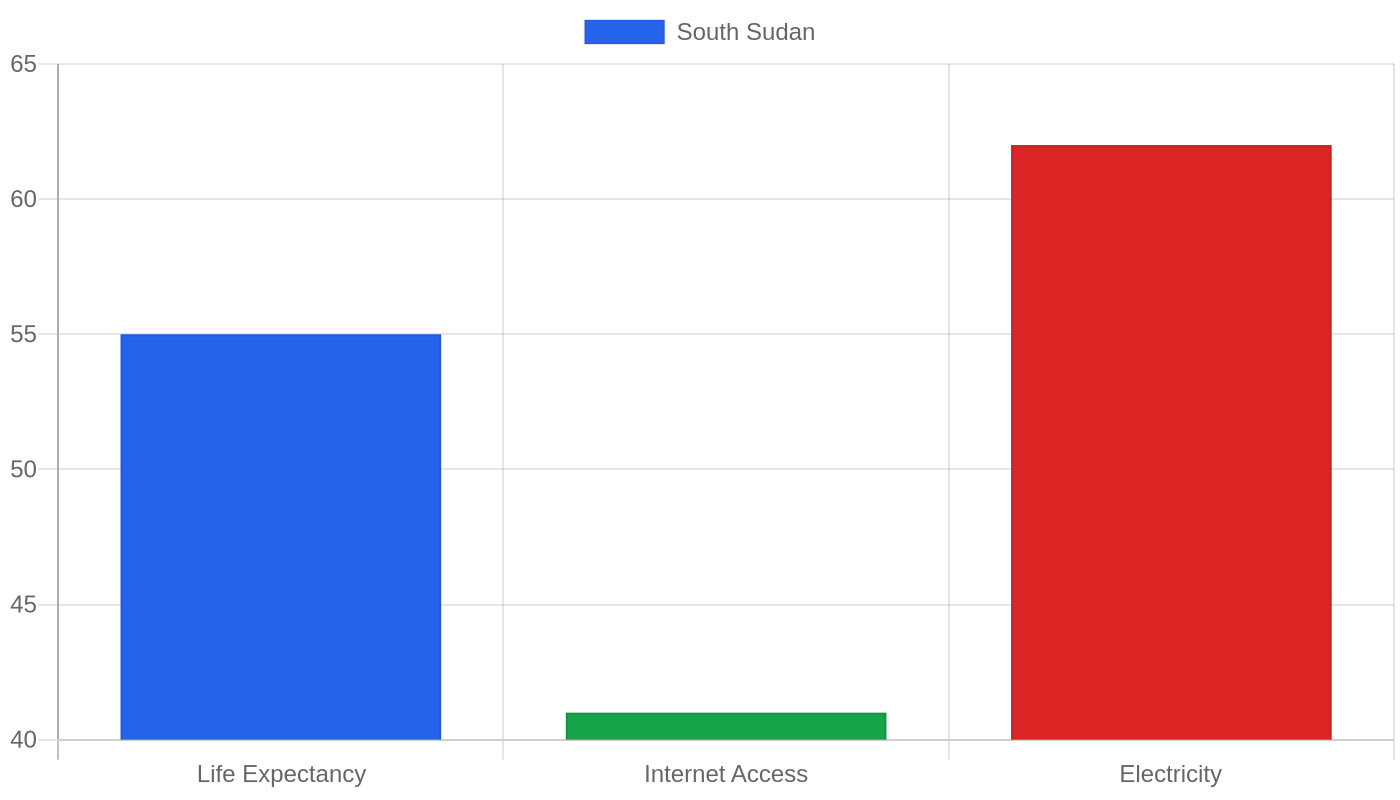
When examining the core economic indicators, one encounters a significant void in quantitative data. According to the latest World Bank statistics, key metrics such as GDP growth, inflation CPI, unemployment rates, total GDP in USD, GDP per capita in PPP, GNI per capita, and even population figures are listed as N/A. This absence of data is not merely a statistical oversight but reflects the profound difficulties inherent in measuring the economy of a young, post-conflict nation.
In many developing economies, high levels of informal trade, subsistence agriculture, and cash-based transactions make accurate census and price tracking exceptionally difficult. Consequently, traditional models of economic analysis struggle to apply, leaving investors and international aid organizations to rely on qualitative assessments rather than hard numbers.
The lack of these fundamental indicators means that the true scale of economic output and the purchasing power of citizens remain obscured, complicating efforts to design effective monetary policy or targeted social programs.
A Banking-Centric Corporate Landscape
Despite the macroeconomic data gaps, the microeconomic landscape reveals a clear sectoral focus: financial services. The list of top companies operating within the country is dominated almost entirely by banks, including the Bank of South Sudan, Buffalo Commercial Bank, Cooperative Bank of South Sudan, Equity Bank South Sudan Limited, Ivory Bank, KCB Bank South Sudan Limited, Mountain Trade and Development Bank, and Nile Commercial Bank.
This concentration suggests that the primary engine of formal business activity is credit provision and financial intermediation. Alongside this robust banking sector, consumer services are represented by Feeder Airlines and Southern Star Airlines, indicating that connectivity and transport are also vital commercial pillars.
The presence of multiple regional players, such as KCB Bank and Equity Bank, alongside local entities, points to a competitive yet concentrated market where financial inclusion is likely a central business strategy. For businesses looking to enter the market, partnerships with these established financial institutions may be more viable than direct industrial investments, given the current infrastructure realities.
Safety, Governance, and Daily Life
Assessing the quality of life and safety in South Sudan requires navigating a landscape of missing data. Both the Crime Index and Safety Index are reported as N/A, which presents a challenge for expatriates and tourists seeking to gauge personal security risks. However, the political environment is defined by the established rule of law under the 2011 transitional constitution, providing a formal mechanism for governance despite potential implementation hurdles.
The transition from the Interim Constitution of 2005 marks a significant step in stabilizing the political hierarchy, although the availability of specific safety metrics remains elusive. This lack of transparent safety data often correlates with regions undergoing complex post-conflict transitions, where official statistics may lag behind ground realities.
For residents and visitors alike, the combination of a structured political framework and undefined safety indices suggests a need for heightened caution and reliance on localized intelligence rather than broad national averages.
Institutional Evolution and Future Outlook
The current affairs surrounding South Sudan are deeply rooted in its recent historical milestones. The ratification of the transitional constitution by the Southern Sudan Legislative Assembly remains the defining political event for the country’s legal identity. As the nation moves forward, the focus appears to be on consolidating the authority of President Salva Kiir Mayardit and the institutions he oversees.
The dominance of financial and aviation companies in the corporate registry indicates that private sector activity is aligning with the needs of a growing, albeit small, formal economy. With no recent news items or live indicators provided in the dataset, the “current” situation is best understood as a period of consolidation following the initial shock of independence. The absence of new policy announcements or election cycles in the available data suggests a steady, if opaque, operational mode.
Stakeholders must watch for updates on how the constitutional framework is being implemented in practice, particularly regarding judicial independence and economic regulation.
The Bottom Line
South Sudan represents a unique case study in nation-building where legal structures are in place, but economic metrics are largely invisible. Investors and analysts should focus on the financial sector, specifically the major banks and airlines that form the backbone of visible commerce. The lack of GDP and inflation data necessitates a cautious, qualitative approach to risk assessment.
Ultimately, this country demands patience and deep local engagement, as the formal economic picture remains incomplete while the political foundation solidifies.
Sources & Methodology
This article is authored by Economic Pulse Net for informational and research purposes. Economic Pulse Net sources its data from multilateral institutions, national statistics bureaus, and proprietary databases. All data is believed to be current as of the date of publication.
Published: October 10, 2026 | Category: Research — South Sudan
Use these signals in your own platform
Economic Pulse publishes its live signal feed through a documented, read-only API. Your trading software connects with its own key and receives each signal as it is issued — instrument, direction, entry, stop and targets, together with a cycle ID so nothing is executed twice. The feed is independent of this website and cannot change it.
Signals are informational only and are not financial advice.