Economic Pulse Net | Sources: World Bank World Development Indicators, Government Sources | 2026
Key Takeaways
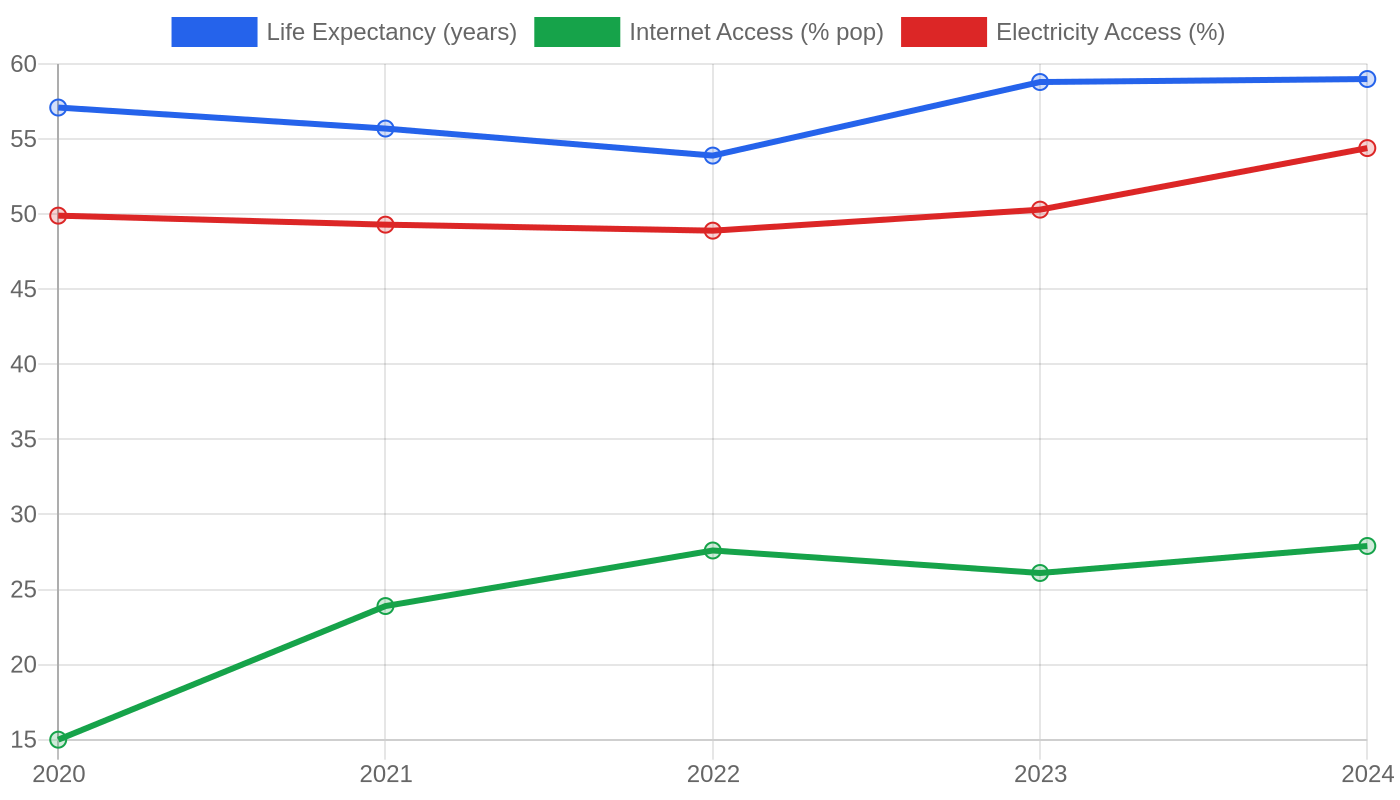
– Somalia’s economic data landscape remains remarkably sparse, with the World Bank unable to provide verified figures for GDP growth, inflation, unemployment, or per-capita income — a telling indicator of the institutional challenges that persist three decades after state collapse.
– The private sector, led by telecommunications firms like Hormuud Telecom and Golis Telecom, has effectively become the country’s economic backbone, filling the void left by a still-consolidating central government.
– Somalia operates as a federal parliamentary representative democratic republic, with a president serving as head of state and commander-in-chief of the armed forces, and a prime minister selected to lead the government — a structure that continues to evolve amid regional tensions.
– The financial sector shows signs of embryonic formalisation, with the Central Bank of Somalia joined by emerging private institutions like First Somali Bank and Bank of Somaliland, though the broader economy remains heavily reliant on remittances and informal trade.
– The absence of reliable crime and safety indices, alongside missing cost-of-living data, underscores the difficulty of assessing quality-of-life metrics in a country still navigating post-conflict reconstruction.
The Numbers That Aren’t There — And What They Tell Us
When the World Bank publishes a country profile with “N/A” stamped across every major economic indicator, that absence itself becomes the story. For Somalia, the latest data on GDP growth, inflation, unemployment, and even population figures remain unverified — a statistical vacuum that speaks volumes about the institutional fragmentation that has defined the country since the early 1990s.
Yet beneath this data void, a resilient economic reality persists. Somalia’s economy has long operated on a parallel track: formal institutions remain weak, but private enterprise thrives. The telecommunications sector stands as the clearest example of this phenomenon. Hormuud Telecom, the country’s largest operator, has built a mobile money ecosystem that has leapfrogged traditional banking infrastructure entirely.
Golis Telecom, operating primarily in the northern regions, has similarly carved out a substantial customer base in an environment where physical infrastructure remains challenging.
The industrial base remains narrow but present. Bosaso Tannery, located in the northeastern port city, represents one of the few formal manufacturing operations, processing hides and skins for export. Hafun Fishing Company taps into Somalia’s extensive coastline — the longest in mainland Africa — though the fishing industry remains vastly underdeveloped relative to its potential.
The consumer services sector, represented by companies like Air Somalia and Eastern Television Network, continues to operate despite the absence of robust regulatory frameworks.
Inflation and employment data are similarly absent, but anecdotal evidence and the sheer persistence of these enterprises suggest an economy that has found ways to function, if not formally thrive. The World Bank’s inability to provide figures should not be read as economic inactivity; rather, it reflects the difficulty of conducting standard statistical surveys in an environment where government reach remains uneven and security concerns persist.
The Cost of Living Puzzle — Informal Markets, Formal Gaps
Understanding what it actually costs to live in Somalia requires navigating a landscape where official statistics simply do not exist. The World Bank provides no housing cost data, no rental indices, and no comparative pricing against regional neighbours. This absence is not accidental — it reflects the reality of an economy where much of daily commerce occurs through informal channels, cash transactions, and clan-based networks.
What can be inferred from the corporate landscape is that basic services — telecommunications, transport, and consumer goods — are available and competitively priced in major urban centres like Mogadishu, Hargeisa, and Bosaso. Hargeisa Taxi, a consumer services company, operates in the self-declared Republic of Somaliland, where a degree of political stability has allowed for more predictable business operations than in the south.
The Hafun Fishing Company’s presence suggests that food supply chains, at least for coastal communities, retain some local production capacity.
The absence of data on rent versus buy dynamics, utility costs, or daily expenses means that external observers must rely on qualitative assessments. What is clear is that Somalia’s urban centres have experienced significant reconstruction and population growth, with diaspora returnees and international organisations driving demand for housing and services.
The cost of living in Mogadishu’s secure zones, where international agencies and the federal government operate, is widely understood to be substantially higher than in outlying districts — a bifurcated market that official statistics would likely struggle to capture even if they existed.
Investment and Business Climate — Telecoms Lead, Finance Follows
The most striking feature of Somalia’s business environment is the inversion of typical economic development patterns. Rather than the state leading infrastructure development and private enterprise following, Somalia’s private sector has built the networks that the government could not. Hormuud Telecom’s dominance in mobile services and mobile money has made financial inclusion more widespread in Somalia than in several African countries with far more developed formal economies.
The financial sector is beginning to formalise. The Central Bank of Somalia, long hampered by capacity constraints, now operates alongside First Somali Bank and Bank of Somaliland, with the latter serving the semi-autonomous northern region. These institutions represent early attempts to rebuild trust in formal banking after the collapse of the country’s last comprehensive financial system in the early 1990s.
However, the sector remains tiny relative to the informal hawala money transfer networks that continue to handle the bulk of remittance flows from the Somali diaspora — funds that are lifelines for millions of households.
For investors, the opportunities are real but conditional. Telecommunications, fishing, renewable energy, and port development all present significant potential. The presence of Bosaso Tannery suggests that agro-industrial processing can work, though scaling such operations requires security, reliable power, and access to export markets.
The political structure — a federal parliamentary republic with power-sharing arrangements among clans — creates both opportunities and complications for business, as navigating regional governments and the federal administration in Mogadishu can be equally essential.
Security, Politics, and the Texture of Daily Life
The political landscape of Somalia is defined by its federal structure, established to accommodate the country’s diverse clan and regional identities after decades of centralised dictatorship and subsequent civil war. The president serves as head of state and commander-in-chief of the Somali Armed Forces, wielding significant authority over security matters.
The prime minister, selected by the president, leads the government and manages day-to-day administration — a division of power that has at times generated friction between the two offices.
Crime and safety indices are unavailable from the World Bank, but the security situation remains the single most important factor shaping both political and economic life. The federal government, with support from international partners, has gradually extended its control over territory that was once held by militant groups, but significant areas remain contested.
This security gradient directly affects economic activity: businesses in more stable regions, such as Somaliland and parts of Puntland, operate with greater predictability than those in southern conflict zones.
The quality of life in Somalia is thus deeply uneven. In Hargeisa, the capital of Somaliland, a functioning administration provides services and a degree of public safety that contrasts sharply with parts of Mogadishu. The presence of companies like Eastern Television Network and Air Somalia indicates a functioning media and transport sector, at least in urban centres.
Yet the absence of reliable data on happiness, welfare, or social indicators makes it difficult to assess how these operational realities translate into broader quality-of-life outcomes for ordinary Somalis.
What’s Happening Now — A State in the Making
Somalia’s current moment is defined by the ongoing consolidation of federal authority and the parallel maturation of its private sector. The federal parliamentary system, established through successive transitional processes, continues to face tests of legitimacy and capacity. The relationship between Mogadishu and regional administrations — particularly Somaliland, which operates as a de facto independent state — remains unresolved and is arguably the most consequential political question facing the country.
On the economic front, the telecommunications sector shows no signs of slowing. Hormuud Telecom’s expansion of mobile money services continues to integrate Somalis into the digital economy, even as formal banking remains nascent.
The presence of multiple financial institutions — the Central Bank of Somalia, First Somali Bank, and Bank of Somaliland — suggests a gradual movement toward regulatory normalisation, though the sector remains a fraction of what Somalia’s population and economic potential would warrant.
The fishing industry, represented by Hafun Fishing Company, sits at the intersection of economic opportunity and security challenges. Somalia’s coastline is among the richest fishing grounds in the region, yet illegal foreign fishing and the legacy of piracy have constrained development. The federal government’s efforts to assert maritime jurisdiction are ongoing, with success dependent on broader state capacity.
For the international community, Somalia remains a focus of diplomatic engagement, humanitarian assistance, and security cooperation. The federal government’s legitimacy, while recognised internationally, continues to depend on its ability to deliver tangible improvements in security and economic opportunity.
The private sector, for its part, appears willing to invest in that future — but the absence of reliable data, enforceable contracts, and predictable regulation remains a substantial brake on the scale of investment the country could attract.
The Bottom Line
Somalia is not a country for conventional economic analysis. The World Bank’s inability to provide core indicators is not a statistical oversight but a reflection of a reality where the state remains in construction and the economy operates through informal networks and resilient private enterprise. For investors with genuine risk tolerance and long time horizons, the telecommunications and fishing sectors offer genuine opportunities.
For policymakers and development professionals, Somalia represents one of the most complex state-building projects of the 21st century. And for the Somali people, the economy that has emerged from the ashes of state collapse is a testament to entrepreneurial resilience — even as the formalisation of that economy remains the country’s defining challenge.
Sources & Methodology
This article is authored by Economic Pulse Net for informational and research purposes. Economic Pulse Net sources its data from multilateral institutions, national statistics bureaus, and proprietary databases. All data is believed to be current as of the date of publication.
Published: August 01, 2026 | Category: Research — Somalia
Use these signals in your own platform
Economic Pulse publishes its live signal feed through a documented, read-only API. Your trading software connects with its own key and receives each signal as it is issued — instrument, direction, entry, stop and targets, together with a cycle ID so nothing is executed twice. The feed is independent of this website and cannot change it.
Signals are informational only and are not financial advice.