Economic Pulse Net | Sources: World Bank World Development Indicators, Government Sources | 2026
Key Takeaways
* Sierra Leone operates under a highly centralized political system where the executive branch holds extensive power, shaping the broader business environment.
The corporate landscape is dominated by consumer services, particularly aviation, alongside key financial institutions and local manufacturing giants.
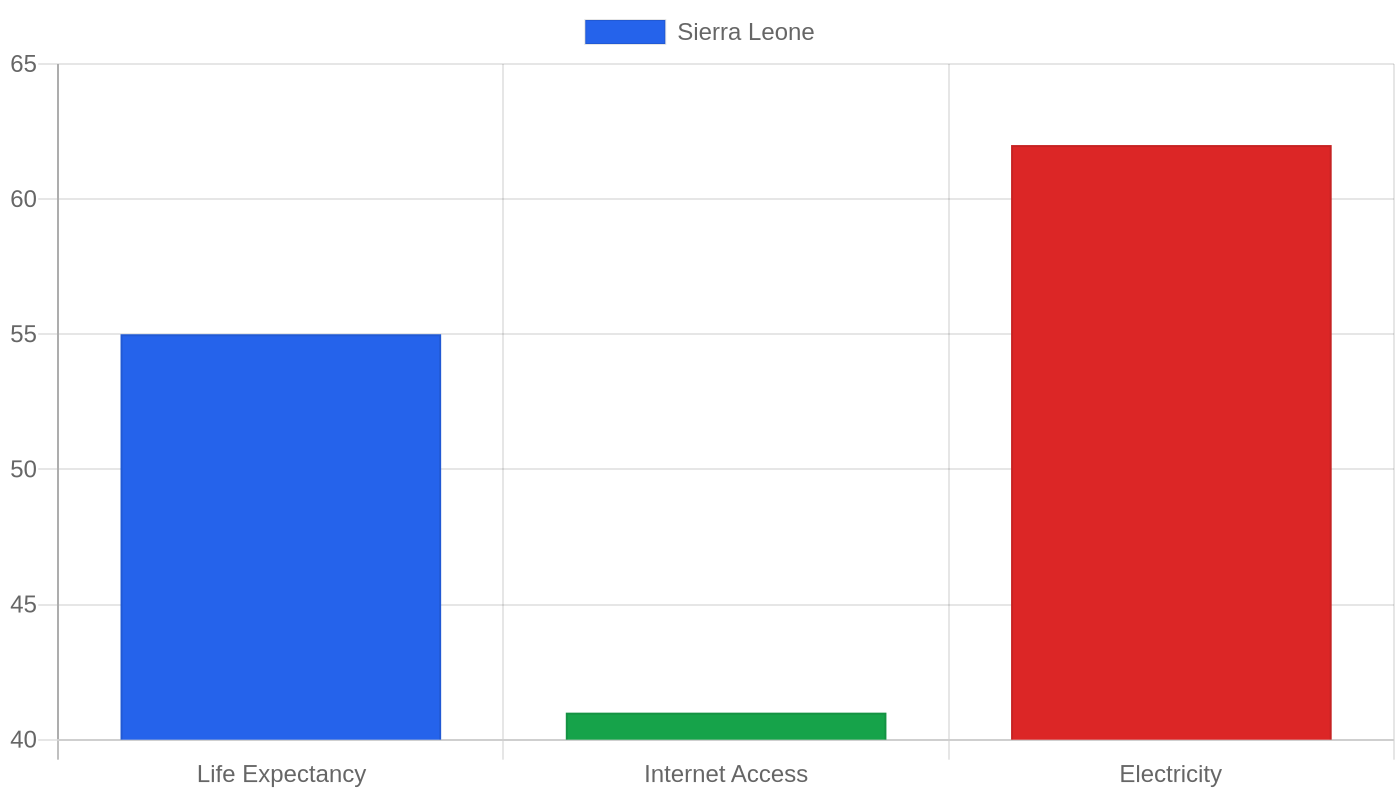
Specific macroeconomic indicators such as GDP growth, inflation rates, and unemployment figures are currently unreported in available datasets, necessitating a focus on structural and institutional analysis.
Safety and crime metrics are not currently quantified, requiring investors to rely on qualitative assessments of the political and social climate.
Despite data gaps in traditional economic metrics, the presence of established entities like Sierra Leone Brewery Limited and major banks suggests an active, albeit opaque, commercial sector.
The Architecture of Power and Governance
To understand Sierra Leone’s economic trajectory, one must first look past standard GDP charts and examine the machinery of the state itself. The country functions as a constitutional republic, anchored by the 1991 Constitution, which establishes a framework for a directly elected president and a unicameral legislature. However, the true center of gravity lies within the executive branch.
According to the provided data, the Government of Sierra Leone is characterized by a dominant unitary central government with relatively weak local government structures. This concentration of authority means that policy shifts, regulatory changes, and economic directives flow primarily from the top down. The president, identified as the most powerful government official, wields extensive powers and influence over the nation’s direction.
For international observers and domestic stakeholders alike, this political reality implies that stability and reform efforts are heavily dependent on the administration’s capacity to manage a centralized system.
While specific fiscal outputs remain unlisted, the structural dominance of the presidency suggests that economic decisions are likely made with a high degree of central coordination, potentially allowing for swift policy implementation but also creating bottlenecks if consensus is lacking at the national level.
A Consumer-Driven Corporate Landscape
In the absence of detailed industrial output statistics, the composition of Sierra Leone’s top companies offers a revealing glimpse into its economic priorities. The list of major enterprises is heavily skewed toward consumer services, specifically the aviation sector. Companies such as Afrik Air Links, Air Leone, Air Rum, Bellview Airlines, Fly 6ix, Paramount Airlines, and SALPOST dominate the headlines, indicating that connectivity and logistics are critical pillars of the current economy.
This saturation of airline firms suggests a market deeply focused on movement and service delivery, perhaps reflecting both the challenges of infrastructure and the necessity of air travel for commerce in the region. Beyond aviation, the financial sector is represented by significant players like the Bank of Sierra Leone and Rokel Commercial Bank, highlighting the importance of credit and banking services in facilitating trade.
In the realm of tangible goods, Sierra Leone Brewery Limited stands out as a key entity in consumer goods, providing insight into the domestic manufacturing and consumption habits of the population. The prominence of these specific industries paints a picture of an economy driven by service provision and basic consumer needs rather than heavy industry or high-tech manufacturing.
Cost of Living and Daily Realities
Assessing the cost of living in Sierra Leone presents a challenge due to the lack of specific CPI data or housing cost indices in the provided dataset. Without precise figures on rent-to-buy ratios or daily expense benchmarks, it is difficult to make direct quantitative comparisons to regional averages. However, the presence of established consumer brands and international-style airlines implies a certain baseline of commercial activity that supports a functioning market economy.
Typically, in economies where aviation and banking sectors are well-represented among top companies, there exists a tiered cost structure catering to both expatriates and the local elite. The absence of reported crime and safety indices further complicates the quality-of-life assessment, as security concerns often correlate with insurance costs, housing premiums, and general daily expenditures. Investors and residents must therefore infer living standards from the availability of services rather than hard numbers.
The existence of major financial institutions suggests that formal banking channels are accessible, which can help mitigate some cash-handling risks associated with higher-cost environments. Ultimately, while exact price tags remain unknown, the operational footprint of these large corporations indicates that a modern, albeit possibly expensive, urban economy exists within the country.
Investment Climate and Business Environment
For businesses looking to enter or expand in Sierra Leone, the investment climate is defined by the opportunities within the service and financial sectors. The sheer number of aviation-related companies in the top tier underscores the potential for growth in logistics, tourism support, and passenger transport. However, the dominance of these firms may also signal intense competition or market saturation in the airline industry.
The financial sector, led by the Bank of Sierra Leone and Rokel Commercial Bank, offers a stable platform for credit facilities and transactional services, which are essential for any new business venture. The inclusion of Sierra Leone Brewery Limited in the corporate rankings points to enduring demand for consumer staples, suggesting that food and beverage manufacturing remains a resilient part of the economy.
SALPOST’s presence in the industrials category highlights the ongoing need for postal and courier services, a sector that often grows in tandem with e-commerce and small business activity. Prospective investors should note that while specific regulatory hurdles are not detailed, the strong central government structure means that navigating bureaucracy will likely require engaging with national-level authorities rather than local municipalities.
The business environment appears to reward those who can establish strong relationships with these established incumbents or fill gaps in the service chain they cover.
Safety, Politics, and Quality of Life
The intersection of safety and politics in Sierra Leone requires careful navigation, given the current limitations in available data. The Crime Index and Safety Index are listed as N/A, meaning there are no quantifiable metrics to guide risk assessment regarding personal security or property crime. This gap in data does not imply safety; rather, it suggests that reliable statistical reporting on these issues is either inconsistent or unavailable.
Politically, the country’s landscape is defined by the 1991 Constitution and the overwhelming influence of the president. This centralized power dynamic can contribute to stability if the administration is effective, but it can also lead to uncertainty if political transitions are contentious. The lack of happiness data or social well-being indices further obscures the lived experience of the average citizen.
For expatriates and long-term residents, the combination of unmeasured crime levels and a highly centralized political system means that situational awareness and local intelligence will be more valuable than standardized safety scores. The quality of life is likely tied closely to one’s integration into the formal economic sectors represented by the top companies, which may offer better security and resources than the informal economy.
What’s Happening Now: Structural Observations
While real-time news feeds and live economic indicators are not provided in the current dataset, the structural elements of Sierra Leone’s governance and corporate world offer clues about the present moment. The emphasis on a “dominant unitary central government” suggests that current affairs are likely driven by presidential decrees or national policy announcements rather than decentralized local initiatives.
The proliferation of airline companies in the top corporate list indicates that connectivity remains a pressing national priority, possibly reflecting ongoing efforts to improve access to remote areas or boost tourism. The continued operation of major banks like Rokel Commercial Bank and the Bank of Sierra Leone implies that the financial system is holding steady despite potential external shocks.
Furthermore, the presence of SALPOST in the industrials sector hints at ongoing investments or maintenance in public service infrastructure. Without specific recent news events, the “now” in Sierra Leone is best understood through these enduring institutional frameworks. The country appears to be in a state of managed continuity, where the political center exerts strong control over economic activities, and businesses operate within the established hierarchies of finance, aviation, and consumer goods.
The Bottom Line
Sierra Leone presents a complex profile for observers, characterized by a powerful central government and a corporate sector focused on services and consumer goods. With macroeconomic data such as GDP and inflation currently unavailable, the primary lens for analysis must be institutional and structural. Investors and analysts should watch this country for developments in its aviation and financial sectors, which appear to be the engines of its recorded economic activity.
The lack of safety and crime data serves as a reminder that qualitative due diligence is essential before making any commitments. Ultimately, Sierra Leone is a market where political stability and central policy direction are the most critical variables to monitor.
Sources & Methodology
This article is authored by Economic Pulse Net for informational and research purposes. Economic Pulse Net sources its data from multilateral institutions, national statistics bureaus, and proprietary databases. All data is believed to be current as of the date of publication.
Published: October 11, 2026 | Category: Research — Sierra Leone
Use these signals in your own platform
Economic Pulse publishes its live signal feed through a documented, read-only API. Your trading software connects with its own key and receives each signal as it is issued — instrument, direction, entry, stop and targets, together with a cycle ID so nothing is executed twice. The feed is independent of this website and cannot change it.
Signals are informational only and are not financial advice.