Economic Pulse Net | Sources: World Bank World Development Indicators, Government Sources | 2026
Key Takeaways
* Senegal remains a political stabilizer in West Africa, characterized by a republican structure with a president elected every five years since 2016.
The corporate landscape is dominated by state-linked utilities like Senelec and telecommunications giants such as Sonatel and Ikatel.
Consumer services and industrials form the backbone of major enterprises, including Air Sénégal International and the Dakar–Niger Railway.
While specific macroeconomic indicators like GDP growth and inflation are currently unreported, the nation’s historical political continuity suggests institutional resilience.
Investors must navigate a market where safety indices and crime statistics are not publicly quantified, relying instead on qualitative assessments of stability.
The Architecture of Growth and Industry
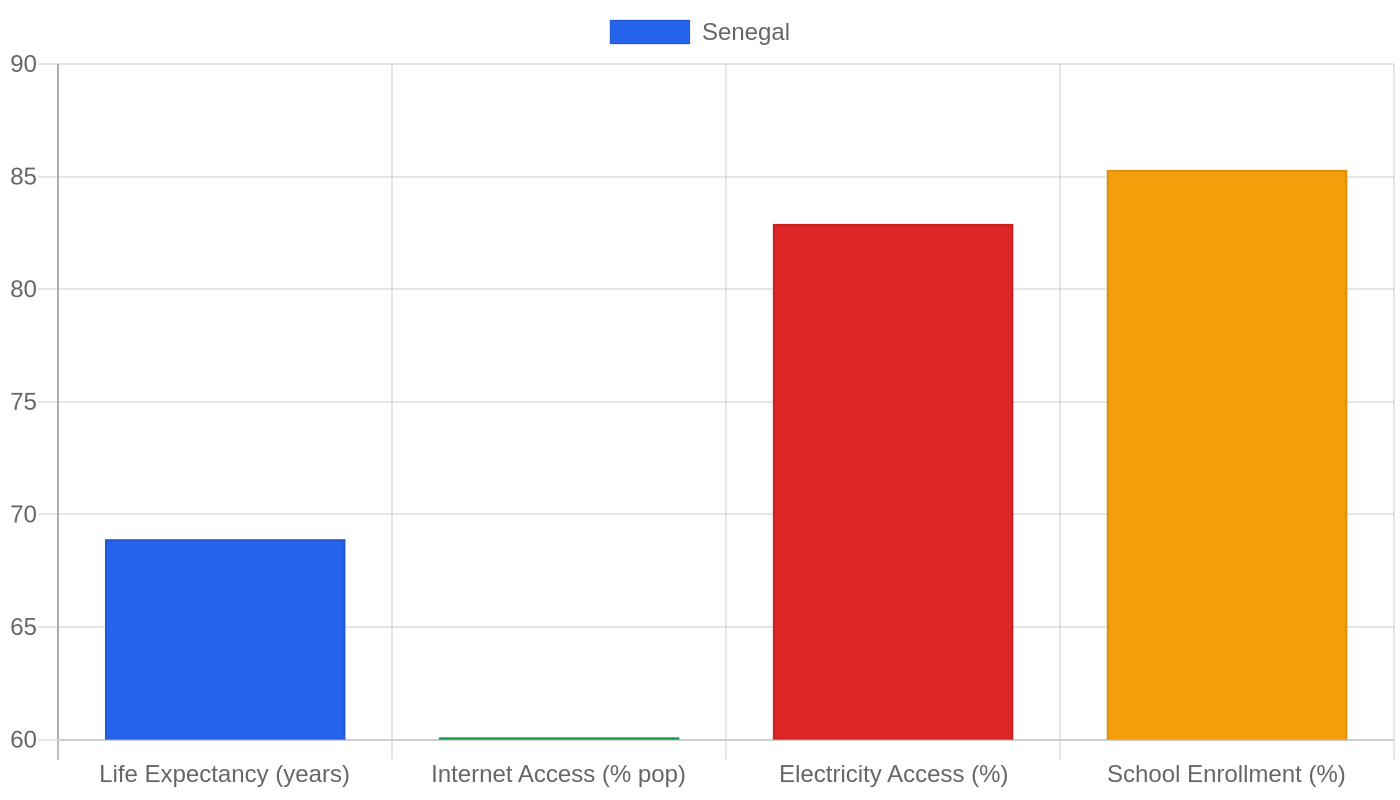
Senegal’s economic engine is driven by a diverse mix of industrial and service-oriented sectors, though precise macroeconomic metrics remain opaque. According to available data from the World Bank, specific figures for GDP growth, inflation rates, and unemployment levels are currently listed as N/A, indicating a gap in real-time reporting or data availability for this period. However, the structural composition of the economy offers clues to its operational rhythm.
The presence of major players in the utilities sector, such as Senelec, highlights the critical role of infrastructure in maintaining daily economic activity. Similarly, the telecommunications industry, represented by heavyweights like Sonatel and Ikatel, suggests a growing digital connectivity that likely underpins modern business transactions. In the industrial sphere, entities like the Dakar–Niger Railway and La Poste point to a logistics network that connects urban centers with regional trade partners.
These foundational industries provide a stable, albeit quantitatively undefined, floor for the national economy. Without concrete numbers on GDP per capita or GNI, it is difficult to assess wealth distribution, but the existence of these established corporations implies a functioning market ecosystem. The absence of reported data does not negate the physical reality of these operations; rather, it underscores the need for qualitative analysis over quantitative speculation.
For observers, the focus shifts from rapid expansion metrics to the sustainability of existing industrial frameworks and their capacity to absorb future shocks.
Navigating Daily Expenses and Housing Markets
Understanding the cost of living in Senegal requires looking at the interplay between essential services and housing dynamics, even in the absence of direct CPI figures. With inflation data marked as N/A, consumers and expatriates cannot rely on official price trend analyses to guide budgeting decisions. Instead, one must infer economic pressure from the performance of key utility providers.
Senelec, as a primary utility company, plays a pivotal role in household budgets through electricity and water costs, which are often subsidized or regulated in ways that differ from free-market extremes. The telecommunications sector, led by Sonatel, also impacts disposable income, as mobile and internet services have become essential utilities for both personal communication and small business operations.
Housing markets in Dakar, while not explicitly detailed in the provided text, are typically influenced by the broader stability of the financial services sector, including insurers like Amsa assurances Sénégal. When official cost-of-living indices are unavailable, residents often rely on local market comparisons to gauge rent versus buy ratios. This lack of standardized data can create uncertainty for long-term planning, forcing individuals to depend on informal networks for accurate pricing information.
Consequently, the daily economic experience in Senegal is shaped less by headline inflation numbers and more by the tangible costs of energy, connectivity, and shelter.
Investment Opportunities and Corporate Landscape
The investment climate in Senegal is defined by a concentration of power within a few key conglomerates and state-associated entities. Major companies dominate the visible economic landscape, offering both opportunities and challenges for new entrants. In the consumer services sector, Air Sénégal International, Atlantis Airlines, Groupement Aérien Sénégalais, and Senegal Airlines compete to connect the nation domestically and internationally.
This fragmentation among airlines suggests a competitive environment for travel and tourism, potentially opening niches for specialized logistics or charter services. The industrial sector is anchored by the Dakar–Niger Railway and La Poste, highlighting the importance of cross-border trade and postal services in the regional economy. For investors, the telecommunications duopoly or oligopoly formed by Sonatel and Ikatel represents a high-barrier entry but also a mature market with established user bases.
Financial services are represented by Amsa assurances Sénégal, indicating a developed insurance market that supports broader commercial activities. The prominence of these specific firms suggests that foreign direct investment may be most successful when partnering with or supplying these established giants rather than attempting to build entirely new verticals from scratch.
The business environment appears to favor entities with strong logistical networks and regulatory compliance, given the state-linked nature of several top companies.
Stability, Safety, and Political Continuity
Senegal’s political framework provides a unique lens through which to view its social contract and quality of life. As a republic, the country has undergone significant constitutional evolution regarding the presidency. Prior to 2016, the presidential term varied significantly, ranging from seven years from independence to 2001, five years from 2001 to 2008, and back to seven years from 2008 to 2016.
Since 2016, the president has been elected every five years by adult voters, signaling a move toward shorter, more frequent accountability cycles. This political history is deeply intertwined with the nation’s cultural identity; the first president, Léopold Sédar Senghor, was not only a statesman but a renowned poet and writer, becoming the first African elected to the Académie française.
His successor, Abdou Diouf, later served as the general secretary of the same prestigious organization, illustrating the intellectual caliber of Senegal’s leadership. The third president, Abdoulaye Wade, continued this tradition of politically engaged elites. Regarding safety, current Crime and Safety Indices are listed as N/A, meaning there are no standardized statistical benchmarks for security risks.
This absence of data complicates risk assessments for travelers and businesses, requiring reliance on anecdotal evidence and diplomatic advisories. The political stability implied by regular elections contrasts with the lack of quantifiable safety metrics, creating a complex picture of governance.
Current Affairs and Policy Shifts
The immediate context of Senegal’s development is heavily influenced by its historical political transitions and ongoing institutional reforms. The shift in presidential terms to a five-year cycle in 2016 reflects a broader trend toward aligning democratic practices with international norms, potentially enhancing investor confidence in policy continuity.
The legacy of leaders like Senghor and Diouf, who bridged literature and diplomacy, continues to shape Senegal’s soft power in West Africa, positioning it as a diplomatic anchor in a region often prone to instability. While specific recent news events are not detailed in the provided text, the structural focus on telecommunications and railways indicates ongoing investments in digital and physical infrastructure.
The presence of multiple airline companies suggests efforts to expand connectivity, which is crucial for trade and tourism recovery. Business developments appear centered on strengthening the core utilities and transport sectors, which are vital for economic resilience. The lack of updated GDP or inflation data means that current affairs are interpreted through the lens of institutional strength rather than economic velocity.
Stakeholders are likely monitoring how the five-year electoral cycle impacts long-term planning and whether new administrations will prioritize deregulation or state-led development.
The Bottom Line
Senegal presents a case study in political resilience and institutional depth, even amidst gaps in hard economic data. Investors and policymakers should watch this country not for explosive growth metrics, but for its potential as a stable hub for telecommunications, logistics, and consumer services in West Africa.
The dominance of a few key players in utilities and telecoms offers clear partnership opportunities, while the rich political history suggests a society that values continuity and intellectual engagement. Ultimately, Senegal’s appeal lies in its structural foundations rather than its current statistical volatility.
Sources & Methodology
This article is authored by Economic Pulse Net for informational and research purposes. Economic Pulse Net sources its data from multilateral institutions, national statistics bureaus, and proprietary databases. All data is believed to be current as of the date of publication.
Published: October 11, 2026 | Category: Research — Senegal
Use these signals in your own platform
Economic Pulse publishes its live signal feed through a documented, read-only API. Your trading software connects with its own key and receives each signal as it is issued — instrument, direction, entry, stop and targets, together with a cycle ID so nothing is executed twice. The feed is independent of this website and cannot change it.
Signals are informational only and are not financial advice.