Economic Pulse Net | Sources: World Bank World Development Indicators, Government Sources | 2026
Key Takeaways
– Rwanda operates as a de facto one-party state under the Rwandan Patriotic Front (RPF), with Paul Kagame in continuous leadership since 1994, creating political stability that investors crave but at the cost of democratic pluralism.
– The financial sector dominates the corporate landscape, with at least seven major banks—including Bank of Kigali and Equity Bank Rwanda—forming the backbone of formal economic activity, alongside consumer goods giant Bralirwa Brewery.
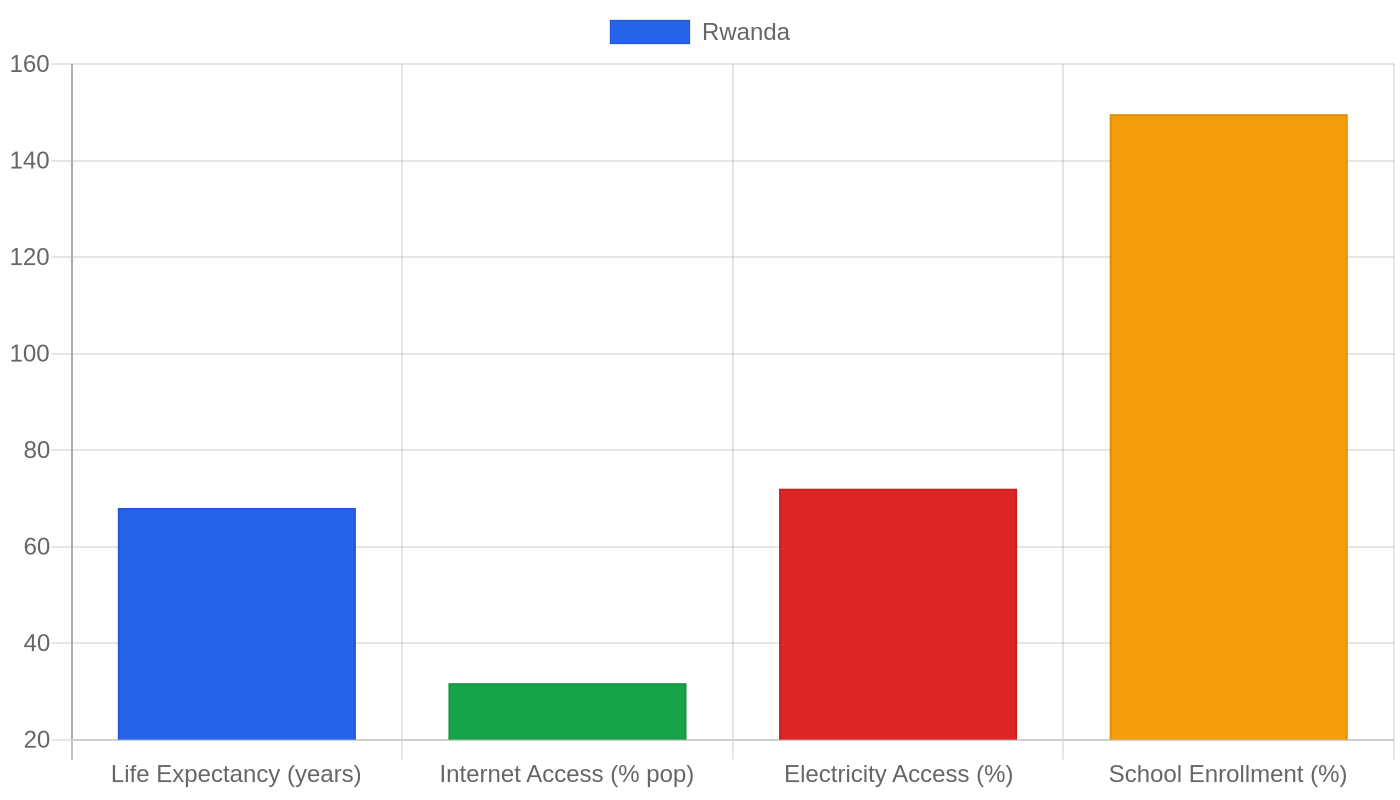
– Despite limited publicly available macroeconomic data from the World Bank, Rwanda’s development model has long prioritized efficiency, infrastructure, and ease of doing business over political openness.
– The country’s political landscape, as described in available data, features manipulated elections, banned opposition parties, and electoral fraud—a reality that coexists with Rwanda’s reputation for order and low crime.
The Kigali Consensus — Finance, Brews, and the Growth Machine
Rwanda’s economic story is written in the ledgers of its banks. The list of top companies reads like a roll call of financial institutions: AB Bank Rwanda, Access Bank Rwanda, Bank of Africa Rwanda Limited, Bank of Kigali, Banque Populaire du Rwanda SA, Banque Populaire du Rwanda, Compagnie Générale de Banque, and Equity Bank Rwanda Limited. Eight banks dominate the formal corporate sector, according to the data provided.
This concentration tells us something essential about Rwanda’s economic model: it is a system built on financial intermediation, where capital flows through a tightly controlled banking network rather than through diffuse market competition.
Bralirwa Brewery, the consumer goods giant, stands as the notable non-financial heavyweight, alongside Bourbon Coffee in consumer services. The brewing and coffee sectors reflect Rwanda’s dual economic identity—a modernizing services hub with deep agricultural roots. Yet the World Bank data provides no specific figures for GDP growth, inflation, unemployment, or GDP per capita. This absence of macroeconomic metrics is itself noteworthy.
In a country that markets itself as Africa’s Singapore, the lack of publicly available baseline data raises questions about transparency in economic reporting.
The financial sector’s dominance suggests an economy where credit allocation, rather than entrepreneurial dynamism, drives activity. Banks lend, businesses borrow, and growth follows a centrally managed trajectory. The RPF’s control over political life extends into economic governance, creating a system where stability is high but organic market development may be constrained.
The Price of Order — Housing, Living Costs, and the Urban Premium
Data on Rwanda’s cost of living is not available in the provided materials, but the structure of its corporate sector offers indirect clues. With eight major banks headquartered primarily in Kigali, the capital city concentrates economic opportunity and, by extension, housing demand.
The presence of Bourbon Coffee—a premium consumer brand—suggests a growing middle class with disposable income, but also points to an economy where consumption is bifurcated between a small urban elite and a largely rural population.
Rwanda’s development model has historically emphasized public infrastructure, clean streets, and digital governance. These priorities come with costs. Urban housing in Kigali, particularly in well-serviced neighborhoods, commands premium prices relative to regional peers. The country’s reputation for order and low crime—though specific indices are not available in this data—creates demand from expatriates, diplomats, and aid workers, further pressuring the housing market.
The rent-versus-buy calculation in Kigali likely favors renting for most residents, given limited mortgage penetration outside the banking sector’s corporate lending focus.
Banking on Stability — Investment Climate and Corporate Rwanda
The investment climate in Rwanda is defined by its corporate roster. Eight financial institutions dominate, creating an ecosystem where banking is both the primary industry and the gatekeeper for other sectors. For investors, this concentration offers clarity: the rules of the game are set by a small number of well-capitalized players, and the central bank maintains tight oversight.
The World Bank’s data shows no foreign banks among the top companies—all are domestic or regional African institutions—indicating a financial sector that is locally rooted rather than globally exposed.
Bralirwa Brewery represents the consumer goods opportunity. Beer consumption correlates with rising incomes, and Bralirwa’s dominance suggests a captive market with strong distribution networks. Bourbon Coffee, meanwhile, taps into Rwanda’s global brand as a premium coffee origin, though its presence as a top company indicates that value addition and retail are becoming more significant than raw commodity exports.
For foreign investors, the calculation is straightforward: Rwanda offers political stability, efficient bureaucracy, and a disciplined workforce. But the political landscape data notes that elections are manipulated, opposition parties are banned, and critics face arrest or assassination. This creates a fundamental tension. The same system that guarantees order also suppresses the kind of open contestation that typically accompanies mature market economies.
Investors must weigh the efficiency gains against the democratic deficits.
The Governance Premium — Safety, Politics, and Life Under the RPF
Rwanda’s political landscape, as described in the data, is unambiguous: a de facto one-party state ruled by the Rwandan Patriotic Front and Paul Kagame since 1994. The RPF is described as Tutsi-dominated but with support from other communities. Elections, the data states, are manipulated through banning opposition parties, arresting or assassinating critics, and electoral fraud. This is not a marginal observation—it is the central political fact of the country.
Yet this system produces outcomes that many countries envy. Crime and safety indices are not available in the data, but Rwanda’s reputation for public safety is well-established. The trade-off is stark: citizens and residents enjoy physical security and efficient public services, but at the cost of political voice. The quality of life in Rwanda is therefore a study in contradictions.
Streets are clean, buses run on time, corruption is low by regional standards, and women hold significant parliamentary representation. But the data makes clear that these achievements rest on a foundation of political repression.
For the average Rwandan, daily life may feel orderly and predictable. For the political activist or opposition figure, it is a landscape of surveillance and risk. The RPF’s continuous rule since the genocide provides a narrative of stability and reconciliation, but the data also reveals that this stability is maintained through mechanisms that would be unacceptable in most democracies.
Current Affairs — The Silence of the Data
The available data provides no recent news, live indicators, or current affairs updates for Rwanda. This absence is itself a kind of information. In a country where the government tightly controls media and political expression, the lack of timely, independent reporting is consistent with the political landscape described in the data.
The RPF’s dominance extends to the information sphere, making it difficult to assess real-time economic conditions, inflation trends, or policy shifts without relying on official sources.
What can be inferred from the corporate data is that Rwanda’s banking sector remains the primary engine of formal economic activity. Any significant policy developments—whether monetary policy adjustments, new lending regulations, or shifts in foreign investment rules—would likely be transmitted through these financial institutions.
The absence of recent news in the data means this article cannot report on specific reforms or elections, but it can note that the political structure described makes dramatic policy shifts unlikely. The RPF’s grip on power ensures continuity, for better or worse.
The Bottom Line
Rwanda is a country for investors who prioritize stability over democracy, efficiency over openness, and order over pluralism. The financial sector offers clear entry points, particularly in banking and consumer goods, but the political risks are not the conventional ones—they are the risks of a system where power is concentrated, dissent is suppressed, and succession is uncertain. Development economists and governance researchers should watch Rwanda as a case study in the authoritarian development model.
For the casual observer, Rwanda remains a paradox: a clean, safe, well-run country where the price of order is political freedom.
Sources & Methodology
This article is authored by Economic Pulse Net for informational and research purposes. Economic Pulse Net sources its data from multilateral institutions, national statistics bureaus, and proprietary databases. All data is believed to be current as of the date of publication.
Published: July 19, 2026 | Category: Research — Rwanda
Use these signals in your own platform
Economic Pulse publishes its live signal feed through a documented, read-only API. Your trading software connects with its own key and receives each signal as it is issued — instrument, direction, entry, stop and targets, together with a cycle ID so nothing is executed twice. The feed is independent of this website and cannot change it.
Signals are informational only and are not financial advice.