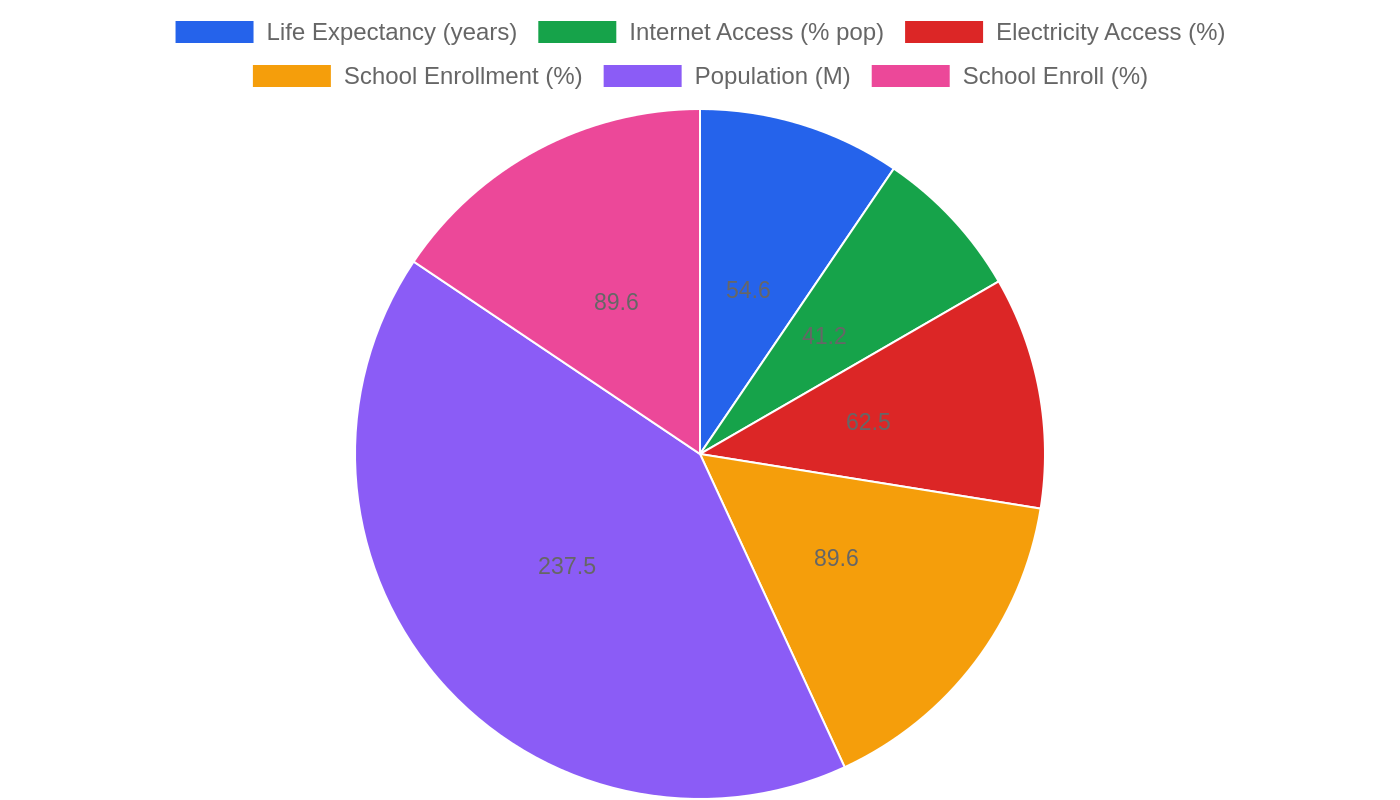
Economic Pulse Net | Sources: World Bank World Development Indicators, Government Sources | 2026
Key Takeaways
– Nigeria’s inflation rate has surged to 23.01 percent, according to World Bank data, placing immense pressure on household purchasing power and business operating costs across Africa’s most populous nation.
– The country operates as a federal republic with 36 states and a presidential system, where both the president and state governors are limited to two four-year terms.
– Major financial and industrial players like Access Bank, BUA Cement, and BUA Foods dominate the corporate landscape, while consumer services firms including Arik Air and Aero Contractors signal a struggling aviation sector.
– Recent tax reform laws implemented one year ago are beginning to show signs of shaping President Tinubu’s economic vision, according to analysis from Premium Times.
– Soaring cooking gas prices are squeezing both Nigerian households and businesses, as reported by Premium Times in a special investigation.
The Inflation Trap — Why 23 Percent Matters
Nigeria’s economy is navigating treacherous waters. The World Bank reports a Consumer Price Index inflation rate of 23.01 percent — a figure that fundamentally reshapes how ordinary Nigerians live, work, and plan for the future. When inflation runs at this level, the purchasing power of the naira erodes visibly month by month. A family that could fill a cooking gas cylinder three months ago now struggles to afford half that amount.
Businesses face the same dilemma: input costs rise, margins shrink, and the temptation to pass costs to consumers becomes a survival mechanism.
The World Bank data shows Nigeria’s GNI per capita stands at $1,360. That figure, when placed against a 23 percent inflation rate, tells a stark story. For a nation where per capita income hovers just above the low-income threshold, double-digit inflation doesn’t just nibble at living standards — it devours them. The absence of reported GDP growth figures and unemployment data in the World Bank dataset creates a frustrating gap, but the inflation number alone signals an economy under severe strain.
Monetary policymakers face a brutal trade-off: raise interest rates to tame inflation and risk choking off investment, or hold steady and watch prices spiral further.
The industrial composition of Nigeria’s economy, while not fully detailed in the data provided, can be inferred from its top companies. Financial services dominate through Access Bank and the Central Bank of Nigeria. Industrial giants like BUA Cement and C&I Leasing Group PLC suggest a construction and infrastructure sector that remains active. Consumer goods appear through BUA Foods.
Yet the presence of three airlines — Arik Air, Aero Contractors, and Chanchangi Airlines — in the top companies list hints at an aviation sector that, while prominent, faces the same inflationary headwinds affecting fuel costs and ticket prices.
The Cost of Living Crunch — Cooking Gas and Daily Survival
When Premium Times publishes a special report on how soaring cooking gas prices are squeezing Nigerian households and businesses, it is documenting a crisis that touches nearly every home in the country. Cooking gas is not a luxury in Nigeria; it is a daily necessity for millions of families who rely on it for meal preparation.
The newspaper’s investigation reveals a pattern familiar across the economy: global price pressures combine with domestic currency weakness and supply chain bottlenecks to push essential costs beyond reach.
Housing costs, while not specified in the data, must be understood within the context of a $1,360 GNI per capita economy. In cities like Lagos, Abuja, and Port Harcourt, rental prices absorb a significant portion of household income. The gap between what people earn and what they must spend on shelter, food, and energy has widened considerably.
Regional comparisons are difficult without specific data, but Nigeria’s urban housing market has historically been characterized by high demand, limited formal supply, and a large informal rental sector where prices are set by negotiation rather than market indices.
Daily expenses for transportation, food, and utilities have become a moving target. The 23 percent inflation rate means that a basket of goods that cost 10,000 naira a year ago now costs over 12,300 naira. For households already living close to the margin, that difference forces difficult choices: fewer meals, cheaper substitutes, or reduced spending on health and education.
Corporate Giants and Investment Climate — Where the Money Moves
Nigeria’s corporate landscape is dominated by a mix of financial institutions, industrial conglomerates, and consumer-facing businesses. Access Bank stands as a pillar of the financial sector, while the Central Bank of Nigeria itself appears on the list of top companies — a reminder of the central role monetary authority plays in shaping economic conditions.
BUA Cement and BUA Foods represent the industrial and consumer goods backbone, suggesting that domestic manufacturing and processing remain significant despite the challenging environment.
The aviation sector’s strong presence among top companies — Arik Air, Aero Contractors, and Chanchangi Airlines — indicates both opportunity and vulnerability. Airlines operate on thin margins globally; in a high-inflation, currency-volatile environment like Nigeria, those margins become razor-thin.
The presence of Cassava Republic Press and Chocolate City Records in the top companies list points to a creative and publishing sector that, while smaller in economic weight, adds cultural and soft-power value to the Nigerian economy.
For investors, the current climate presents a paradox. High inflation and currency uncertainty deter foreign capital. Yet the sheer size of Nigeria’s population — though not specified in the data, it is well-known as Africa’s largest — creates an enormous consumer market. Companies that can navigate the inflation environment, manage supply chains effectively, and price products appropriately stand to capture significant market share.
The tax reform laws highlighted by Premium Times suggest that the government is attempting to create a more predictable fiscal environment, though one year is too short a period to judge their full impact.
Politics, Safety, and the Quality of Life Equation
Nigeria’s political structure as a federal republic modelled on a presidential system provides both stability and friction. With 36 states and the Federal Capital Territory of Abuja operating as independent units, power is dispersed between the national government and state governors. The president serves as both head of state and head of government, elected by popular vote for a maximum of two four-year terms. State governors operate under the same term limits.
This structure, borrowed from the United States, creates multiple centers of political and economic power.
The absence of crime and safety indices in the provided data makes it impossible to offer specific security assessments. However, Nigeria’s security challenges are well-documented in broader reporting: insurgency in the northeast, banditry in the northwest, separatist tensions in the southeast, and urban crime in major cities. These factors directly affect quality of life and investment decisions.
Businesses must factor security costs into their operations, and households in affected regions face additional stress beyond the economic pressures of inflation.
The quality of life for an average Nigerian is shaped primarily by economic reality. With a GNI per capita of $1,360, the country sits firmly in the lower-middle-income bracket by World Bank classifications. The 23 percent inflation rate means that whatever income households earn buys less each month. Political stability, while maintained through the federal system, is tested by economic hardship.
The one-year anniversary of tax reform laws, as reported by Premium Times, suggests that the Tinubu administration is pursuing structural changes, but the benefits of reform take time to materialize — time that households struggling with cooking gas prices may not feel they have.
Reform One Year On — Tinubu’s Economic Vision Under the Microscope
The most current news from Nigeria centers on two parallel stories: the implementation of tax reform laws and the crisis in cooking gas prices. Premium Times reports that one year after the tax reform laws were enacted, President Tinubu’s economic foresight is “taking shape,” according to analyst Aderonke Atoyebi.
This assessment suggests that the administration’s fiscal strategy is beginning to yield measurable results, though the specifics of those results are not detailed in the data provided.
Simultaneously, the same newspaper’s special report on cooking gas prices paints a picture of ongoing hardship. The fact that both stories — reform progress and household squeeze — can coexist tells us something important about Nigeria’s current moment. Structural reforms take years to filter down to household budgets. Tax policy changes may improve government revenue and fiscal stability over time, but they do not immediately lower the price of cooking gas or reduce inflation.
The tension between these two narratives defines Nigeria’s economic outlook. On one hand, the government is taking steps to modernize the tax system and create a more business-friendly environment. On the other hand, the immediate pressures of 23 percent inflation and rising energy costs threaten to erode public support for reform before its benefits are felt.
The next six to twelve months will be critical: if inflation begins to moderate and the reform dividends become visible, the Tinubu strategy will gain credibility. If prices continue to rise and households feel no relief, the political cost could be significant.
The Bottom Line
Nigeria is a country of immense economic potential trapped in a cycle of high inflation and structural adjustment. For investors with long time horizons and high risk tolerance, the combination of reform momentum, a large consumer market, and dominant corporate players like Access Bank and BUA Cement offers opportunity. For the average Nigerian household, the immediate reality is one of struggle — cooking gas prices rising, purchasing power falling, and the promise of reform still distant.
Anyone watching Nigeria should focus on two indicators over the coming year: the inflation trajectory and the real-world impact of tax reforms on business activity and household costs.
Sources & Methodology
This article is authored by Economic Pulse Net for informational and research purposes. Economic Pulse Net sources its data from multilateral institutions, national statistics bureaus, and proprietary databases. All data is believed to be current as of the date of publication.
Published: July 22, 2026 | Category: Research — Nigeria
Use these signals in your own platform
Economic Pulse publishes its live signal feed through a documented, read-only API. Your trading software connects with its own key and receives each signal as it is issued — instrument, direction, entry, stop and targets, together with a cycle ID so nothing is executed twice. The feed is independent of this website and cannot change it.
Signals are informational only and are not financial advice.