Economic Pulse Net | Sources: World Bank World Development Indicators, Government Sources | 2026
Key Takeaways
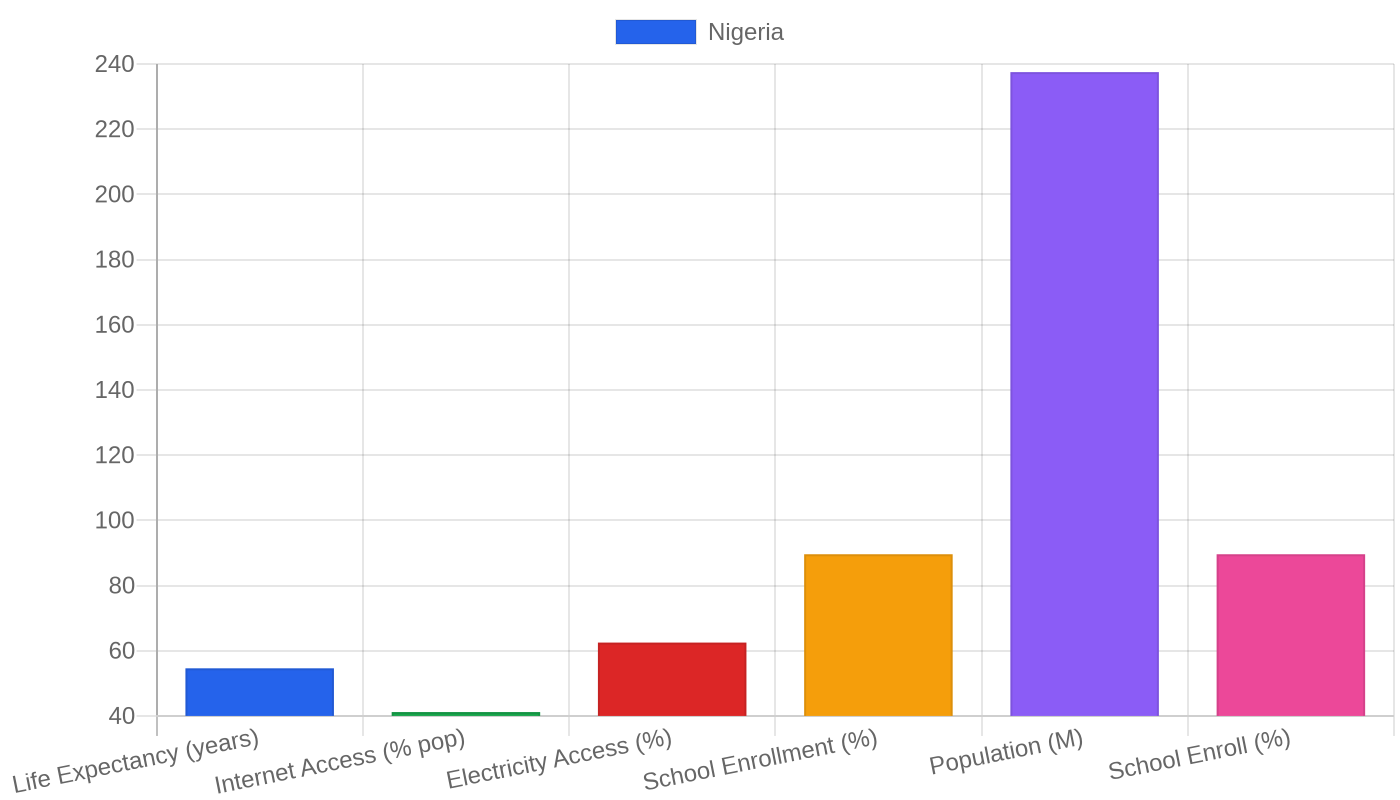
– Nigeria’s economy expanded by 4.01% in 2025, according to the World Bank, marking a significant acceleration that signals recovery in Africa’s most populous nation.
– Inflation remains the dominant threat to household welfare, with the Consumer Price Index sitting at a punishing 23.01% — eroding purchasing power across all income brackets.
– With a GDP of $290.8 billion and a population approaching 238 million, Nigeria’s per capita income of just $1,360 highlights the vast gap between headline growth and lived reality.
– The financial and industrial sectors are driving corporate activity, with major players like Access Bank and BUA Cement leading expansion plans even as consumers struggle with soaring energy costs.
– Political stability under the federal presidential system provides a framework for reform, but the data suggests the benefits of growth are not yet reaching the majority of citizens.
Growth on Paper, Pain in the Pocket
The headline figure is undeniably encouraging. Nigeria’s GDP grew by 4.01% in 2025, according to the World Bank. That is a pace that many developed economies would envy. But the number demands context. With a total GDP of $290.8 billion spread across nearly 238 million people, the per capita figure of $9,531 on a purchasing power parity basis tells a more nuanced story. The average Nigerian’s economic output, when adjusted for local prices, is roughly one-tenth that of the average American.
The GNI per capita — a measure of what citizens actually earn — sits at just $1,360, a stark reminder that much of the economic activity remains concentrated in corporate and government hands rather than circulating through household incomes.
The inflation rate of 23.01% is the counterweight to the growth story. When prices rise at nearly a quarter of their value each year, a 4% GDP expansion is quickly swallowed. The World Bank data does not break down which sectors are driving inflation, but the national newspaper reports that cooking gas prices are “soaring” and squeezing households and businesses alike.
This is the classic Nigerian paradox: an economy that is expanding in aggregate terms while millions of citizens experience a shrinking standard of living. For the central bank, the challenge is acute. It must balance the need to support growth with the imperative to tame inflation — a tightrope walk that no monetary authority in the world has perfected.
The Cost of Breathing: Living Expenses in Africa’s Largest Economy
The inflation figure of 23.01% is not an abstraction. It translates directly into the price of food, transport, and shelter. The World Bank data does not provide a detailed cost-of-living breakdown, but the implications of such high inflation are clear. A household that spent 100,000 naira on groceries a year ago now needs 123,000 naira to buy the same basket of goods.
For the millions of Nigerians working in the informal economy — which the World Bank data suggests is substantial, given the low GNI per capita — wages rarely keep pace. The result is a steady erosion of purchasing power that pushes more families toward the economic margins.
Housing costs are particularly punishing in major cities like Lagos and Abuja, where demand far outstrips supply. Rent for a modest apartment in a decent neighborhood can consume 60% or more of a minimum-wage salary. Homeownership remains a distant dream for most, given the combination of high interest rates, land title disputes, and the sheer cost of construction materials.
The national newspaper’s special report on cooking gas prices underscores the broader energy crisis: when households cannot afford to cook, the basic functions of daily life become a source of financial anxiety. Compared to regional peers like Ghana or Kenya, Nigeria’s inflation problem is more severe, making it one of the most expensive places in sub-Saharan Africa to simply get by.
Titans of Industry: Where the Money Is Flowing
The corporate landscape in Nigeria is dominated by a mix of financial institutions, industrial conglomerates, and consumer-facing businesses. Access Bank leads the financial sector, while BUA Cement and BUA Foods anchor the industrial and consumer goods segments, according to the World Bank data. The presence of three airlines — Aero Contractors, Arik Air, and Chanchangi Airlines — suggests a competitive aviation market, though the sector has historically struggled with fuel costs and currency volatility.
The Central Bank of Nigeria itself is listed among the top companies, a reflection of its outsized role in shaping the economic environment.
The most promising signal comes from BUA Foods, which the national newspaper reports is planning a “major expansion” to support Nigeria’s economic growth and food security. This is significant because food inflation is the most painful component of the 23.01% CPI figure. If BUA Foods can increase domestic production and reduce reliance on imports, it could help stabilize prices over the medium term.
The industrial sector, represented by BUA Cement and C&I Leasing Group, is also well-positioned to benefit from infrastructure spending and urbanization. However, the business environment remains challenging. Currency volatility, fuel shortages, and regulatory uncertainty are perennial complaints.
The presence of the Central Bank as a listed entity underscores how deeply the state is intertwined with the private sector — a double-edged sword that provides stability in some areas while creating bottlenecks in others.
Democracy in Practice: Politics and Daily Life
Nigeria operates as a federal republic modelled after the United States, with 36 states and the Federal Capital Territory of Abuja. The president is both head of state and head of government, elected by popular vote to a maximum of two four-year terms. State governors follow the same term limits. This system, according to the World Bank data, provides a predictable political framework.
Elections are contested, power transfers occur, and the rule of law — however imperfect — provides a baseline for business and civic life.
The quality of life, however, is shaped by factors beyond the political structure. The World Bank data does not provide a crime index or safety index for Nigeria, but the combination of high inflation, low per capita income, and a young population creates social pressures that can manifest in insecurity. The national statistics bureau, the National Bureau of Statistics, is actively working to improve data collection, as evidenced by its recent sensitisation workshop on GDP and CPI rebasing.
This is a positive sign: better data leads to better policy. But for now, the lived experience of many Nigerians is one of economic strain. The political system offers avenues for change, but the pace of improvement in daily living conditions has not matched the ambitions of the country’s democratic institutions.
The Heat Is On: What’s Happening in Nigeria Right Now
The most immediate story in Nigeria is the battle between growth and inflation. The National Bureau of Statistics recently celebrated African Statistics Day 2024, a reminder that data-driven policymaking is a priority. More concretely, the Statistician General of the Federation delivered a keynote address at a sensitisation workshop for stakeholders on the GDP and CPI rebasing exercise. This is technical work, but it matters.
Rebasing the GDP and CPI will change how growth and inflation are measured — and potentially alter the narrative around the economy’s performance.
On the business front, BUA Foods’ expansion plans are the most tangible sign of corporate confidence. The national newspaper reports that the company is positioning itself to support both economic growth and food security, which suggests that at least one major player sees opportunity in the current environment. Meanwhile, the special report on soaring cooking gas prices highlights the immediate pressure on households and small businesses.
When energy costs rise, everything becomes more expensive — transport, food preparation, manufacturing. The Central Bank of Nigeria faces a delicate task: it must manage inflation without choking off the 4.01% growth that the World Bank has recorded. The next few quarters will reveal whether policymakers can thread that needle.
The Bottom Line
Nigeria in 2025 is a country of stark contradictions: 4% GDP growth alongside 23% inflation, a $290 billion economy where the average citizen earns just $1,360 a year. Investors should watch this market for its sheer scale and the potential of sectors like food processing and financial services. Policy analysts should watch the inflation data and the rebasing exercise as indicators of whether reform is actually taking hold.
The Nigerian story is not one of simple optimism or pessimism — it is a complex, high-stakes drama where the outcome will shape the future of the entire West African region.
Sources & Methodology
This article is authored by Economic Pulse Net for informational and research purposes. Economic Pulse Net sources its data from multilateral institutions, national statistics bureaus, and proprietary databases. All data is believed to be current as of the date of publication.
Published: July 16, 2026 | Category: Research — Nigeria
Use these signals in your own platform
Economic Pulse publishes its live signal feed through a documented, read-only API. Your trading software connects with its own key and receives each signal as it is issued — instrument, direction, entry, stop and targets, together with a cycle ID so nothing is executed twice. The feed is independent of this website and cannot change it.
Signals are informational only and are not financial advice.