Economic Pulse Net | Sources: World Bank World Development Indicators, Government Sources | 2026
Key Takeaways
– Morocco’s political system is classified as a hybrid regime, ranking third in the MENA region but 95th globally, according to The Economist Democracy Index — a label that carries economic consequences for investor confidence and institutional trust.
– The economy remains anchored by a powerful cluster of domestic conglomerates spanning energy, banking, media, and consumer goods, with Attijariwafa Bank, **Akwa Group**, and **Al Mada** leading the corporate landscape.
– Despite its regional prominence, Morocco faces structural questions about democratic governance and economic inclusion, with the Democracy Index noting democratic backsliding since 2011.
– The country’s economic narrative is increasingly defined by its dual identity: a modernising business hub with sophisticated financial services, and a society still grappling with the gap between institutional promise and lived experience.
The Growth Paradox: A Regional Powerhouse With Unfinished Business
Morocco has long positioned itself as Africa’s gateway — a stable, business-friendly bridge between Europe and the continent. Its corporate sector is genuinely impressive. From Attijariwafa Bank, one of the continent’s most influential financial institutions, to **Akwa Group** and **Afriquia** in energy, to **Al Mada**, the sprawling conglomerate with interests across multiple sectors, Morocco has built a domestic business class that punches well above its weight.
The presence of **Air Arabia Maroc** and **Africa Morocco Link** in transportation, alongside media players like **2M TV**, underscores a diversified economic base that many regional peers would envy.
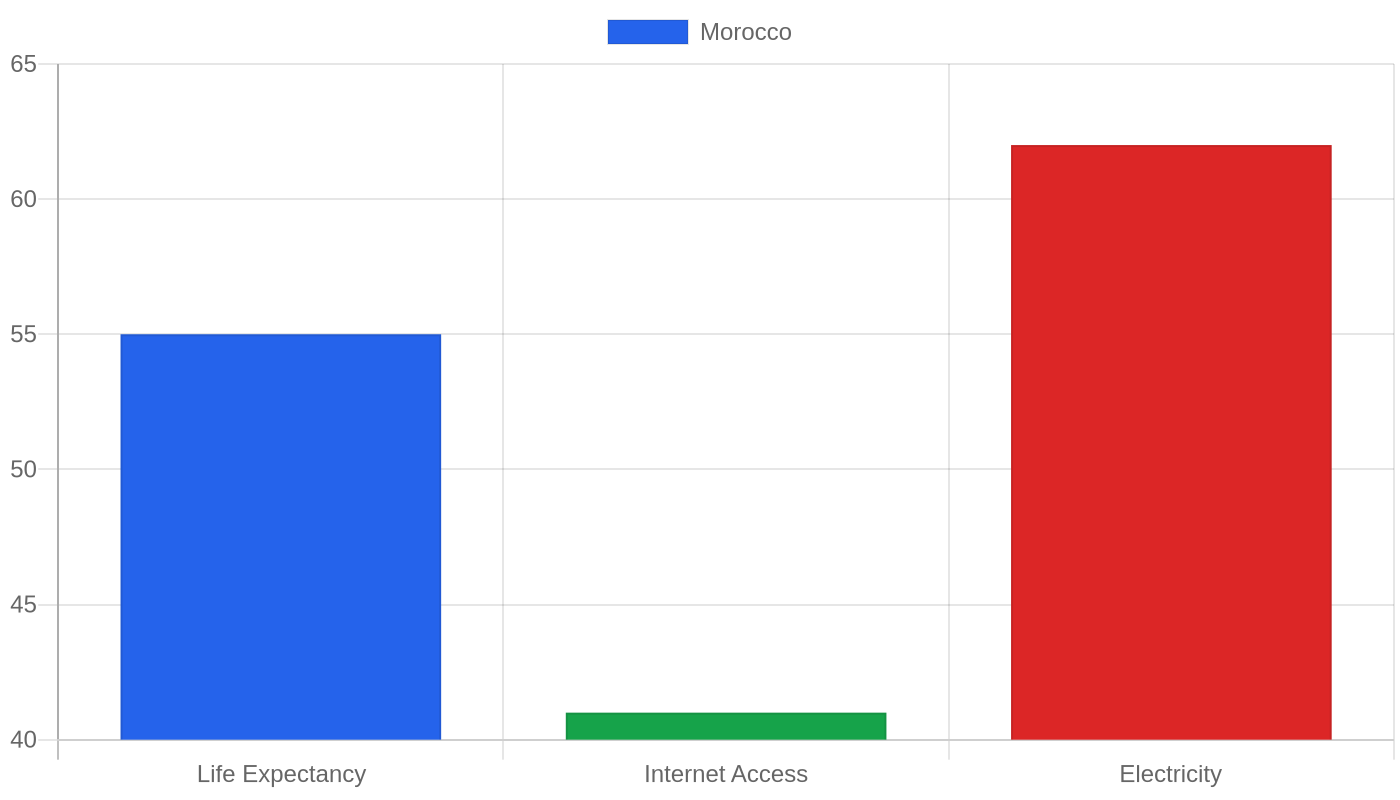
Yet the headline numbers tell a more complicated story. The World Bank’s latest data shows no confirmed figures for GDP growth, inflation, unemployment, or GDP per capita — a statistical silence that is itself revealing. When a major economy’s metrics go unpublished, it suggests either data collection challenges or a political climate where transparency is not always the default.
Morocco’s economic narrative, therefore, rests less on hard numbers and more on the qualitative reality of its institutions and business environment.
The structural challenge is clear: Morocco has built the scaffolding of a modern economy — banks, airlines, energy companies, media houses — but the political superstructure remains contested. The Economist Democracy Index’s classification of Morocco as a hybrid regime, with noted backsliding since 2011, raises uncomfortable questions about whether economic modernisation can be sustained without deeper political reform.
In practice, this means businesses operate in an environment where policy can shift with royal decree, where civil society space is constrained, and where the rule of law, while improving, is not always predictable.
The Cost of Living Question: A Tale of Two Moroccos
For the Moroccan middle class, the cost of living is a daily negotiation between aspiration and reality. The country’s major urban centres — Casablanca, Rabat, Marrakech — have seen property prices climb steadily, driven by foreign investment, a growing tourism sector, and a preference for real estate as a store of value.
Renting in desirable neighbourhoods of Casablanca can consume a significant share of household income, while buying remains out of reach for many younger Moroccans without family support or access to subsidised housing programmes.
The data provided does not include specific cost-of-living indices, but the broader picture is well understood: Morocco is cheaper than most European destinations but increasingly expensive by regional standards. Food prices, energy costs, and imported goods are sensitive to global commodity swings and the value of the dirham. For the substantial informal sector — which employs a large share of the working population — these pressures are amplified by the absence of social safety nets and formal wage structures.
The housing market, in particular, reflects the country’s inequalities. Luxury developments in Marrakech and along the Atlantic coast cater to international buyers and wealthy Moroccans, while affordable housing supply lags behind demand. The government has launched social housing initiatives over the years, but the gap between policy intent and on-the-ground delivery remains a persistent theme in everyday Moroccan economic life.
Business and Investment: Conglomerate Power and the Search for New Engines
Morocco’s investment climate is defined by the outsized role of its major corporate groups. Attijariwafa Bank is not just a bank; it is a financial ecosystem that touches everything from retail banking to corporate finance, insurance, and international operations across Africa. **Al Mada**, formerly known as SNI, is the investment vehicle of the royal family and holds stakes in mining, telecoms, real estate, and consumer goods.
**Akwa Group** dominates energy distribution through **Afriquia** and has expanded into media, real estate, and industry.
This concentration of economic power has advantages and drawbacks. On one hand, these conglomerates provide stability, capital, and expertise that smaller firms cannot access. They anchor the stock exchange, support employment, and give Morocco a corporate depth that many African economies lack.
On the other hand, the close relationship between business elites and the political establishment — including the monarchy — can crowd out independent entrepreneurship and deter foreign investors who prefer more transparent, competitive markets.
The sectors to watch are those where Morocco has genuine competitive advantages: renewable energy, where the country has made significant investments in solar and wind; automotive manufacturing, which has grown into a major export industry; and tourism, which remains a vital source of foreign currency.
The presence of consumer goods companies like Aïcha and **AB Sport** indicates a growing domestic market for branded products, while **Agma Lahlou-Tazi** in financial services points to a sophisticated insurance and advisory sector.
Safety, Politics, and the Quality of Life
Morocco is generally considered a safe country by regional standards. Crime rates in major cities are moderate, and violent crime against tourists is relatively rare, though petty theft and scams are common in busy tourist areas. The data provided does not include specific crime indices, but the qualitative picture is consistent: Morocco is safer than many of its neighbours, and the security apparatus is well-organised and visible.
The political landscape, however, is more complex. The Economist Democracy Index’s classification of Morocco as a hybrid regime — ranking third in the MENA region but 95th globally — captures the country’s paradoxical position. It is more open than most Arab states, with a parliament, political parties, and a reasonably free press.
Yet real power remains concentrated in the monarchy, and the democracy index’s finding of backsliding since 2011 suggests that the modest reforms following the Arab Spring have stalled or reversed.
For ordinary Moroccans, this political reality shapes quality of life in subtle but significant ways. Economic opportunity is often tied to political connections. Freedom of expression is constitutionally guaranteed but practically limited. And the gap between the country’s modern, cosmopolitan facade and its more conservative, hierarchical social structures creates a persistent tension.
The result is a society that is outwardly stable but inwardly questioning — a mood captured in the growing number of young Moroccans seeking opportunities abroad.
What’s Happening Now: Stagnation or Recalibration?
Morocco in 2026 finds itself at a moment of cautious recalibration. The democratic backsliding identified by The Economist Democracy Index has not triggered crisis, but it has created a climate of uncertainty among international partners and domestic reformers alike. The government continues to present itself as a reliable ally and investment destination, and the corporate sector remains active, with major conglomerates consolidating their positions and exploring new markets.
The absence of fresh World Bank economic data is itself a talking point. In a region where transparency is increasingly valued by investors, Morocco’s statistical silence raises questions about the reliability of official figures and the government’s willingness to submit to external scrutiny. At the same time, the country’s strategic advantages — proximity to Europe, political stability, a diversified economy, and a young population — remain intact.
The most pressing question is whether Morocco can reform its political system without destabilising the economic gains of the past two decades. The hybrid regime model has delivered growth and stability, but it has also concentrated power and wealth in ways that may not be sustainable.
As the region evolves, and as younger Moroccans demand more accountability, the country will need to find a new equilibrium — one that preserves its economic momentum while addressing the democratic deficit that The Economist Democracy Index has so clearly documented.
The Bottom Line
Morocco is a country that rewards patient observation. Its economic fundamentals are solid, its corporate sector is sophisticated, and its strategic position is enviable. But the political system’s hybrid character — and its noted democratic backsliding — creates risks that investors, analysts, and policymakers cannot ignore. This is a country to watch for those interested in the intersection of economic modernisation and political constraint.
Morocco is not a failing state, but it is a state in tension with itself — and that tension will define its trajectory for years to come.
Sources & Methodology
This article is authored by Economic Pulse Net for informational and research purposes. Economic Pulse Net sources its data from multilateral institutions, national statistics bureaus, and proprietary databases. All data is believed to be current as of the date of publication.
Published: August 07, 2026 | Category: Research — Morocco
Use these signals in your own platform
Economic Pulse publishes its live signal feed through a documented, read-only API. Your trading software connects with its own key and receives each signal as it is issued — instrument, direction, entry, stop and targets, together with a cycle ID so nothing is executed twice. The feed is independent of this website and cannot change it.
Signals are informational only and are not financial advice.