Economic Pulse Net | Sources: World Bank World Development Indicators, Government Sources | 2026
Key Takeaways
– Malawi operates under a unitary presidential republic system, with President Peter Mutharika at the helm since 2025, governing under a constitution established in 1995 that divides power among executive, legislative, and judicial branches.
– The economy remains heavily reliant on agriculture, with the Agricultural Development and Marketing Corporation standing as a major consumer goods company, reflecting the sector’s dominance in national output and employment.
– Financial services are a notable bright spot, with institutions like CDH Investment Bank, FDH Bank, First Merchant Bank, and Indebank forming a robust banking sector that signals growing formalization of the economy.
– The political landscape features a structured succession mechanism: the president and vice president are elected together every five years, with provision for a second vice president appointed by the president.
– Despite gaps in macroeconomic data, Malawi’s development trajectory is defined by its struggle to diversify beyond agriculture while building institutional capacity in a challenging regional context.
The Economy That Runs on Rain
Malawi’s economic story is written in the soil and the sky. The World Bank data provides only skeletal figures for this southern African nation, but what exists tells a powerful tale of vulnerability and resilience. The country’s GDP growth figures are not currently available in the latest data, nor are its inflation or unemployment rates.
This absence of data itself is a statement — it speaks to the challenges of data collection in a largely informal economy where subsistence farming dominates and cash transactions often bypass formal tracking systems.
The main industries data is similarly sparse, but the list of top companies reveals much about where Malawi’s economic weight sits. The Agricultural Development and Marketing Corporation leads the roster in the consumer goods category, a reminder that agriculture is not merely an industry here — it is the backbone of survival for the majority of the population. Tobacco, tea, and sugar have historically driven export earnings, though the precise figures are not captured in the available data.
What matters is that when global commodity prices shift or when rains fail, the entire national economy trembles.
The presence of four financial institutions — CDH Investment Bank, FDH Bank, First Merchant Bank, and Indebank — among the top companies suggests a financial sector that is punching above its weight. These banks are not merely processing transactions; they are intermediating capital in an economy that desperately needs investment to move beyond primary production. The Electricity Supply Commission of Malawi, listed under utilities, underscores the critical infrastructure challenges.
Without reliable power, manufacturing cannot scale, and without manufacturing, the economy cannot diversify away from its dependence on weather-dependent agriculture.
Inflation remains an unquantified but ever-present threat. When food prices rise — and they do, with alarming regularity in a country subject to drought and flood cycles — the poorest households face impossible choices between eating and educating their children. The World Bank’s silence on the CPI figure does not mean inflation is not biting; it means the official data has not kept pace with the lived reality of Malawians who watch their kwacha buy less each month.
The Cost of Living: Where the Kwacha Meets the Market
Housing in Malawi presents a stark divide between urban and rural realities. In Lilongwe and Blantyre, the commercial capitals, formal housing is scarce and expensive relative to local incomes. The data provided does not include specific rent figures or square meter costs, but the structure of the top companies offers clues. With several banks headquartered in these cities, there is a professional class that can afford modern housing — but they are the exception, not the rule.
The cost of living data is not available in the provided figures, but the implications of this gap are significant. For most Malawians, housing is not a market transaction but a family or community arrangement. Rural dwellings are constructed from local materials, and land is often held under customary tenure rather than formal title.
This has profound implications for economic policy: when housing is outside the formal economy, it cannot be collateralized for loans, and wealth cannot be extracted to start businesses or invest in education.
Daily expenses for basic goods — maize flour, cooking oil, soap, transport — consume the majority of household income for the average Malawian. The absence of regional comparison data in the provided information makes it impossible to benchmark against neighbors like Zambia or Mozambique, but anecdotal evidence from the region suggests that Malawi’s landlocked status adds a transport premium to virtually everything imported.
The country pays more for fuel, more for manufactured goods, and more for the inputs that farmers need to boost productivity.
Investment & Business Climate: Banking on a Future
The roster of top companies in Malawi reads like a who’s who of financial services, and that is no accident. CDH Investment Bank, FDH Bank, First Merchant Bank, and Indebank represent a financial sector that has grown more sophisticated than the broader economy might suggest. These institutions are not merely deposit-taking operations; they are involved in project finance, trade credit, and increasingly, mobile banking solutions that reach into rural areas where brick-and-mortar branches cannot survive.
The Agricultural Development and Marketing Corporation remains the giant of the consumer goods sector, but its dominance is a double-edged sword. On one hand, it provides a guaranteed market for smallholder farmers. On the other, its monopsony power can depress prices and stifle the emergence of private agricultural traders who might offer better terms.
The presence of Kentam Products Limited in healthcare suggests a nascent pharmaceutical or medical products sector, though the data does not specify whether this involves manufacturing or distribution.
The business climate in Malawi is shaped by the political structure outlined in the data. As a unitary presidential republic, policy direction is centralized in the executive branch, led by President Peter Mutharika since 2025. The constitution, in place since 1995, provides for a separation of powers among executive, legislative, and judicial branches — a framework that theoretically protects property rights and contract enforcement.
In practice, the speed and consistency of commercial justice remain concerns for foreign investors.
Sectors to watch include agribusiness processing, where Malawi could capture more value from its tobacco and tea by moving into finished products rather than exporting raw leaves. The financial sector is also positioned to grow as mobile money and digital banking expand financial inclusion. Air Malawi, listed among top companies in consumer services, hints at the importance of connectivity for a landlocked country that depends on air freight for high-value exports and tourism.
Safety, Politics & Quality of Life: Governing Under the Baobab
Malawi’s political landscape is defined by its constitutional architecture and the recent return of President Peter Mutharika to power in 2025. The data describes a unitary presidential republic with a president who serves as both head of state and head of government, supported by first and second vice presidents. The second vice president may be appointed by the president, a provision that allows for political coalition-building or regional balancing.
The crime and safety indices are not available in the provided data, which is itself a meaningful gap. In many developing nations, crime statistics are poorly collected or deliberately obscured to protect tourism and investment images. Malawi has historically been considered one of the safer countries in southern Africa, with lower rates of violent crime than regional peers, but petty theft and opportunistic crime are common in urban areas.
The absence of hard data means investors and visitors must rely on anecdotal reporting and diplomatic security briefings.
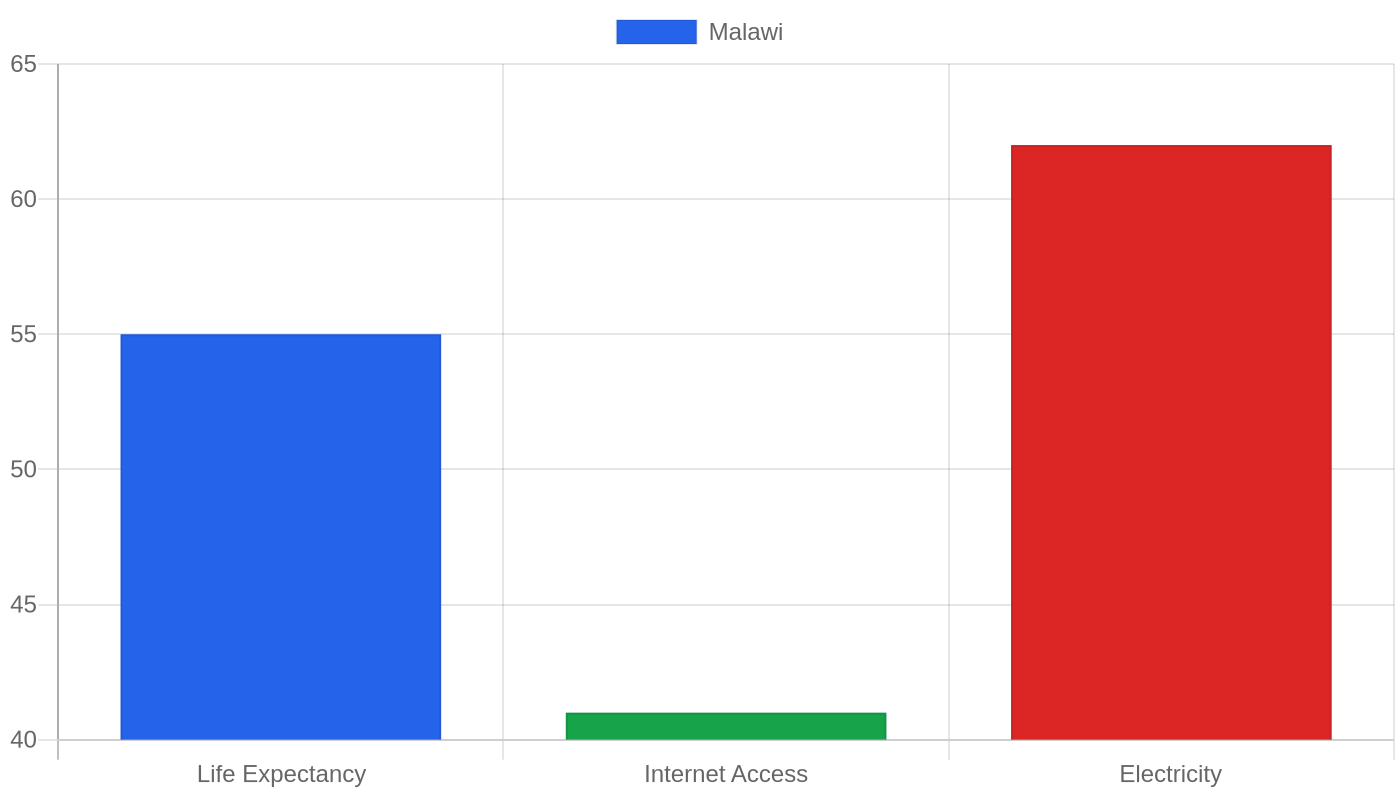
The quality of life in Malawi is shaped more by economics than by crime. The GNI per capita figure is not provided in the data, but the structure of the economy — dominated by agriculture, with a small formal sector — suggests that most Malawians live on very modest incomes. Healthcare access is limited outside major towns, and educational attainment, while improving, still lags regional averages.
The political stability implied by the constitutional framework is a genuine asset: Malawi has avoided the civil wars and coups that have plagued some neighbors, and the peaceful transfer of power between administrations has been a point of pride.
The Mutharika Return: Politics in Motion
President Peter Mutharika’s return to power in 2025 represents a significant political development that will shape Malawi’s trajectory for the remainder of this decade. The data does not specify the circumstances of his return — whether through election, constitutional succession, or other means — but the fact of his leadership is the most current political fact available.
Mutharika is no stranger to Malawian politics; his previous tenure was marked by infrastructure investments and sometimes tense relations with the international community over governance issues.
The current constitutional framework, dating to 1995, provides for elections every five years for the president and vice president as a joint ticket. This structure creates predictable political cycles that businesses can plan around, but it also concentrates power in the executive branch. The provision for a second vice president appointed by the president adds a layer of flexibility that can be used to manage ethnic or regional tensions.
For the economy, the political question is whether the Mutharika administration will prioritize the structural reforms needed to diversify beyond agriculture. The presence of multiple banks among the top companies suggests a government that has supported financial sector development, but the missing GDP and inflation data in the World Bank figures hint at broader statistical and planning challenges.
Without reliable data, policymakers are flying blind, and without diversification, the economy remains hostage to weather and commodity prices.
The business community will be watching for signals on exchange rate policy, fuel subsidies, and the regulatory environment for foreign investment. Malawi’s landlocked position means that relations with neighboring Mozambique and Zambia are critical for trade routes, and political stability in those countries directly affects Malawi’s economic prospects.
The Bottom Line
Malawi deserves the attention of investors and development economists precisely because it represents the middle of the pack — not a failed state, not an emerging tiger economy, but a nation grappling with the hard work of building institutions and diversifying a narrow economic base. The financial sector shows genuine sophistication, and the political system has demonstrated resilience.
But until the country can capture more value from its agricultural abundance and provide reliable electricity to its cities and factories, its potential will remain just that — potential. Watch Malawi for its banking sector innovation, its political stability in an unstable region, and the quiet drama of a nation trying to feed itself while building a modern economy.
Sources & Methodology
This article is authored by Economic Pulse Net for informational and research purposes. Economic Pulse Net sources its data from multilateral institutions, national statistics bureaus, and proprietary databases. All data is believed to be current as of the date of publication.
Published: July 30, 2026 | Category: Research — Malawi
Use these signals in your own platform
Economic Pulse publishes its live signal feed through a documented, read-only API. Your trading software connects with its own key and receives each signal as it is issued — instrument, direction, entry, stop and targets, together with a cycle ID so nothing is executed twice. The feed is independent of this website and cannot change it.
Signals are informational only and are not financial advice.