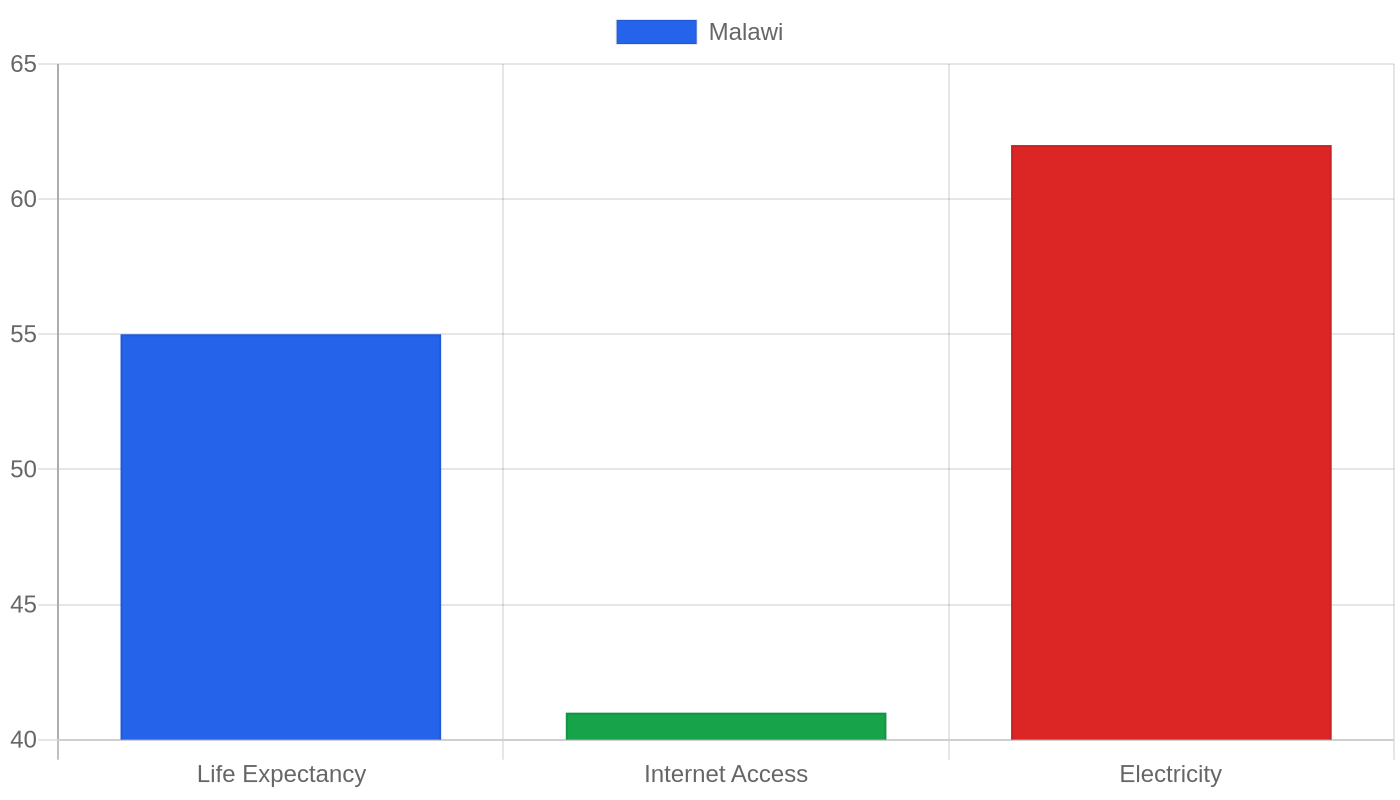
Economic Pulse Net | Sources: World Bank World Development Indicators, Government Sources | 2026
Key Takeaways
* Malawi operates as a unitary presidential republic under President Peter Mutharika, who has led the nation since 2025, ensuring a clear executive structure.
The economy is anchored by key domestic entities such as the Agricultural Development and Marketing Corporation and a robust financial sector featuring multiple banks.
Essential services are dominated by state-linked or major private players, including Air Malawi for transport and the Electricity Supply Commission for utilities.
Detailed macroeconomic indicators such as GDP growth, inflation rates, and unemployment figures are currently unreported, creating a data vacuum for international investors.
Political stability is codified in the 1995 constitution, which establishes a five-year electoral cycle for the presidency and vice-presidencies.
The Architecture of Power and Policy
Malawi’s political framework provides a distinct backdrop against which its economic activities unfold. As a unitary presidential republic, the country maintains a centralized government structure that concentrates significant authority within the executive branch. Since 2025, President Peter Mutharika has served as both head of state and head of government, operating alongside first and second vice presidents and the Cabinet of Malawi.
This leadership model is defined by the current constitution, which was established on 18 May 1995, providing a legal foundation for the separation of powers among the executive, legislative, and judicial branches. The electoral system mandates that the president and vice president are elected together every five years, a mechanism designed to ensure democratic accountability and continuity in governance.
While the specific mechanisms for appointing a second vice president remain partially described in the foundational texts, the overall structure suggests a deliberate effort to balance regional representation with national unity. This political setup creates a predictable, albeit rigid, environment for policy implementation, where executive decisions can be enacted swiftly through the cabinet apparatus.
However, the absence of recent, detailed economic metrics from the World Bank means that the tangible impact of these political structures on daily economic life remains difficult to quantify precisely. The interplay between this stable political timeline and the unknowns of current economic performance defines the current national narrative.
The Engine of Growth: Industries and Corporate Landscape
The Malawian economy is driven by a mix of agricultural processing, financial services, and essential utility provision, with several key companies dominating their respective sectors. At the forefront is the Agricultural Development and Marketing Corporation, a critical player in consumer goods that likely serves as a backbone for the nation’s agrarian output. In the service sector, Air Malawi facilitates connectivity, while Capital Radio Malawi influences public discourse and advertising reach.
The financial landscape is particularly vibrant, populated by institutions such as CDH Investment Bank, FDH Bank, First Merchant Bank, and Indebank, which collectively handle investment banking, commercial lending, and financial intermediation. Insurance needs are met by Britam, ensuring risk management capabilities for businesses and individuals alike. On the healthcare front, Kentam Products Limited stands out as a major entity in health care, reflecting the importance of medical services in the industrial mix.
Furthermore, the Electricity Supply Commission of Malawi controls the utilities sector, highlighting the state’s or quasi-state role in infrastructure delivery. These companies represent the visible tip of the economic iceberg, suggesting a diversified but perhaps constrained market where large, established firms hold significant sway over resource allocation.
Without specific GDP or per capita income data from the World Bank, it is challenging to gauge the exact scale of their contributions, yet their prominence indicates a mature, if modest, corporate ecosystem.
Navigating Daily Life and Living Standards
For residents and expatriates alike, understanding the cost of living in Malawi requires looking beyond headline inflation numbers, which are currently listed as unavailable. The presence of established players like Britam for insurance and various merchant banks suggests a formalized economy where standard financial products are accessible, implying a baseline level of monetary engagement.
Housing costs and rent versus buy dynamics are inferred to be shaped by the availability of credit through institutions like CDH Investment Bank and FDH Bank, which would facilitate long-term property financing. Daily expenses are likely influenced by the operational efficiency of the Electricity Supply Commission, as energy reliability directly impacts household and business overheads.
While precise regional comparisons are impossible due to the lack of CPI data, the dominance of local entities like the Agricultural Development and Marketing Corporation hints at an economy that may still rely heavily on domestic production rather than imported goods, potentially insulating some basic food prices from global volatility.
However, the absence of safety indices and crime statistics adds an element of uncertainty to quality-of-life assessments, making personal experience crucial for those considering relocation. The general impression is one of a functional but opaque market where official data trails behind ground-level realities.
Business Climate and Investment Opportunities
Investors eyeing Malawi must navigate a landscape defined by strong institutional presences rather than rapid statistical expansion. The financial sector appears to be the most developed area for business activity, with four distinct banking entities—CDH Investment Bank, FDH Bank, First Merchant Bank, and Indebank—competing for market share. This competition could foster better service offerings and potentially lower barriers to entry for small and medium enterprises seeking capital.
The agricultural sector, represented by the Agricultural Development and Marketing Corporation, offers opportunities for those involved in supply chain logistics and commodity trading. Meanwhile, the utilities sector, managed by the Electricity Supply Commission, presents challenges and opportunities for infrastructure development and energy efficiency projects. Healthcare, via Kentam Products Limited, indicates a growing demand for medical services and pharmaceutical distribution.
For foreign direct investment, the clarity of the political system under President Mutharika provides a stable regulatory horizon, even if the economic returns are currently obscured by missing World Bank data. Businesses should focus on sectors with clear corporate leaders and essential service demands, where operational risks are mitigated by established market players.
Safety, Politics, and Quality of Life
The social fabric of Malawi is woven through its political stability and the structural guarantees provided by its constitution. With a crime index and safety index currently marked as unavailable, prospective residents and investors must rely on anecdotal evidence and general regional trends to assess personal security.
The political landscape, however, is well-documented; the unitary presidential system ensures that governance is not fragmented, reducing the risk of internal political fragmentation that often plagues other nations in the region. President Peter Mutharika’s leadership since 2025, operating within the framework of the 1995 constitution, suggests a period of consolidated power that may prioritize order and continuity.
The five-year election cycle offers regular checkpoints for public sentiment, allowing for peaceful transitions of power if the democratic processes hold firm. Happiness data is similarly absent, leaving the subjective quality of life to be inferred from the stability of basic services like electricity and the availability of financial and healthcare services.
Ultimately, the combination of a clear political hierarchy and essential service providers creates a baseline of predictability, even in the face of missing safety metrics.
Current Affairs and Policy Direction
The current affairs in Malawi are dominated by the ongoing administration of President Peter Mutharika, who assumed office in 2025, setting the tone for national priorities. The government continues to operate under the constitutional provisions established in 1995, focusing on maintaining the integrity of the executive, legislative, and judicial branches.
Recent developments center on the consolidation of this political structure, with the appointment mechanisms for vice-presidential roles remaining a key area of administrative focus. While specific economic reforms are not detailed in the available data, the continued operation of major state-linked entities like the Electricity Supply Commission suggests a focus on maintaining essential infrastructure.
The business community is likely adapting to the policies set forth by the current cabinet, with financial institutions playing a crucial role in supporting any new economic initiatives. The lack of recent inflation or GDP data implies that immediate policy shifts may be reactive rather than proactive, aimed at stabilizing existing conditions rather than pursuing aggressive growth targets.
This period appears to be one of consolidation, where the government seeks to solidify its mandate before addressing deeper structural economic changes.
The Bottom Line
Malawi presents a case study in political stability amidst economic opacity. Investors and observers should watch this country for its predictable governance structure and the resilience of its core corporate institutions. The clear lines of political authority under President Mutharika offer a safe harbor for long-term strategic planning, even if short-term economic metrics are hidden.
Those interested in emerging markets with low political risk but high information asymmetry will find Malawi a compelling, if cautious, prospect.
Sources & Methodology
This article is authored by Economic Pulse Net for informational and research purposes. Economic Pulse Net sources its data from multilateral institutions, national statistics bureaus, and proprietary databases. All data is believed to be current as of the date of publication.
Published: October 11, 2026 | Category: Research — Malawi
Use these signals in your own platform
Economic Pulse publishes its live signal feed through a documented, read-only API. Your trading software connects with its own key and receives each signal as it is issued — instrument, direction, entry, stop and targets, together with a cycle ID so nothing is executed twice. The feed is independent of this website and cannot change it.
Signals are informational only and are not financial advice.