Economic Pulse Net | Sources: World Bank World Development Indicators, Government Sources | 2026
Key Takeaways
– Libya remains in a precarious political equilibrium, with the country still divided between rival administrations in the east and west following the Second Libyan Civil War that erupted in 2014.
– The nation’s economic identity is overwhelmingly defined by hydrocarbons, with major state-linked players like Arabian Gulf Oil Company and Brega Marketing Company dominating the corporate landscape.
– The airline and consumer services sector shows surprising resilience, with multiple carriers including Afriqiyah Airways and Buraq Air operating despite years of instability.
– Financial infrastructure persists through institutions like the Agricultural Bank of Libya and regional investment banks, suggesting attempts to maintain economic functionality amid political fragmentation.
– The country’s trajectory hinges on whether the post-2011 political settlement can stabilise enough to allow the oil-dependent economy to diversify and rebuild.
The Paradox of Plenty: An Economy Held Hostage by Politics
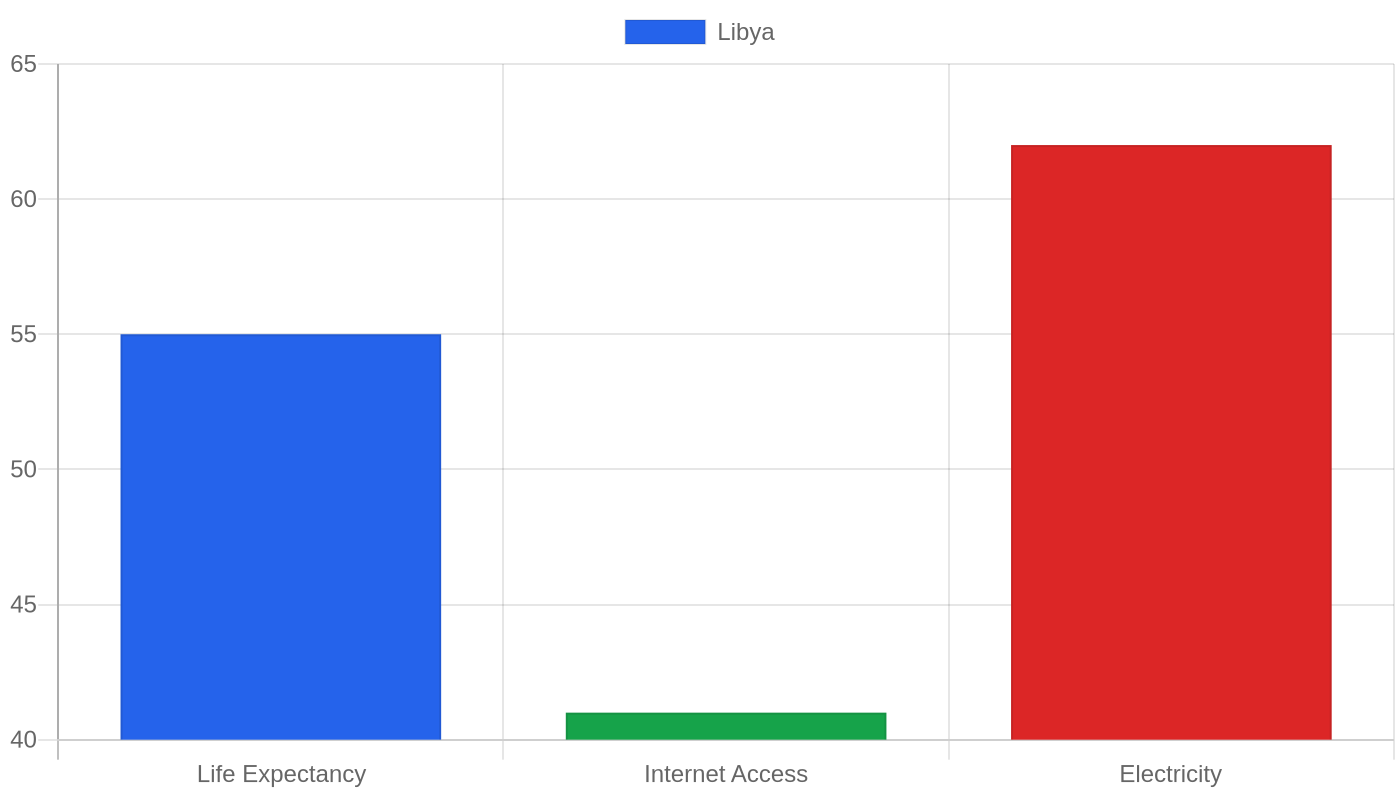
Libya’s economic story is one of immense potential perpetually deferred. The World Bank’s latest data presents a near-total vacuum — GDP growth, inflation, unemployment, and per-capita income figures are all unavailable, a statistical silence that speaks volumes about the institutional breakdown that has gripped the country since 2011.
This absence of reliable macroeconomic data is not merely an administrative gap; it is a symptom of a state that has struggled to maintain the basic apparatus of economic governance through more than a decade of conflict.
The Arab Spring and the subsequent NATO-backed intervention that toppled Muammar Gaddafi did not simply remove a dictator — they dismantled the entire economic architecture that had managed the country’s vast oil wealth. The First Libyan Civil War gave way to factional violence, which in turn escalated into the Second Libyan Civil War in 2014. Each phase of conflict has further degraded the institutions needed to collect data, implement policy, and provide basic services.
For economists and investors alike, the lack of hard numbers is itself the most telling statistic available.
What remains clear is that Libya’s economy, such as it functions, is built on hydrocarbons. The presence of Arabian Gulf Oil Company and Brega Marketing Company among the nation’s top firms underscores the continued dominance of the oil and gas sector. Yet without reliable GDP figures from the World Bank, analysts must rely on production snapshots and anecdotal evidence to gauge economic activity.
The reality is that Libya’s economy is not currently measurable by conventional metrics because it is not currently functioning as a conventional economy. It is a rentier state in suspension, waiting for a political settlement that would allow its primary asset — oil — to flow freely and fund reconstruction.
The Price of Daily Life in a Fractured State
Cost of living data for Libya is conspicuously absent, and that absence is deeply meaningful. In a country where state subsidies for fuel, food, and utilities were once the cornerstone of the social contract, the collapse of central authority has created a patchwork of pricing regimes controlled by local militias, smugglers, and regional authorities.
The World Bank provides no inflation figures, but the lived experience of Libyans is one of scarcity and price volatility, particularly in imported goods that require functioning ports and foreign currency reserves.
Housing presents a particularly acute challenge. The pre-2011 state had invested heavily in public housing, but years of conflict have destroyed significant portions of the housing stock in major cities like Benghazi and Misrata. Reconstruction has been slow and uneven, hampered by security concerns and the absence of a unified national budget. For ordinary Libyans, the choice between renting and buying is often moot — the issue is finding any habitable accommodation at all.
The regional context suggests that North African housing markets typically see rental yields of 5-7 percent, but in Libya, the market operates outside such norms, driven instead by displacement patterns and security considerations.
The cost of basic goods has been further distorted by the parallel currency markets that emerged during the civil war, with the official exchange rate diverging wildly from the black-market rate. This has created a two-tier pricing system where those with access to state salaries at official rates are effectively subsidised, while those dependent on the private sector face far higher real costs.
Until a unified monetary policy can be restored, the cost of living in Libya will remain unpredictable and unevenly distributed.
Business Under Fire: Enterprise in a Security Vacuum
The corporate landscape of Libya is a study in survival against the odds. The list of top companies reveals a curious mix of pre-revolutionary institutions and newer ventures attempting to carve out space in a difficult environment. The aviation sector is particularly notable, with Afriqiyah Airways, Buraq Air, Air Libya, Air One Nine, and Alajnihah Airways all appearing among the nation’s leading firms.
This cluster suggests that despite the no-fly zones and airport closures that have punctuated the conflict, there remains demand for air travel — both for the diaspora and for domestic connectivity between the fractured regions.
The financial sector shows similar persistence. The Agricultural Bank of Libya continues to operate, as does Banque Sahélo-Saharienne pour l’Investissement et le Commerce, a regional institution that reflects Libya’s historical economic ties to the Sahel and West Africa. These banks face extraordinary challenges, from liquidity shortages to the difficulty of enforcing contracts in a weak legal environment.
Yet their continued presence suggests that some semblance of commercial activity persists, and that there is a foundation upon which a future recovery could be built.
Arabian Cement Company represents the industrial sector, and its survival is significant. Cement is a bellwether industry — it is needed for reconstruction, and its continued operation suggests that some construction activity is taking place, likely driven by private rebuilding efforts in areas secured by various factions. For investors willing to accept significant risk, these companies represent potential entry points into a market that could experience explosive growth if political stabilisation ever arrives.
The business climate, however, remains characterised by extreme uncertainty, with no clear regulatory framework, persistent security threats, and the ever-present risk of asset freezes or nationalisation depending on which faction holds power at any given moment.
The Security Paradox: Danger and Daily Life
Libya’s political landscape is defined by the legacy of two civil wars and the ongoing struggle for control. The World Bank provides no crime or safety indices, but the broader picture is one of a country where the state’s monopoly on violence has fragmented. The 2011 intervention that ended the Libyan Arab Jamahiriya and resulted in Gaddafi’s death did not usher in the democratic transition that many had hoped for.
Instead, it unleashed competing militias, regional powers, and ideological factions that have turned the country into a patchwork of armed fiefdoms.
The Second Libyan Civil War, which began in 2014, entrenched this fragmentation, with rival governments claiming legitimacy in Tripoli and Tobruk. For ordinary citizens, this has meant a daily reality of checkpoints, power cuts, and the constant threat of renewed conflict. The safety index, were one to exist, would likely reflect a country where personal security depends less on state protection and more on tribal affiliations, geographic location, and the goodwill of local armed groups.
Yet there are signs of grudging normalcy. The continued operation of airlines and banks suggests that in certain areas, particularly those under stable control, daily life has achieved a fragile equilibrium. The quality of life in Libya is thus profoundly uneven — for those with connections and resources, the country offers opportunities; for those without, it offers danger and deprivation.
The political future remains uncertain, with no clear path toward the kind of unified governance that would allow for the reconstruction of state institutions and the restoration of public services.
A Nation at the Precipice: What Happens Next
The current moment in Libya is defined by a tense and unstable peace. The headlines from the country speak of a political landscape still shaped by the aftershocks of the Arab Spring and the foreign military intervention of 2011. The collapse of the Libyan Arab Jamahiriya and the killing of Muammar Gaddafi created a vacuum that has yet to be filled by any legitimate, unified authority.
The factional violence that followed the First Civil War and escalated into the Second has left the country with parallel governments, competing central banks, and no clear mechanism for national reconciliation.
The World Bank’s absence of current economic data is itself a news story — it indicates that international institutions are unable to conduct normal monitoring activities, and that the Libyan state cannot provide the basic statistical infrastructure required for modern economic management. This is not a country in crisis in the sense of a sudden shock; it is a country in a prolonged state of suspension, unable to move forward but no longer experiencing the worst of the active conflict.
What happens next depends on whether the current ceasefire can be converted into a lasting political settlement. The oil sector remains the key — whoever controls hydrocarbon revenues controls the future of the state. The presence of major oil companies among Libya’s top firms is a reminder that the country’s wealth remains its most valuable asset, and also its most contested.
For the international community, Libya represents both a cautionary tale about intervention and a potential partner in stabilising energy markets. For Libyans, the hope is that the current fragile peace can hold long enough to allow for elections, constitutional reform, and the rebuilding of state institutions.
The Bottom Line
Libya is a country that cannot be understood through conventional economic metrics, because it has not yet reconstituted the basic institutions that produce such metrics. For investors, the risk is currently prohibitive, but the potential rewards are enormous — a stable Libya would be one of the most attractive reconstruction stories in the region. For policymakers, the country is a test case for post-conflict stabilisation.
For the Libyan people, it is a daily struggle to survive while hoping that the political class can finally deliver the peace that has remained elusive since 2011. The world should watch Libya not for what it is today, but for what it could become if the current window of opportunity is seized rather than squandered.
Sources & Methodology
This article is authored by Economic Pulse Net for informational and research purposes. Economic Pulse Net sources its data from multilateral institutions, national statistics bureaus, and proprietary databases. All data is believed to be current as of the date of publication.
Published: August 04, 2026 | Category: Research — Libya
Use these signals in your own platform
Economic Pulse publishes its live signal feed through a documented, read-only API. Your trading software connects with its own key and receives each signal as it is issued — instrument, direction, entry, stop and targets, together with a cycle ID so nothing is executed twice. The feed is independent of this website and cannot change it.
Signals are informational only and are not financial advice.