Economic Pulse Net | Sources: World Bank World Development Indicators, Government Sources | 2026
Key Takeaways
– Libya remains a nation split by political and military divisions, with no unified government capable of implementing coherent economic policy since the 2011 collapse of the Gaddafi regime.
– The country’s economy is overwhelmingly dependent on oil and gas, with state-owned and affiliated energy companies dominating the list of major enterprises.
– Despite possessing Africa’s largest proven oil reserves, Libya’s GDP, inflation, and unemployment data remain officially unrecorded by the World Bank, reflecting the deep dysfunction of state institutions.
– The political landscape is defined by a protracted civil war and factional violence that has prevented the emergence of stable governance or reliable economic planning.
– For investors and analysts, Libya represents a high-risk, high-potential enigma — vast resource wealth trapped inside a broken state apparatus.
The Phantom Economy — Oil Wealth Without a Ledger
To understand Libya’s economic condition is to confront a paradox. The World Bank, the global arbiter of economic measurement, reports no data for Libya’s GDP growth, inflation, unemployment, GDP per capita, or GNI per capita. This is not an oversight. It is a statement. When a country’s statistical systems collapse alongside its government, the numbers simply stop coming.
What can be said with certainty is that Libya’s economy is a single-industry machine. The country’s top companies tell the story plainly: Arabian Gulf Oil Company, Brega Marketing Company — both oil and gas giants — sit alongside a handful of airlines and financial institutions. The dominance of Afriqiyah Airways, Air Libya, and Buraq Air in the corporate landscape hints at a service sector that has tried to maintain connectivity despite the chaos. But the engine remains hydrocarbons.
The Agricultural Bank of Libya and Banque Sahélo-Saharienne pour l’Investissement et le Commerce represent a financial sector that operates under extraordinary strain. Banking in a country without central authority means navigating sanctions, liquidity crises, and competing political claims over reserves. The presence of Arabian Cement Co. among the top firms suggests some industrial activity persists, but construction and manufacturing are entirely hostage to the security situation.
Without official GDP figures, economists must rely on proxy indicators. Oil production levels, port activity, and central bank reserve data — often reported by competing factions — provide fragmentary glimpses. The reality is that Libya’s economy functions as a patchwork of regional and militia-controlled zones, each with its own informal rules of commerce. The World Bank’s silence is the most honest data point available.
Housing and Daily Life — Survival in a Divided Country
Cost of living data for Libya is as absent as its GDP figures, and for the same reasons. When the World Bank cannot measure inflation, it means price signals are distorted, markets are fragmented, and the state has lost the capacity to track basic economic activity. In practical terms, Libyans face an economy where the cost of staple goods varies dramatically between Tripoli, Benghazi, and the contested southern regions.
Housing is particularly volatile. In areas under stable militia control, rent prices can spike or collapse overnight depending on security conditions. The concept of a national housing market is meaningless when large swaths of cities remain damaged from civil war and entire neighborhoods are controlled by armed groups. For the majority of Libyans, homeownership is less a financial decision than a matter of family inheritance and territorial survival.
Daily expenses for food, fuel, and medicine are heavily subsidized by oil revenues — when the state can distribute them. But subsidies create their own distortions. Black markets flourish where official supply chains break down, and the gap between the subsidized price and the market price fuels corruption. For ordinary Libyans, the cost of living is not measured in CPI baskets but in the daily negotiation of checkpoints, shortages, and the erratic availability of cash.
Investment and Business — The High-Stakes Gamble
For the investor willing to accept extraordinary risk, Libya offers access to one of the world’s great untapped resource economies. The list of major companies reads like a directory of state-linked enterprises. Arabian Gulf Oil Company, Brega Marketing Company, and the various airlines are all either state-owned or closely tied to political factions. There is no meaningful private sector to speak of — business in Libya is politics by other means.
The financial sector is dominated by institutions like the Agricultural Bank of Libya and Banque Sahélo-Saharienne pour l’Investissement et le Commerce. These banks operate in an environment where international sanctions, competing central bank authorities, and the threat of asset seizures make normal banking impossible. Foreign investors face a maze of competing claims over contracts, licenses, and property rights.
The sectors to watch are those that serve the oil industry — logistics, security, maintenance, and transport. Any serious business in Libya must first solve the security equation. Companies like Afriqiyah Airways and Buraq Air survive because they provide essential connectivity for a population that cannot rely on roads. The airlines are not just transport providers; they are lifelines in a country where internal movement can be deadly.
Safety, Politics and Quality of Life — A Nation Under Siege by Itself
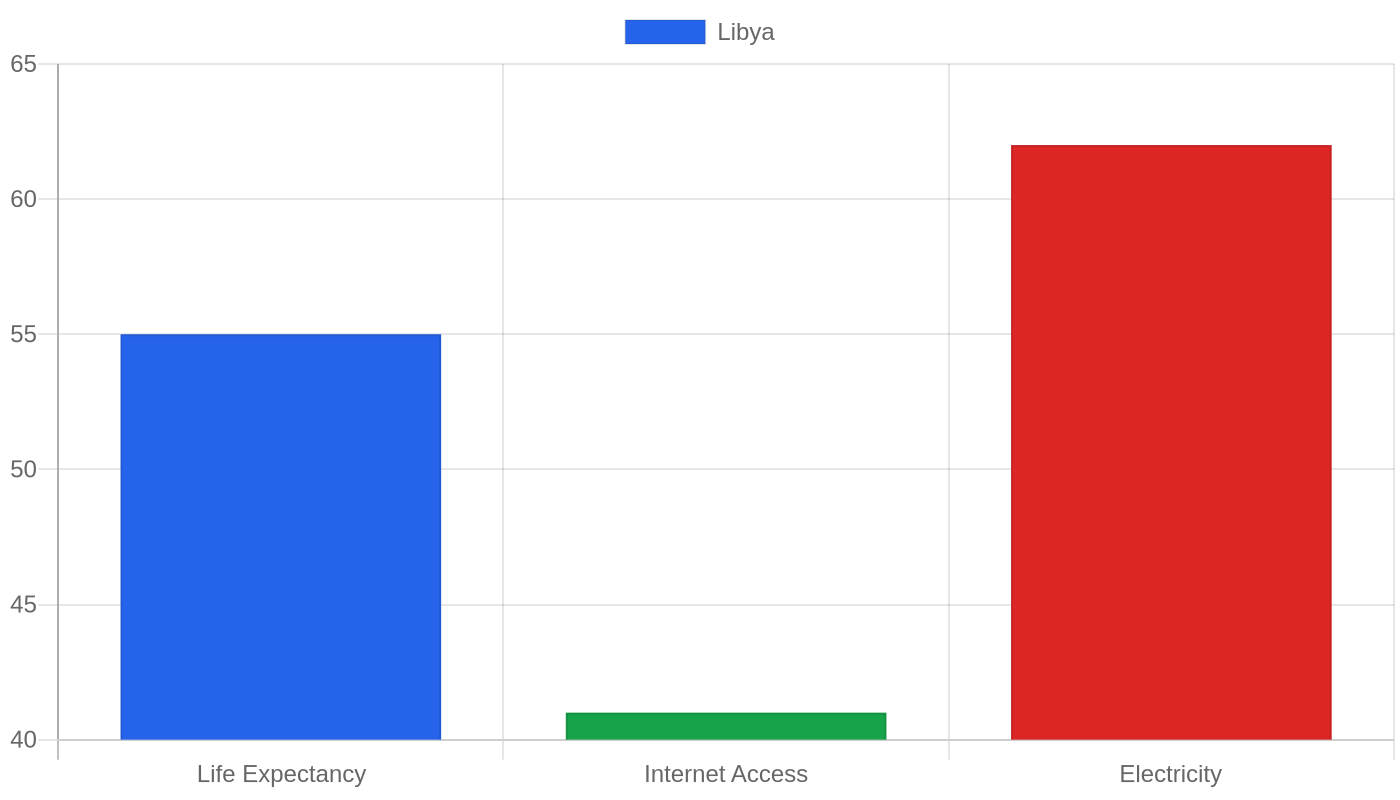
The Crime Index and Safety Index for Libya are marked as unavailable, which is itself a form of data. When international indices cannot measure crime, it means the distinction between criminal violence and political violence has collapsed. Libya is not a country with a crime problem; it is a country where the state has lost its monopoly on force.
The political landscape is the defining feature of Libyan life. Since the Arab Spring and the NATO intervention that toppled Muammar Gaddafi in 2011, Libya has been in a state of continuous crisis. The First Libyan Civil War gave way to factional violence, which escalated into the Second Libyan Civil War in 2014. The country remains divided between rival governments, parliaments, and military commands, each backed by different militias and international patrons.
For the average Libyan, quality of life is determined by which faction controls their neighborhood. Access to electricity, water, healthcare, and education varies wildly. The collapse of state institutions means that basic services are provided, when they are provided at all, by local authorities, tribal networks, or armed groups. Happiness data is unavailable, but the lived experience of Libyans is one of permanent uncertainty.
The Current Moment — Stasis as a Political Strategy
As of 2026, Libya remains locked in a political stalemate that has become its own form of stability. No major offensive has shifted the front lines, but no political settlement has unified the country either. The rival governments in Tripoli and the east continue to claim legitimacy, while the United Nations and various international mediators cycle through peace plans that gain traction only to collapse.
The oil sector continues to function, but barely. Production is periodically disrupted by blockades, political disputes over revenue distribution, and the simple decay of infrastructure. The central bank remains split, with competing boards claiming authority over the country’s reserves. Inflation goes unmeasured, but the black market exchange rate tells a story of a currency under constant pressure.
What is happening now is not a crisis in the dramatic sense — it is a slow, grinding erosion of whatever remained of the Libyan state after 2011. The political landscape described in the available data — the collapse of the Libyan Arab Jamahiriya, the killing of Gaddafi, the factional violence, the Second Civil War — is not history. It is the ongoing present. The country has not emerged from crisis; it has learned to live inside it.
The Bottom Line
Libya is a country for those who can afford to wait. The resource wealth is real, the strategic position on the Mediterranean is valuable, and the potential for reconstruction is enormous. But none of that matters until a unified political authority emerges that can guarantee contracts, secure borders, and restore basic state functions. For now, Libya is a cautionary tale about what happens when a rentier state collapses without a diversified economy to fall back on.
Watch this country for the day the politics shift — but do not hold your breath.
Sources & Methodology
This article is authored by Economic Pulse Net for informational and research purposes. Economic Pulse Net sources its data from multilateral institutions, national statistics bureaus, and proprietary databases. All data is believed to be current as of the date of publication.
Published: July 16, 2026 | Category: Research — Libya
Use these signals in your own platform
Economic Pulse publishes its live signal feed through a documented, read-only API. Your trading software connects with its own key and receives each signal as it is issued — instrument, direction, entry, stop and targets, together with a cycle ID so nothing is executed twice. The feed is independent of this website and cannot change it.
Signals are informational only and are not financial advice.