Economic Pulse Net | Sources: World Bank World Development Indicators, Government Sources | 2026
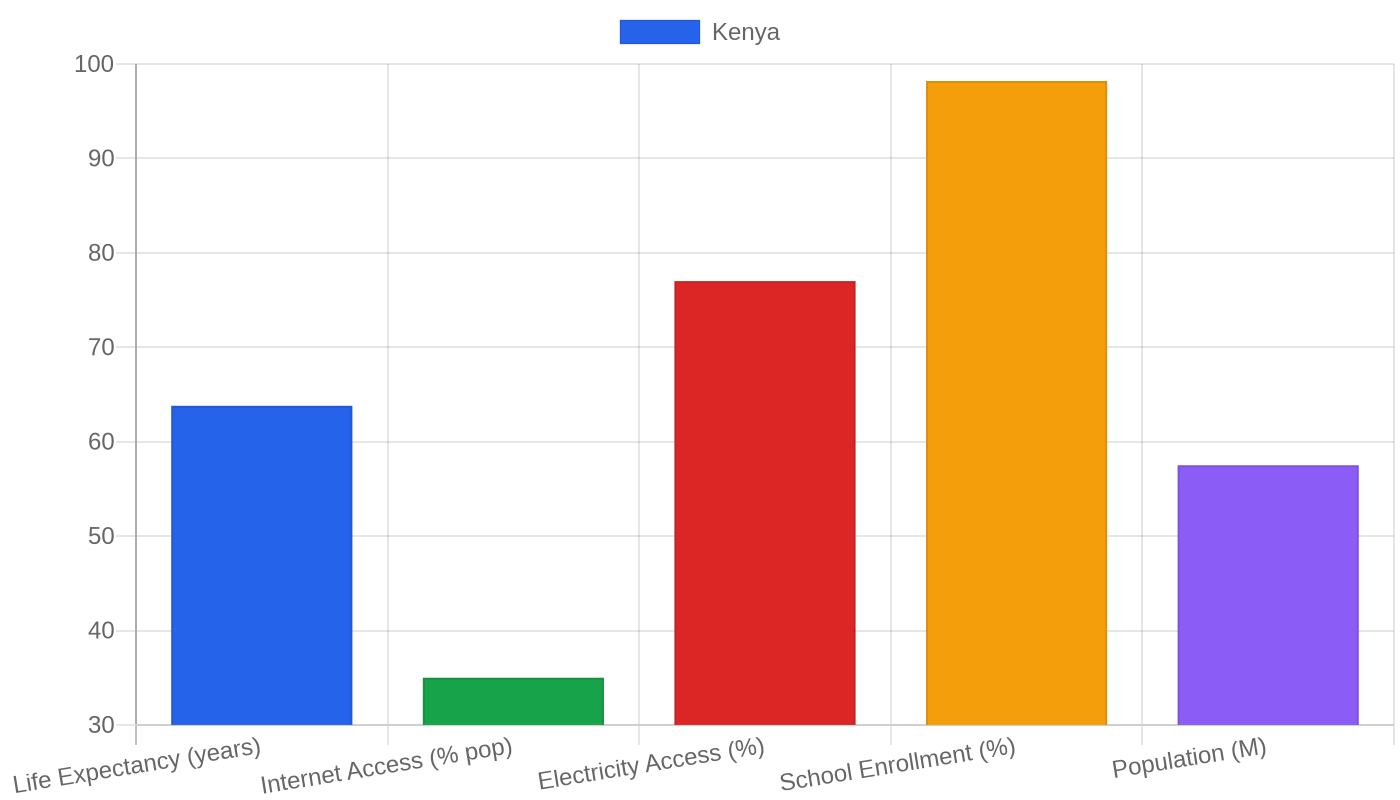
Kenya has long been East Africa’s most dynamic economy, a regional hub for finance, aviation, and media. But beneath the surface of Nairobi’s gleaming skyscrapers and the nation’s famed entrepreneurial spirit, a complex story is unfolding. With inflation cooling to a manageable 4.07% and unemployment hovering just above 5%, the macroeconomic picture appears stable.
Yet the political landscape, scarred by decades of executive overreach and a judiciary fighting to maintain independence, raises questions about whether Kenya can sustain its growth trajectory. Add in a population of over 57 million, a young and restless workforce, and a corporate sector dominated by financial services and industrial giants, and you have a country that is simultaneously full of promise and peril.
Key Takeaways
– Inflation is under control: At 4.07%, Kenya’s CPI is enviably low by regional standards, giving the central bank room to maneuver on monetary policy.
– Unemployment is low but misleading: The official rate of 5.45% masks deep underemployment and a vast informal economy that employs the majority of Kenyans.
– Democracy is tested: Kenya’s political system remains a presidential republic with multi-party competition, but historical executive interference in the judiciary during the Moi era still casts a long shadow.
– Corporate Kenya is financial-heavy: The top companies list is dominated by banks, insurers, and cement manufacturers, with consumer services firms like 98.4 Capital FM and CMC Aviation adding diversity.
– No GDP data, but don’t look away: The World Bank has not provided Kenya’s latest GDP figures, but the country’s per capita income and growth trajectory remain critical unknowns for investors.
The Numbers Game — Inflation, Employment, and the Missing GDP Puzzle
Kenya’s latest inflation reading of 4.07%, as reported by the World Bank, is a rare bright spot. In a region where double-digit price spikes are common, this figure suggests that the Central Bank of Kenya has managed to keep a lid on consumer prices, even as global shocks ripple through supply chains. For ordinary Kenyans, this means that the cost of basic goods like maize flour, cooking oil, and transport has not spiraled out of control—a significant achievement in an import-dependent economy.
The unemployment rate of 5.45% is equally low on paper. But any economist worth their salt will tell you that Kenya’s official jobless figure is a statistical mirage. The vast majority of the workforce operates in the informal sector—street vendors, boda boda motorcycle riders, casual farm laborers—where stable employment is a luxury. The real story is underemployment: millions of Kenyans working part-time or in jobs far below their skill level.
The World Bank data does not capture this nuance, but it is the lived reality for a nation where the median age is under 20 and the population is growing rapidly.
The absence of GDP growth and per capita figures from the World Bank is a glaring gap. Without these numbers, it is impossible to say whether Kenya’s economy is expanding fast enough to absorb its 57 million citizens. What we do know is that the country’s main industries—financial services, cement manufacturing, aviation, and media—are concentrated in a few urban centers. The rural majority remains heavily dependent on agriculture, a sector notoriously vulnerable to drought and climate shocks.
Until the World Bank or Kenya’s national statistics bureau releases updated GDP data, the true health of the economy remains a matter of educated guesswork.
The Cost of Living — Nairobi’s Housing Squeeze and the Urban-Rural Divide
The World Bank has not provided a cost of living index for Kenya, but any visitor to Nairobi can feel the pressure. Rent in the capital’s desirable neighborhoods—Westlands, Kilimani, Lavington—has soared over the past decade, driven by a growing middle class and an influx of expatriates and regional corporate headquarters. For a one-bedroom apartment in a secure compound, monthly rent can easily exceed 80,000 Kenyan shillings, a sum out of reach for the majority of the population.
Buying property is even more daunting, with mortgage rates that can exceed 12% and land ownership mired in complex customary laws.
Outside Nairobi, the picture shifts dramatically. In rural areas, housing is often family-owned and built incrementally, with costs measured in labor and materials rather than cash. But the trade-off is access to services: healthcare, education, and reliable electricity remain patchy. Daily expenses like food and transport are cheaper outside the city, but so are earning opportunities.
The result is a country where the cost of living is deeply stratified by geography, and where the dream of upward mobility often requires a move to the capital—and a willingness to pay its steep price.
Banking on Growth — Kenya’s Corporate Titans and Investment Climate
Kenya’s top companies, as listed by the World Bank, read like a who’s who of East African capitalism. The financial sector dominates: ABC Bank, Chase Bank Kenya, Commercial Bank of Africa, and CIC Insurance Group are all heavyweights. These institutions have expanded aggressively into mobile banking and microfinance, driving financial inclusion in a country where traditional bank branches are scarce outside major towns.
The industrial sector is anchored by cement giants like ARM Cement and Bamburi Cement, which feed Kenya’s construction boom, while Carbacid Investments plays a niche but vital role in the basic materials supply chain.
The consumer services sector adds texture. 98.4 Capital FM is a major media player, shaping public discourse in a nation where radio remains the most accessible news source. ALS – Aircraft Leasing Services and CMC Aviation underscore Kenya’s role as a regional aviation hub, serving the UN, NGOs, and safari tourism. For investors, the message is clear: Kenya offers a diversified, service-led economy with strong financial infrastructure.
But the risks are equally real—political instability, corruption, and the lingering memory of executive overreach during the Moi era all weigh on the business climate. The World Bank’s data offers no governance index, but the political landscape section makes clear that the judiciary’s independence remains a live issue.
Safety, Politics, and the Quality of Life Question
The World Bank has not provided a crime index or safety index for Kenya, but the country’s reputation is mixed. Nairobi has a well-documented problem with petty crime and carjackings, while rural areas are generally safer but face risks from cattle rustling and land disputes.
The political landscape, as described by the World Bank, is formally democratic: Kenya is a presidential republic with a multi-party system, executive power vested in the government, and legislative authority shared between the National Assembly and the Senate. The judiciary is constitutionally independent, but the World Bank notes that during former president Daniel arap Moi’s tenure, there was “growing concern” that the executive was “increasingly meddling” with judicial affairs.
This legacy is not ancient history. Moi’s rule ended in 2002, but his influence on Kenya’s political culture persists. The current constitution, adopted in 2010, was designed to prevent a repeat of executive overreach, but trust in institutions remains fragile.
For the average Kenyan, quality of life is a story of contrasts: a vibrant civil society and a free press (exemplified by outlets like Business Daily Africa) coexist with grinding poverty, weak public services, and a political class that often puts self-interest above national development. The World Bank provides no happiness data, but the resilience of Kenyans—their humor, their hustle, their faith—is the country’s most undervalued asset.
What’s Happening Now — Corporate Maneuvers and Economic Headwinds
According to recent news from Business Daily Africa, Kenya’s corporate and economic landscape is in constant flux. The “Corporate” feed suggests that major companies are restructuring, merging, or pivoting to new markets. The “Economy” section points to ongoing policy debates around taxation, debt management, and the cost of living.
The “Markets & Finance” feed indicates that Nairobi’s stock exchange is active, with investors closely watching interest rate decisions and currency stability. The Kenyan shilling has faced pressure against major currencies, and the government’s debt burden—both domestic and external—remains a source of concern.
What makes this moment particularly significant is the intersection of politics and economics. With a population of 57 million and growing, Kenya cannot afford economic stagnation. The government is under pressure to create jobs, improve infrastructure, and maintain the rule of law—all while managing a fiscal deficit. The Business Daily Africa reports suggest that the private sector is doing its part, but the state must keep up.
For now, the mood is cautiously optimistic: inflation is low, unemployment is officially manageable, and the corporate sector is resilient. But the missing GDP data is a warning sign: we are flying blind on the most important measure of economic health.
The Bottom Line
Kenya is a country that rewards patience and punishes complacency. For investors, the financial sector and consumer services offer clear entry points, but due diligence on political risk is essential. For policymakers, the priority must be job creation and judicial independence. For the casual observer, Kenya is a story of a nation that has come far—but still has a long road ahead. Watch this space.
Sources & Methodology
This article is authored by Economic Pulse Net for informational and research purposes. Economic Pulse Net sources its data from multilateral institutions, national statistics bureaus, and proprietary databases. All data is believed to be current as of the date of publication.
Published: July 19, 2026 | Category: Research — Kenya
Use these signals in your own platform
Economic Pulse publishes its live signal feed through a documented, read-only API. Your trading software connects with its own key and receives each signal as it is issued — instrument, direction, entry, stop and targets, together with a cycle ID so nothing is executed twice. The feed is independent of this website and cannot change it.
Signals are informational only and are not financial advice.