Economic Pulse Net | Sources: World Bank World Development Indicators, Government Sources | 2026
Key Takeaways
* Steady Growth Trajectory: Kenya’s economy is projected to expand by approximately 4.63% in 2025, signaling a stable recovery path despite global headwinds, according to World Bank data.
Controlled Inflationary Pressures: With the Consumer Price Index (CPI) hovering around 4.07%, the country is maintaining price stability, which supports consumer confidence and purchasing power.
Robust Corporate Sector: The business landscape is anchored by major players in financial services, cement manufacturing, and aviation, including Commercial Bank of Africa and ARM Cement Limited.
Democratic Framework Under Scrutiny: While the political structure remains a presidential representative democratic republic, historical tensions between the executive and judiciary continue to influence governance perceptions.
Economic Momentum and Structural Foundations
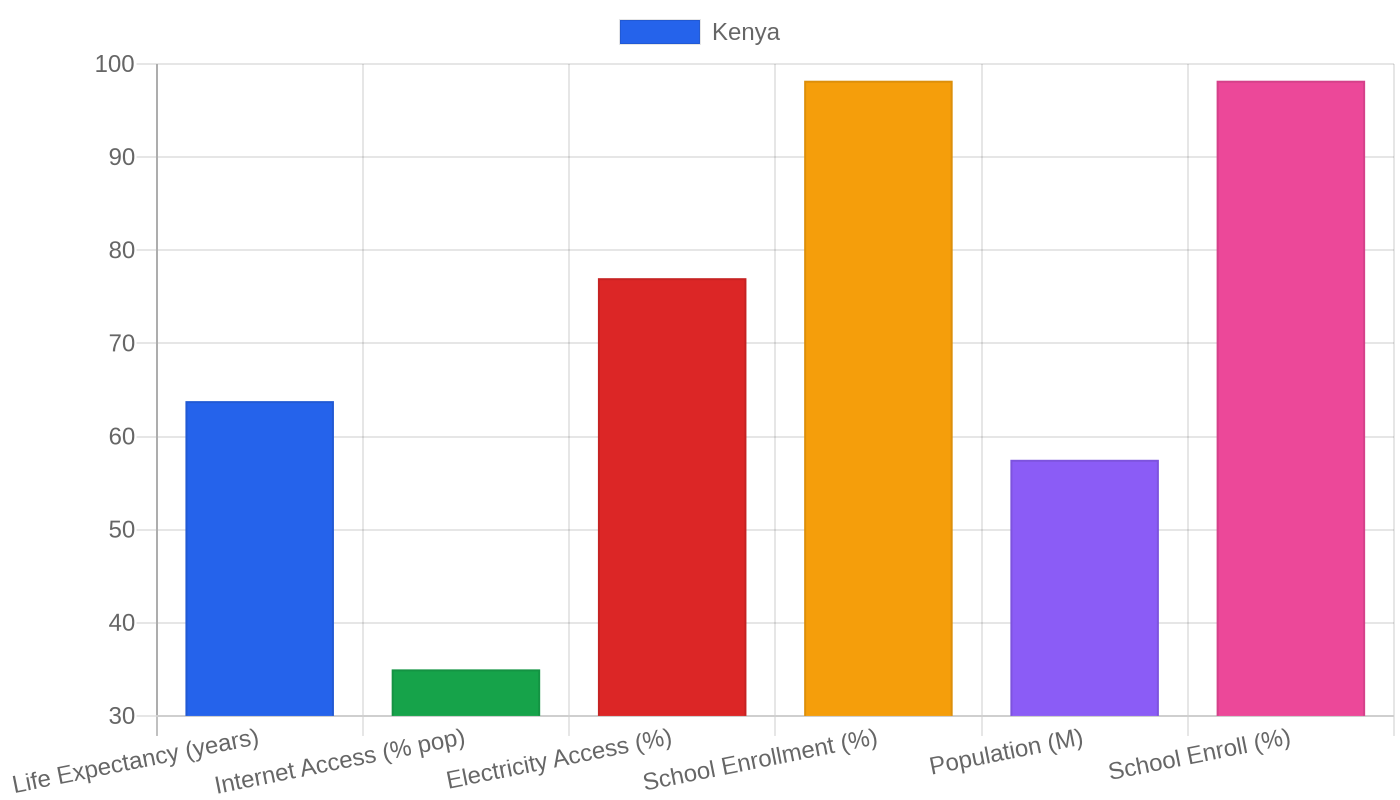
Kenya’s economic outlook for 2025 presents a picture of measured resilience, with GDP growth projected at 4.63261093844984% according to the latest figures from the World Bank. This expansion rate suggests that the nation is successfully navigating post-pandemic adjustments while integrating into broader regional trade networks. The total GDP stands at an impressive $135,941,278,878.815, reflecting a substantial economic base that supports diverse industrial activities.
However, the human element of this growth is nuanced; with a population of 57,532,493.0, the GDP per capita in PPP terms is recorded at $7,015.93578839722, indicating room for improvement in individual wealth accumulation. Unemployment sits at 5.449%, a figure that, while relatively low compared to some regional peers, still highlights the challenge of creating sufficient jobs for a rapidly growing workforce.
Furthermore, the GNI per capita of $2,000.0 underscores the need for inclusive growth strategies to ensure that macroeconomic gains translate into tangible improvements in living standards for the average citizen. These metrics collectively suggest an economy that is expanding but must work harder to distribute prosperity equitably across its demographic landscape.
Cost of Living and Housing Dynamics
The cost of living in Kenya plays a critical role in shaping daily economic realities for its residents, though specific housing indices are not currently detailed in the provided dataset. Generally, urban centers like Nairobi present a mix of high-end international amenities and more affordable local markets, influencing rent versus buy decisions for expatriates and locals alike.
Daily expenses are moderated by the current inflation rate of 4.0693076061457%, which keeps essential goods relatively accessible compared to periods of hyperinflation seen elsewhere. For investors and residents, understanding the interplay between income levels—where the GNI per capita is $2,000.0—and local prices is essential for budgeting.
While precise rental yields or property tax structures are not specified, the general economic stability implied by the controlled CPI suggests that housing costs are likely predictable in the short term. This environment allows for better long-term planning for businesses looking to establish offices or individuals seeking stable residential arrangements, provided they navigate the local market nuances carefully.
Investment Climate and Corporate Landscape
Kenya offers a vibrant investment environment characterized by a strong presence of established corporations across key sectors such as financials, industrials, and consumer services. Major entities like Commercial Bank of Africa and Chase Bank Kenya Limited dominate the financial landscape, providing robust infrastructure for capital flow and credit availability.
In the industrial sector, companies such as ARM Cement Limited and Bamburi Cement are pivotal, driving construction and infrastructure development that underpins economic growth. The consumer services sector is equally dynamic, with firms like 98.4 Capital FM and ALS – Aircraft Leasing Services showcasing the diversity of Kenya’s service-oriented economy.
Additionally, Carbacid Investments in basic materials and CIC Insurance Group highlight the depth of the corporate registry, offering varied opportunities for both domestic and foreign investors. The concentration of these top companies indicates a mature market where regulatory frameworks, though occasionally tested, generally support large-scale commercial operations.
Investors should note that while the corporate sector is strong, success often depends on navigating the complex interplay between private enterprise and public policy.
Safety, Politics, and Quality of Life
Navigating Kenya requires an understanding of its unique political and safety context, which significantly impacts quality of life for residents and businesses. Politically, the country operates as a presidential representative democratic republic with a multi-party system, where the president serves as both head of state and head of government.
Legislative power is shared between the National Assembly and the Senate, ensuring a degree of checks and balances, although the independence of the Judiciary has faced historical challenges, particularly during the tenure of former president Daniel arap Moi, when concerns about executive meddling were prevalent.
Regarding personal security, specific Crime and Safety Indices are listed as N/A in the current data, meaning prospective residents should rely on localized advisories rather than broad statistical averages. This lack of aggregated safety data does not necessarily imply danger but rather highlights the importance of situational awareness in different regions.
For those accustomed to stable democratic institutions, Kenya offers a familiar framework, yet the ongoing tension between branches of government remains a subtle undercurrent in daily political discourse.
Current Affairs and Market Trends
The immediate economic narrative in Kenya is being shaped by developments reported through Business Daily Africa, covering corporate strategies, economic shifts, and market finance updates. Recent corporate news suggests that major players are actively adapting to changing consumer behaviors and technological disruptions, particularly in the banking and media sectors.
Economic reports indicate that policymakers are closely monitoring inflation trends, aiming to keep the CPI near the 4% mark to maintain stability without stifling growth. In the markets and finance sphere, there is a noticeable focus on leveraging digital infrastructure to enhance financial inclusion and attract foreign direct investment. These trends reflect a broader effort to modernize the economy while addressing structural inefficiencies.
As the year progresses, stakeholders are watching how these corporate and economic maneuvers will interact with the political landscape, especially given the historical sensitivities around judicial independence and executive power. The interplay between private sector agility and public policy responsiveness will likely define the next phase of Kenya’s economic evolution.
The Bottom Line
Kenya presents a compelling case for investors and observers seeking a stable, growing market in East Africa with a diversified corporate base. The combination of solid GDP growth projections and controlled inflation provides a favorable backdrop for medium-term investments, particularly in financial services and infrastructure. However, potential entrants must remain vigilant regarding the political nuances and the historical tensions within the governance structure.
Ultimately, Kenya’s appeal lies in its dynamic private sector and resilient economy, making it a country worth watching for those who understand the value of navigating complex, emerging markets.
Sources & Methodology
This article is authored by Economic Pulse Net for informational and research purposes. Economic Pulse Net sources its data from multilateral institutions, national statistics bureaus, and proprietary databases. All data is believed to be current as of the date of publication.
Published: October 10, 2026 | Category: Research — Kenya
Use these signals in your own platform
Economic Pulse publishes its live signal feed through a documented, read-only API. Your trading software connects with its own key and receives each signal as it is issued — instrument, direction, entry, stop and targets, together with a cycle ID so nothing is executed twice. The feed is independent of this website and cannot change it.
Signals are informational only and are not financial advice.