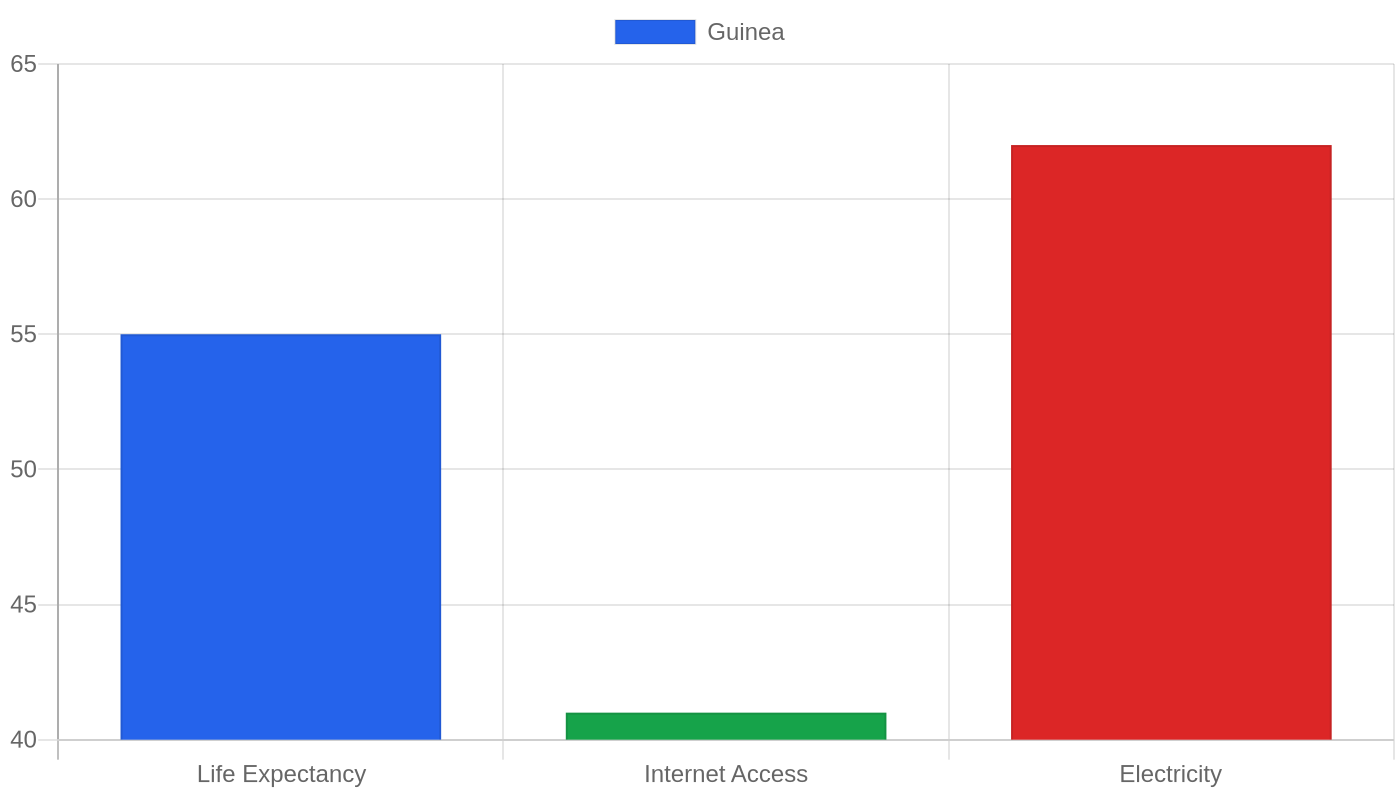
Economic Pulse Net | Sources: World Bank World Development Indicators, Government Sources | 2026
Key Takeaways
– Guinea remains a *de facto* military autocracy following the 2021 coup, with the National Assembly dissolved and political uncertainty suppressing long-term investment.
– The economy is overwhelmingly dependent on bauxite and alumina extraction, with major players like Compagnie des Bauxites de Guinée and Alumina Company of Guinea dominating the industrial landscape.
– Despite vast mineral wealth, critical economic indicators such as GDP growth, inflation, and unemployment are not currently reported by the World Bank, signaling severe data transparency issues.
– Air transport and postal services represent the limited diversification beyond mining, but consumer services remain fragile and underdeveloped.
– Investors face a high-risk environment where political instability and opaque governance overshadow the country’s natural resource potential.
The Bauxite Paradox — Wealth Underground, Uncertainty Above Ground
Guinea sits on the world’s largest reserves of bauxite, the primary ore for aluminium, yet the World Bank provides no current data on GDP growth, inflation, or unemployment. This absence of basic economic statistics is itself a telling indicator. For a country that should be a mining powerhouse, the lack of transparent macroeconomic data suggests either institutional collapse or deliberate opacity — neither of which inspires confidence.
The industrial backbone of the Guinean economy is unmistakably basic materials. The top companies list reads like a roll call of extraction giants: Compagnie des Bauxites de Guinée, Compagnie des bauxites de Kindia, Alumina Company of Guinea, and Halco Mining. These firms dominate the formal economy, generating export revenues that should fuel development. Bauxite mining alone accounts for the vast majority of Guinea’s foreign exchange earnings.
Yet the wealth has historically failed to trickle down to the broader population, a classic resource curse scenario where mineral riches coexist with widespread poverty.
Without GDP per capita or GNI per capita figures from the World Bank, it is impossible to quantify exactly how poor the average Guinean is — but the absence of data suggests that even the most basic economic monitoring systems are not functioning. For a nation that should be recording robust growth figures from its mining sector, the silence from international institutions speaks volumes about governance failures.
The consumer services sector offers a glimpse of economic life beyond the mines. Air Guinee Express, Air Guinee International, Air Guinée, Eagle Air, and Guinee Air Service all appear on the top companies list, indicating that aviation — both domestic and regional — plays a role in connecting this fragmented nation. However, the presence of multiple airlines, some with overlapping names, also hints at a fragmented and possibly unstable industry.
The sole industrial company on the list, Office de la poste guinéenne, highlights how even basic postal infrastructure remains a notable economic actor.
Living on the Edge — The Cost of Survival in Conakry
The World Bank provides no cost of living data for Guinea, which is itself a reflection of how difficult it is to track daily economic realities in a country where informal markets dominate and official statistics are scarce. What can be inferred from the industrial structure is that the economy is dualistic: a small, formal mining sector that generates wealth for elites and foreign investors, and a vast informal economy where most Guineans survive on subsistence agriculture, petty trade, and remittances.
Housing in Conakry, the coastal capital, is notoriously expensive relative to local incomes. The city’s geography — a narrow peninsula jutting into the Atlantic — constrains land supply, driving up rents in the few areas with reliable electricity and water. For a teacher or civil servant earning a modest salary, rent in a decent neighbourhood can consume more than half of monthly income.
Buying property is out of reach for all but the wealthiest, and mortgage financing is virtually nonexistent for ordinary citizens.
Daily expenses for food and transportation are heavily influenced by imported goods. Guinea imports much of its rice, cooking oil, and other staples, making households vulnerable to global price shocks. With no inflation data from the World Bank, it is impossible to say how fast prices are rising, but anecdotal evidence from regional media suggests that the cost of basic goods has climbed steadily since the 2021 coup, as supply chains were disrupted and the currency came under pressure.
The Investment Gamble — Mining Magnates and Military Risk
For investors, Guinea presents a classic high-risk, high-reward proposition. The mining sector is the undeniable draw. Compagnie des Bauxites de Guinée, a joint venture between the Guinean government and international partners, has been operating since the 1960s and remains the country’s largest private employer. Alumina Company of Guinea, which processes bauxite into alumina, adds value locally and represents the kind of downstream processing that could transform the economy.
Halco Mining, another major player, controls significant bauxite reserves and is backed by global aluminium giants.
The sectors to watch beyond mining are limited. Aviation, represented by the cluster of airlines, offers potential for growth if political stability returns and regional trade expands. The postal service, while modest, signals that basic logistics infrastructure exists and could be built upon. But the business environment is severely constrained by the political situation. Since the 2021 coup, the country has been governed as a *de facto* military autocracy, according to the political landscape data.
The National Assembly has been dissolved, and the judicial branch, headed by the Supreme Court of Guinea, operates under military oversight.
Foreign investors face a labyrinth of bureaucratic hurdles, opaque contract enforcement, and the constant risk that political instability could disrupt operations. Mining companies have historically negotiated individual agreements with the government, creating a patchwork of terms that complicates new entry. For small and medium enterprises outside the mining sector, the challenges are even greater: unreliable electricity, poor roads, and a banking system that offers limited credit.
A Nation Under Guard — Safety, Politics, and the Quality of Life
The crime and safety indices are not provided by the available data, which is itself concerning. In countries where data is missing, it often means that crime reporting systems are weak or that the government does not want the figures publicised. What is known from regional reports is that Conakry experiences high rates of petty crime, including theft and muggings, particularly in crowded markets and on public transport.
Violent crime is less common but does occur, and political demonstrations can turn violent quickly.
The political landscape is the defining feature of life in Guinea today. The 2021 coup d’état removed President Alpha Condé, who had altered the constitution to seek a third term, sparking widespread protests. Since then, the military junta has promised a return to civilian rule but has repeatedly delayed elections. The National Assembly, the country’s legislative body whose members were directly elected by the people, has been dissolved.
The president, who under the constitution is both head of state and head of government, is now a military officer with no electoral mandate.
Quality of life for the average Guinean is shaped by this political uncertainty. Public services are limited: electricity blackouts are daily occurrences in Conakry, clean water is not guaranteed, and the healthcare system is chronically underfunded. Education has suffered from teacher strikes and school closures. The mining wealth that should fund these services largely leaves the country or ends up in the hands of a small elite.
For most Guineans, life is a daily struggle against infrastructure failures and political indifference.
The Junta’s Tightrope — What Is Happening in Guinea Right Now
Since the 2021 coup, Guinea has been governed as a *de facto* military autocracy, a status that the international community has condemned but done little to reverse. The Economic Community of West African States (ECOWAS) imposed sanctions initially but has since eased them as the junta made vague promises of a transition timeline. However, those promises have not been kept. The National Assembly remains dissolved, and there is no clear path to elections.
The mining sector continues to operate, largely because the junta needs the revenue and international companies are reluctant to abandon their investments. But new investment has slowed. Global aluminium markets remain strong, and Guinea’s bauxite is still in demand, particularly from China. However, the junta has signalled that it wants to renegotiate mining contracts to capture more revenue for the state, creating tension with existing operators.
On the streets of Conakry, discontent is simmering. Civil society groups and opposition parties have called for a return to civilian rule, but demonstrations are met with a heavy-handed security response. The junta has cracked down on press freedom and arrested journalists, making it difficult for independent news to reach the public. The economy, meanwhile, is struggling under the weight of uncertainty.
Without World Bank data on inflation or growth, it is impossible to quantify the damage, but the anecdotal evidence points to rising hardship.
The Bottom Line
Guinea is a country of extraordinary mineral wealth and extraordinary dysfunction. For investors with a high tolerance for political risk and a long time horizon, the bauxite and alumina sectors offer genuine opportunities — but only if the junta eventually honours its promise to return to civilian rule.
For the average Guinean, the situation is far grimmer: a military government that offers no democratic accountability, an economy that fails to distribute its riches, and a daily life marked by scarcity and insecurity. This is a country to watch for those interested in the resource curse, the fragility of African democracies, and the human cost of political ambition.
Sources & Methodology
This article is authored by Economic Pulse Net for informational and research purposes. Economic Pulse Net sources its data from multilateral institutions, national statistics bureaus, and proprietary databases. All data is believed to be current as of the date of publication.
Published: July 16, 2026 | Category: Research — Guinea
Use these signals in your own platform
Economic Pulse publishes its live signal feed through a documented, read-only API. Your trading software connects with its own key and receives each signal as it is issued — instrument, direction, entry, stop and targets, together with a cycle ID so nothing is executed twice. The feed is independent of this website and cannot change it.
Signals are informational only and are not financial advice.