Economic Pulse Net | Sources: World Bank World Development Indicators, Government Sources | 2026
Key Takeaways
* Political Instability: Since the 2021 coup d’état, Guinea has operated as a de facto military autocracy, creating significant uncertainty for long-term investors despite its republican legal framework.
Mining Dominance: The economy is heavily anchored by basic materials, with major players like Alumina Company of Guinea and Compagnie des Bauxites de Guinée driving industrial output.
Data Gaps Mask Reality: Critical macroeconomic indicators such as GDP growth, inflation, and unemployment are currently listed as N/A, making precise economic forecasting difficult and relying instead on sector-specific observations.
Service Sector Fragmentation: The consumer services landscape is fragmented among numerous aviation entities, including Air Guinee Express and Eagle Air, suggesting a niche but competitive transport network.
Investment Caution Required: While mineral resources offer potential, the lack of transparent data and the ongoing political transition demand extreme caution from foreign capital entering the market.
The Mining Engine Amidst Macroeconomic Silence
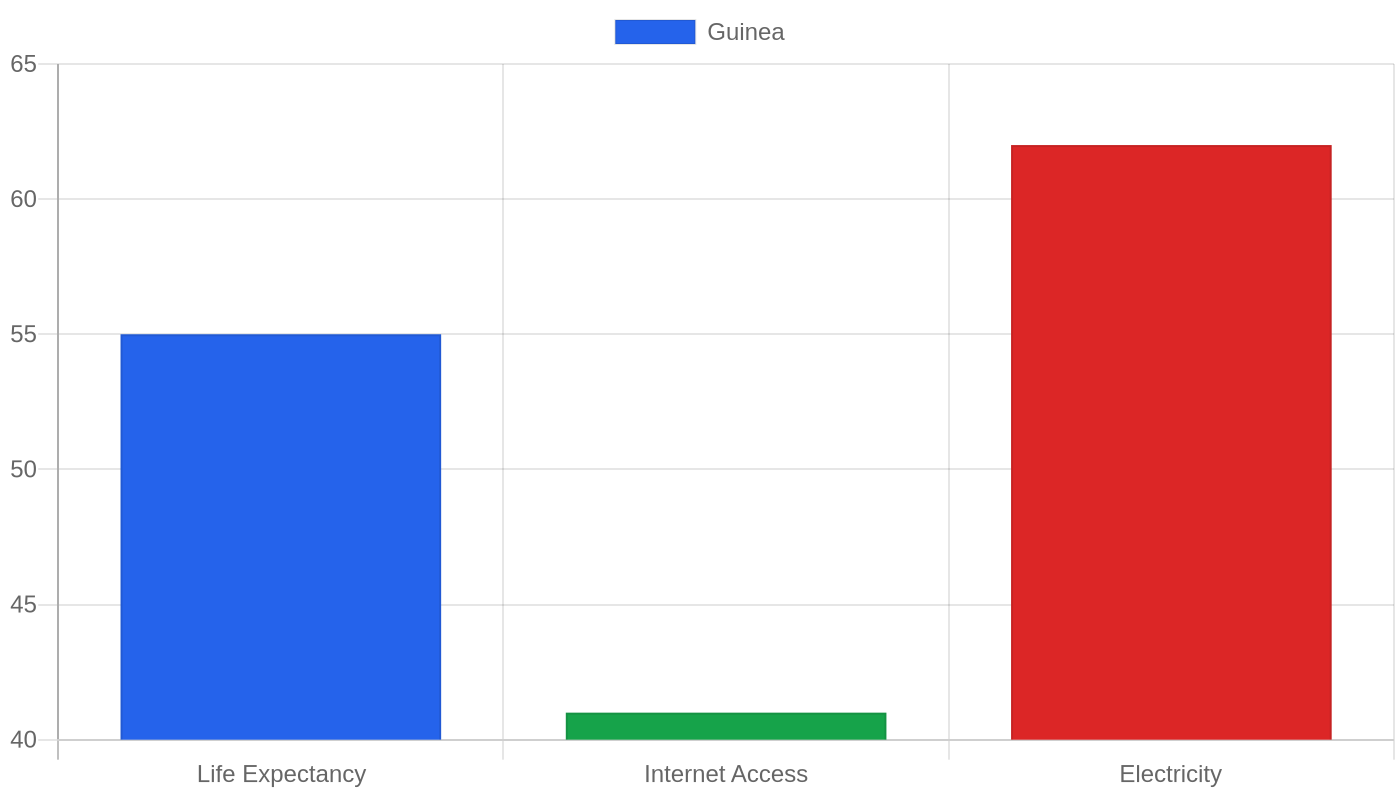
Guinea’s economic narrative is defined by a stark contrast between its immense natural resource potential and a current inability to provide comprehensive macroeconomic metrics. According to World Bank data, key indicators such as GDP growth, inflation rates (CPI), and unemployment figures are currently unavailable, presenting a blind spot for analysts attempting to gauge the country’s immediate health.
This lack of data does not mean the economy is inactive; rather, it highlights a structural reliance on extractive industries that often operate independently of broader national statistical frameworks. The primary driver of this industrial base is the mining sector, specifically bauxite and alumina production, which remains the backbone of the nation’s export earnings.
Major entities such as the Alumina Company of Guinea, Compagnie des Bauxites de Guinée, and Compagnie des bauxites de Kindia dominate the basic materials space, indicating that foreign direct investment is likely concentrated in these heavy-industry segments rather than diversified across the wider economy. Without clear GDP per capita or Gross National Income (GNI) figures, it is challenging to assess how wealth generated by these mines translates into domestic prosperity or infrastructure development.
Consequently, observers must look beyond aggregate numbers and focus on corporate performance within the mining and logistics sectors to understand the true pulse of the Guinean economy. The absence of population data further complicates efforts to calculate per-capita productivity, leaving the scale of the labor force and consumer market largely inferred rather than measured.
Cost of Living and Daily Expenses
Assessing the cost of living in Guinea presents a unique challenge due to the scarcity of standardized consumer price indices and housing market data. With no official CPI figures provided by the World Bank, determining whether daily expenses are rising or falling requires reliance on anecdotal evidence and localized market prices rather than national averages.
For expatriates and local residents alike, the cost of essential goods is likely influenced by import dependencies, particularly for fuel and manufactured goods, given the country’s limited manufacturing base outside of mining support services. Housing costs, whether renting or buying, are not quantified in current reports, making it difficult to compare Guinean real estate values against regional neighbors like Senegal or Côte d’Ivoire.
However, the presence of established logistical and postal services, such as the Office de la poste guinéenne, suggests a functioning, albeit possibly inefficient, distribution network that impacts the final price of goods on shelves. In the absence of hard data on inflation, consumers may face volatility in prices for imported items, while locally produced goods might remain relatively stable but subject to supply chain disruptions.
This environment necessitates a flexible budgeting approach for anyone operating within the country, as traditional economic models for cost-of-living adjustments are currently broken by the lack of transparent statistical reporting.
Investment Climate and Corporate Landscape
The business environment in Guinea is characterized by a dual structure: a robust, capital-intensive mining sector and a fragmented, service-oriented private sector. The list of top companies reveals a heavy concentration in basic materials, with Halco Mining and various bauxite companies controlling significant portions of the extraction industry.
These firms represent the most reliable anchors for foreign investment, offering stability through long-term contracts and international partnerships, even amidst domestic political shifts. On the consumer services side, the aviation sector is notably crowded, featuring multiple operators such as Air Guinee Express, Air Guinee International, Air Guinée, and Eagle Air.
This saturation suggests either high demand for air travel within the region or intense competition for limited market share, potentially impacting profitability for individual carriers. For investors, the key takeaway is that opportunities are highly sector-specific; generalist investments carry higher risks due to the opaque regulatory environment following the 2021 coup.
The judicial branch, headed by the Supreme Court of Guinea, provides the legal framework for dispute resolution, but the practical enforcement of contracts under a de facto military administration remains a critical variable for risk assessment. Business owners must navigate a landscape where legislative continuity is questioned, as the unicameral National Assembly’s role has been altered since the transition to military rule.
Therefore, due diligence must extend beyond financials to include political risk analysis, ensuring that operations can withstand potential policy reversals or social unrest.
Safety, Politics, and Quality of Life
Guinea’s political landscape is currently defined by the aftermath of the 2021 coup d’état, which has transformed the republic into a de facto military autocracy. Although the constitution nominally provides for a directly elected president and a unicameral National Assembly, the reality on the ground is governed by military oversight, creating a disconnect between legal institutions and actual power structures.
This political instability directly impacts safety and quality of life, although specific crime and safety indices are currently listed as N/A, preventing a quantitative assessment of security risks. The absence of these indices does not imply safety; rather, it reflects a gap in monitoring systems that are often disrupted during periods of political transition.
Citizens and expatriates alike must remain vigilant, as the erosion of democratic norms can lead to unpredictable social tensions and restrictions on movement. The head of state, who serves as both head of government and head of state, holds concentrated power, which can streamline decision-making but also reduce accountability and transparency.
For the average citizen, the quality of life is likely affected by the broader economic uncertainties stemming from this political shift, including potential delays in public service delivery and infrastructure projects. The judicial system, while formally headed by the Supreme Court, operates within this constrained political environment, raising questions about the independence of legal recourse for businesses and individuals.
Current Affairs and Immediate Developments
The most pressing dynamic in Guinea right now is the consolidation of power by the military junta following the 2021 coup, which continues to shape all aspects of governance and economic policy. Recent developments indicate that the National Assembly’s functions have been significantly curtailed, leading to a legislative vacuum that the military council fills through decrees rather than parliamentary debate.
This shift has created an atmosphere of uncertainty for international partners and domestic businesses alike, as the timeline for a return to civilian rule remains unclear. While specific recent news events are not detailed in the provided data, the overarching trend is one of isolation and internal restructuring, with the government prioritizing control over open market reforms.
Investors are closely watching for any signs of diplomatic re-engagement or economic liberalization measures that could signal a thaw in relations with Western allies and international financial institutions. The lack of updated GDP and inflation data suggests that statistical agencies may be deprioritized in favor of security and political management, further obscuring the economic picture.
As the country navigates this transitional period, the focus remains on maintaining social order and securing revenue streams from the mining sector, which continues to operate despite the political turmoil. Any future reforms will likely be incremental and cautious, driven by the need to stabilize the currency and attract essential foreign aid without conceding political control.
The Bottom Line
Guinea remains a country of high potential but elevated risk, where mineral wealth contrasts sharply with political unpredictability and data opacity. Investors should approach the market with extreme caution, focusing exclusively on established mining conglomerates with strong international backing rather than speculative ventures in the consumer sector.
The lack of transparent economic data makes traditional valuation models unreliable, requiring a qualitative assessment of political stability and operational resilience. Ultimately, Guinea is best watched by those willing to engage with complex geopolitical risks in exchange for access to some of Africa’s largest untapped bauxite reserves.
Sources & Methodology
This article is authored by Economic Pulse Net for informational and research purposes. Economic Pulse Net sources its data from multilateral institutions, national statistics bureaus, and proprietary databases. All data is believed to be current as of the date of publication.
Published: October 03, 2026 | Category: Research — Guinea
Use these signals in your own platform
Economic Pulse publishes its live signal feed through a documented, read-only API. Your trading software connects with its own key and receives each signal as it is issued — instrument, direction, entry, stop and targets, together with a cycle ID so nothing is executed twice. The feed is independent of this website and cannot change it.
Signals are informational only and are not financial advice.