Economic Pulse Net | Sources: World Bank World Development Indicators, Government Sources | 2026
Key Takeaways
* Guinea operates as a de facto military autocracy following the 2021 coup, despite remaining a republic de jure, creating significant political uncertainty for foreign investors.
The economy is heavily anchored by the basic materials sector, with major players like Alumina Company of Guinea and Compagnie des Bauxites de Guinée driving industrial output.
Consumer services are dominated by local aviation entities, including Air Guinee Express and Eagle Air, highlighting a specific niche in domestic connectivity.
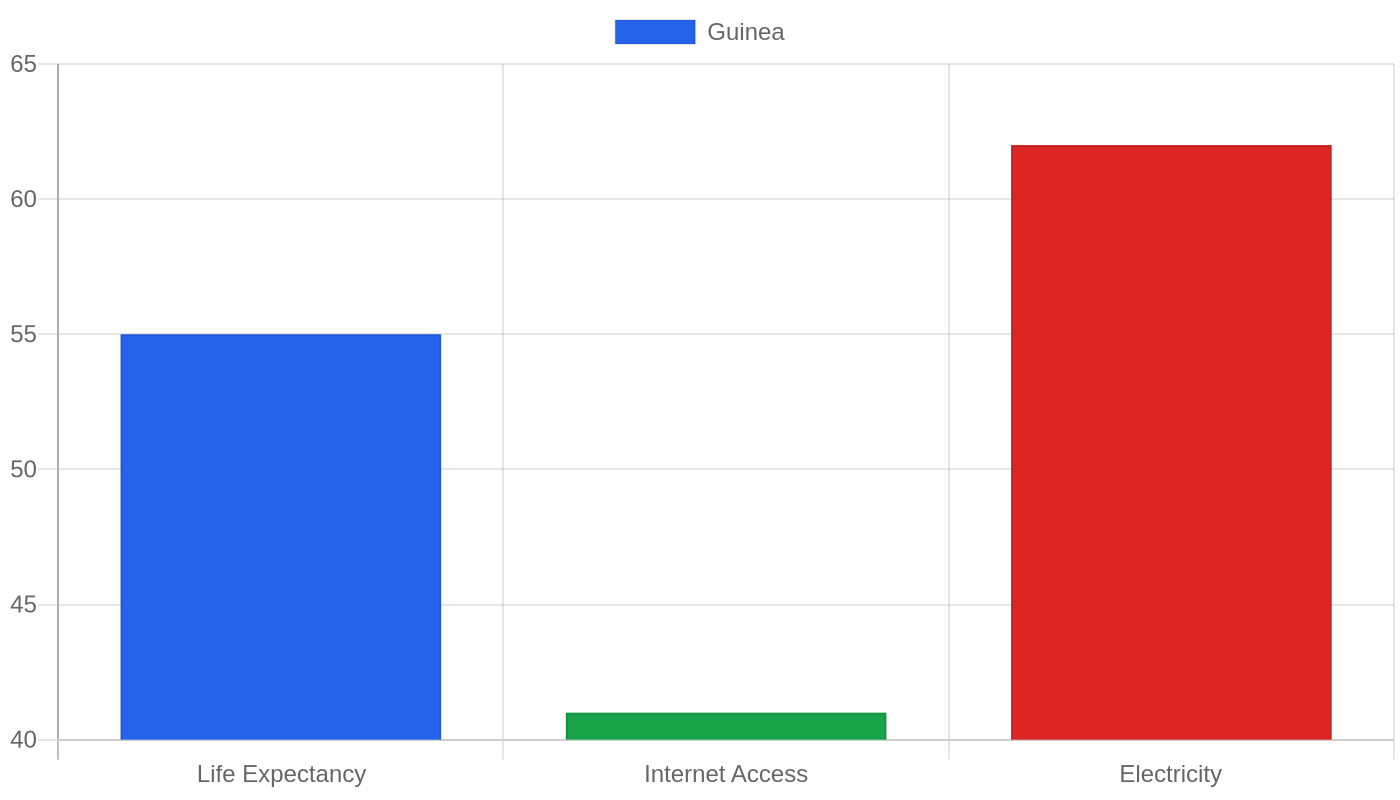
Detailed macroeconomic indicators such as GDP growth, inflation rates, and unemployment figures are currently listed as unavailable, suggesting data transparency challenges or reporting lags.
Safety indices and crime statistics are also not currently available, making risk assessment for expatriates and businesses reliant on qualitative rather than quantitative metrics.
Economic Engines: Mining Dominance Amidst Data Gaps
Guinea’s economic narrative is defined less by broad macroeconomic aggregates and more by its strategic position in global resource supply chains. While the World Bank data indicates that key metrics such as GDP growth, inflation CPI, and unemployment rates are currently marked as “N/A,” the structural backbone of the nation remains visible through its industrial composition. The country is a powerhouse in the basic materials sector, serving as one of the world’s largest holders of bauxite reserves.
This geological wealth translates directly into corporate activity, where firms like Alumina Company of Guinea, Compagnie des Bauxites de Guinée, and Compagnie des bauxites de Kindia operate at scale. These entities do not just extract resources; they form the primary engine of export revenue and foreign direct investment. Halco Mining further diversifies this heavy industry footprint, ensuring that the mining sector remains resilient even when broader economic indicators are obscured.
For international observers, the absence of precise GDP per capita (PPP) or GNI per capita figures does not diminish the tangible reality of these operations. Instead, it highlights an economy where value is generated through commodity exports rather than domestic consumption metrics that might be underreported.
The reliance on these specific industrial outputs suggests that Guinea’s economic health is tightly coupled with global demand for aluminum precursors, making external market forces a more reliable predictor of national prosperity than internal statistical releases.
Cost of Living: Navigating an Unquantified Daily Reality
For residents and business travelers, understanding the cost of living in Guinea requires looking past standard indices, which are currently listed as unavailable. Without a published Crime Index or Safety Index, daily expenses cannot be easily benchmarked against regional averages using traditional safety-adjusted models. However, the presence of a diverse array of consumer service providers offers clues about the urban economic landscape.
Companies such as Air Guinee Express, Air Guinée, and Eagle Air indicate a demand for mobility and connectivity within the capital and major commercial hubs. The existence of multiple aviation brands, including Air Guinee International and Guinee Air Service, suggests that travel costs may vary significantly depending on whether one utilizes domestic carriers or international alternatives.
Furthermore, the operational status of the Office de la poste guinéenne points to ongoing logistical networks that support both personal and commercial transactions. In the absence of concrete housing data, rent versus buy decisions must be approached with caution, likely favoring short-term leases due to the unpredictable nature of long-term property rights in a transitional political climate.
Daily expenses, therefore, become a function of access to these specific service sectors rather than a generalized basket of goods. Expatriates should anticipate higher transaction costs for services that are reliably provided by established private entities, while navigating public infrastructure that may lack standardized pricing models.
Investment & Business Climate: A Sector-Consolidated Opportunity
The investment landscape in Guinea is characterized by a high degree of concentration in the extractive industries and specialized consumer services. For investors seeking entry points, the basic materials sector presents the most robust opportunities, driven by the operational capacity of giants like Alumina Company of Guinea and Compagnie des Bauxites de Guinée. These companies have established supply chains and operational footprints that provide a level of stability often missing in emerging markets.
Beyond mining, the consumer services sector offers a unique ecosystem, primarily through aviation. With entities like Air Guinee Express, Eagle Air, and Guinee Air Service competing in the same space, there is potential for synergies in logistics and passenger transport infrastructure. However, the business environment is complicated by the political shift since the 2021 coup d’état.
While the government structure nominally includes a unicameral National Assembly and a Supreme Court headed by the highest court of appeal, the de facto military autocracy introduces regulatory unpredictability. Investors must navigate a landscape where legislative bodies exist but their power may be constrained by executive military authority. This creates a dual reality: strong fundamental assets in mining and aviation, paired with governance structures that require heightened due diligence.
The Office de la poste guinéenne represents the industrial backbone of communication, yet the overall ease of doing business is likely influenced more by political stability than by bureaucratic efficiency. Consequently, successful investment strategies will likely focus on joint ventures with established local players who have navigated the current political transition.
Safety, Politics & Quality of Life: The Shadow of Transition
Quality of life in Guinea is inextricably linked to its volatile political history and the current state of security. Since the 2021 coup d’état, the country has been governed as a de facto military autocracy, a shift that has profound implications for civil liberties and social stability. Although Guinea remains a republic de jure, with a president who is directly elected and serves as both head of state and head of government, the practical exercise of power lies elsewhere.
The judicial branch, led by the Supreme Court of Guinea, stands as the final court of appeal, yet its independence is often questioned in the shadow of military rule. For citizens and foreigners alike, the lack of a published Crime Index and Safety Index raises serious concerns about personal security. Without quantifiable data on crime rates, assessing the safety of different neighborhoods becomes an exercise in anecdotal evidence and local guidance.
The political landscape is further complicated by the role of the National Assembly, whose members are directly elected but whose legislative influence may be limited under the current regime. This disconnect between formal democratic institutions and actual military control creates a sense of ambiguity that affects daily life. Happiness data, while not explicitly detailed in the provided metrics, can be inferred to be impacted by this political stagnation and the lack of transparent economic indicators.
Residents must adapt to a system where legal protections exist on paper but may be applied inconsistently in practice. Therefore, quality of life is heavily dependent on one’s proximity to power centers and adherence to local norms that prioritize discretion and compliance with military directives.
What’s Happening Now: Institutional Stagnation and Military Rule
The current affairs in Guinea are dominated by the lingering effects of the 2021 coup d’état and the subsequent consolidation of military power. As reported in recent analyses, the nation is firmly entrenched in a period of political transition that lacks clear timelines for a return to full civilian democracy. The government structure, while nominally intact with a directly elected president and a unicameral National Assembly, operates under the shadow of military oversight.
The National Assembly, whose members are directly elected by the people, continues to function as the legislative body, yet its ability to check executive power remains uncertain. The Supreme Court of Guinea maintains its position as the highest and final court of appeal, providing a veneer of judicial continuity amidst political upheaval. This institutional framework suggests that while the mechanisms of governance are present, their operation is filtered through the lens of military authority.
There are no immediate signs of rapid policy shifts or new economic reforms being announced, indicating a strategy of maintaining the status quo until further notice. The absence of fresh macroeconomic data from the World Bank reinforces the idea that the administration is prioritizing control over transparency. Business developments remain focused on existing contracts in the mining and aviation sectors, with little new investment entering the market due to perceived risks.
The current atmosphere is one of cautious waiting, with stakeholders monitoring any changes in the balance of power between the military junta and civil society. This period of stagnation means that the primary news story is not growth, but survival and adaptation within a rigid political structure.
The Bottom Line
Guinea is a country of stark contrasts, offering immense potential in its mineral wealth while presenting significant risks due to its political instability. Investors and analysts should view the nation through the lens of its dominant basic materials companies, which provide a rare source of economic certainty. However, the lack of transparent data on GDP, inflation, and safety makes rigorous financial modeling difficult, requiring a reliance on qualitative risk assessments.
For those considering engagement, the key is to partner with established local entities that have demonstrated resilience during the post-coup era. Ultimately, Guinea is a watchlist country for those interested in resource extraction, but a cautionary tale for those seeking stable, open-market economies.
Sources & Methodology
This article is authored by Economic Pulse Net for informational and research purposes. Economic Pulse Net sources its data from multilateral institutions, national statistics bureaus, and proprietary databases. All data is believed to be current as of the date of publication.
Published: September 25, 2026 | Category: Research — Guinea
Use these signals in your own platform
Economic Pulse publishes its live signal feed through a documented, read-only API. Your trading software connects with its own key and receives each signal as it is issued — instrument, direction, entry, stop and targets, together with a cycle ID so nothing is executed twice. The feed is independent of this website and cannot change it.
Signals are informational only and are not financial advice.