Economic Pulse Net | Sources: World Bank World Development Indicators, Government Sources | 2026
🇬🇼 Guinea-Bissau 2026 — Navigating Political Fragility in a Data Vacuum
Key Takeaways
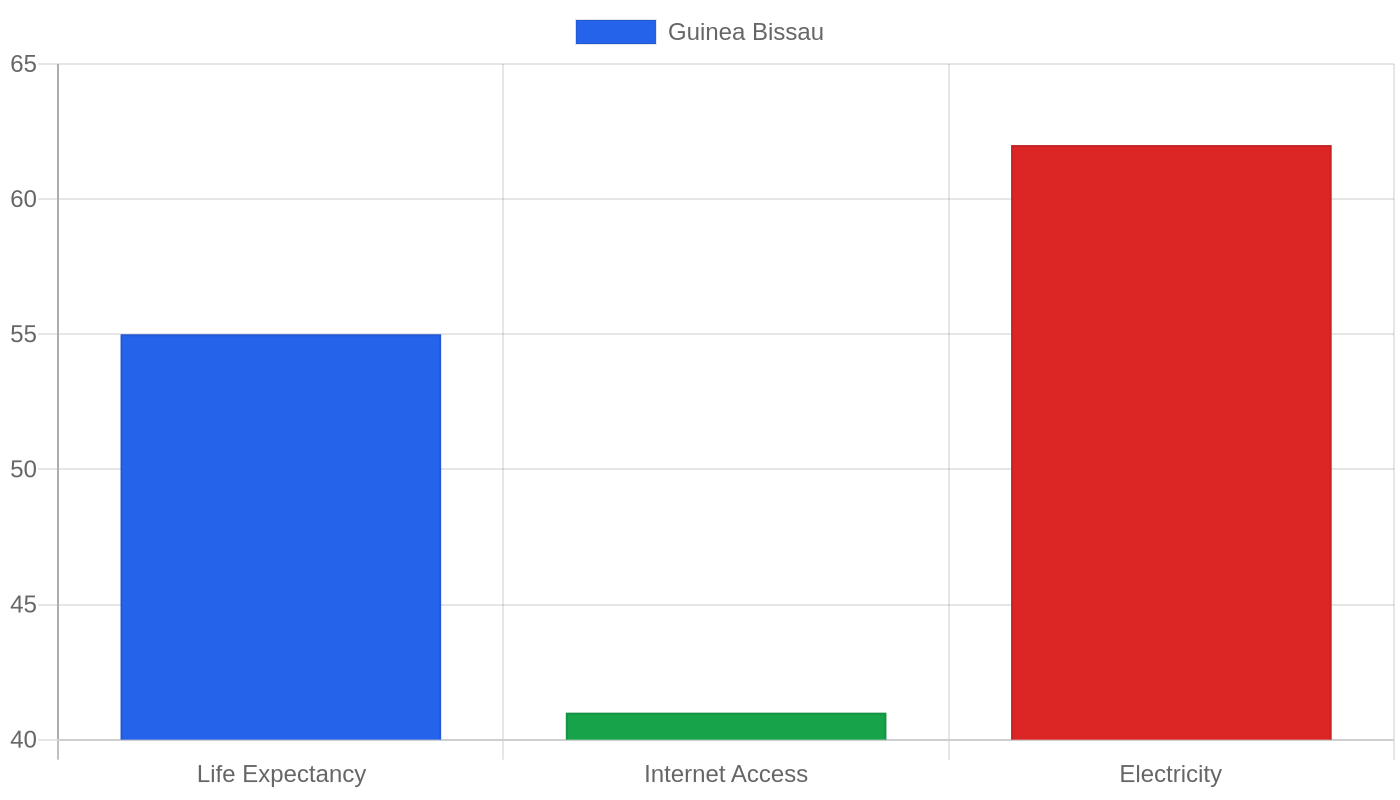
* Data Scarcity: Official economic metrics, including GDP growth, inflation, and unemployment rates, are currently unavailable from the World Bank, creating significant challenges for precise macroeconomic forecasting.
Political Volatility: The nation operates under a semi-presidential system characterized by historical instability; since independence in 1974, no president has successfully completed a full five-year term until Jose Mario Vaz’s conclusion in June 2019.
Governance Shifts: Multi-party governance was only established in mid-1991, marking a relatively recent transition from highly centralized government structures to the current political framework.
Investment Uncertainty: The absence of comprehensive data on top companies, cost of living indices, and crime statistics necessitates extreme caution for foreign investors and analysts seeking reliable entry points.
Economic Stagnation Amidst Statistical Gaps
The economic landscape of Guinea-Bissau presents a unique challenge for international observers: a near-total absence of quantifiable macroeconomic data. According to the latest reports from the World Bank, critical indicators such as GDP growth, inflation CPI, unemployment rates, and overall GDP in USD are listed as “N/A.” This statistical void is not merely a reporting delay but reflects broader structural issues within the country’s administrative capacity to track and report economic performance.
Without baseline figures for GDP per capita (PPP) or Gross National Income (GNI), assessing the standard of living or the scale of the economy becomes an exercise in inference rather than calculation. This lack of transparency complicates efforts to understand the health of main industries, which remain undefined in current datasets. Consequently, policymakers and external partners struggle to design targeted interventions without knowing the precise magnitude of fiscal deficits or surplus.
The inability to measure economic output accurately hinders the country’s ability to attract development aid or foreign direct investment, as donors require predictable metrics to justify funding allocations. In this environment, economic planning relies heavily on anecdotal evidence and regional comparisons rather than hard domestic statistics.
The Unmeasured Cost of Living
Assessing the daily reality for residents in Guinea-Bissau is complicated by the lack of official cost-of-living indices. With no recorded data on housing costs, rent versus buy ratios, or general price levels, it is impossible to benchmark expenses against regional averages using standard economic models. This gap suggests that the informal economy likely plays a dominant role in daily transactions, where prices are determined locally rather than through formalized market mechanisms.
For expatriates or new business entrants, the absence of a transparent pricing structure means that budgeting must be done on a case-by-case basis, relying on local knowledge rather than published indices. Furthermore, the missing data on safety and crime indices further obscures the true cost of doing business or living in urban centers.
Without these foundational numbers, the financial risk profile of the country remains high, as hidden costs related to security, logistics, and informal fees cannot be easily quantified. Residents likely face significant volatility in essential goods prices, driven by supply chain disruptions that go unrecorded in national statistics.
A Business Climate Defined by Institutional History
The investment landscape in Guinea-Bissau is deeply intertwined with its political history, specifically the shift away from centralized control. While specific major companies are not listed in current databases, the business environment is shaped by the legacy of a government that was highly centralized until the establishment of multi-party governance in mid-1991. This relatively recent democratization means that regulatory frameworks may still be evolving, lacking the maturity found in more stable economies.
The semi-presidential system, which divides power between a head of state (the president) and a head of government (the prime minister), creates a complex web of accountability that can slow down bureaucratic processes. Potential investors must navigate a system where institutional memory is fragmented due to frequent changes in leadership. The fact that no president served a full term between 1974 and 2019 indicates a pattern of political interruption that could deter long-term capital commitments.
Therefore, business strategies must prioritize flexibility and local partnerships over rigid long-term projections.
Safety, Politics, and Quality of Life
The quality of life in Guinea-Bissau is shadowed by significant political uncertainty and a lack of safety data. Current indices for crime and safety are marked as “N/A,” leaving residents and visitors without clear guidance on risk levels in different regions. Politically, the nation remains fragile; the semi-presidential system places substantial power in the hands of the president, yet the historical precedent of interrupted terms suggests ongoing instability.
Jose Mario Vaz ended his five-year term on June 24, 2019, breaking the streak of incomplete presidencies, but the underlying structural weaknesses of the state persist. The transition from a highly centralized regime to a multi-party democracy in 1991 did not immediately stabilize governance, as evidenced by the subsequent years of political turbulence.
For citizens, the combination of unclear safety metrics and political unpredictability creates an atmosphere of uncertainty that affects social cohesion and personal security. Happiness data is similarly absent, making it difficult to gauge the subjective well-being of the population beyond objective economic measures.
What’s Happening Now: The Legacy of Transition
Currently, Guinea-Bissau is navigating the aftermath of its historic political shifts, particularly the completion of President Jose Mario Vaz’s term in June 2019. This event marked a rare instance of democratic continuity in a country where executive transitions have often been abrupt or contested. However, the immediate post-Vaz period continues to be defined by the challenges of maintaining stability in a semi-presidential system that lacks robust institutional safeguards.
With no new economic data emerging to signal recovery or growth, the focus remains on political consolidation rather than economic expansion. Analysts are watching closely to see if the end of Vaz’s term will lead to sustained governance or a return to previous patterns of disruption. The absence of fresh news regarding specific reforms or policy shifts suggests that the government is prioritizing internal political management over public-facing economic announcements.
This quiet period underscores the need for patience and careful observation before any significant developments can be reported.
The Bottom Line
Guinea-Bissau represents a high-risk, low-information environment for both investors and researchers. The complete lack of core economic data from the World Bank makes traditional analysis impossible, requiring stakeholders to rely on qualitative assessments of political stability. Those interested in the country should monitor the implementation of policies following the 2019 presidential transition, as this may offer the first clear signals of institutional strength.
Until concrete data emerges, the country remains a frontier market defined more by its political history than its economic potential.
Sources & Methodology
This article is authored by Economic Pulse Net for informational and research purposes. Economic Pulse Net sources its data from multilateral institutions, national statistics bureaus, and proprietary databases. All data is believed to be current as of the date of publication.
Published: October 30, 2026 | Category: Research — Guinea Bissau
Use these signals in your own platform
Economic Pulse publishes its live signal feed through a documented, read-only API. Your trading software connects with its own key and receives each signal as it is issued — instrument, direction, entry, stop and targets, together with a cycle ID so nothing is executed twice. The feed is independent of this website and cannot change it.
Signals are informational only and are not financial advice.