Economic Pulse Net | Sources: World Bank World Development Indicators, Government Sources | 2026
Key Takeaways
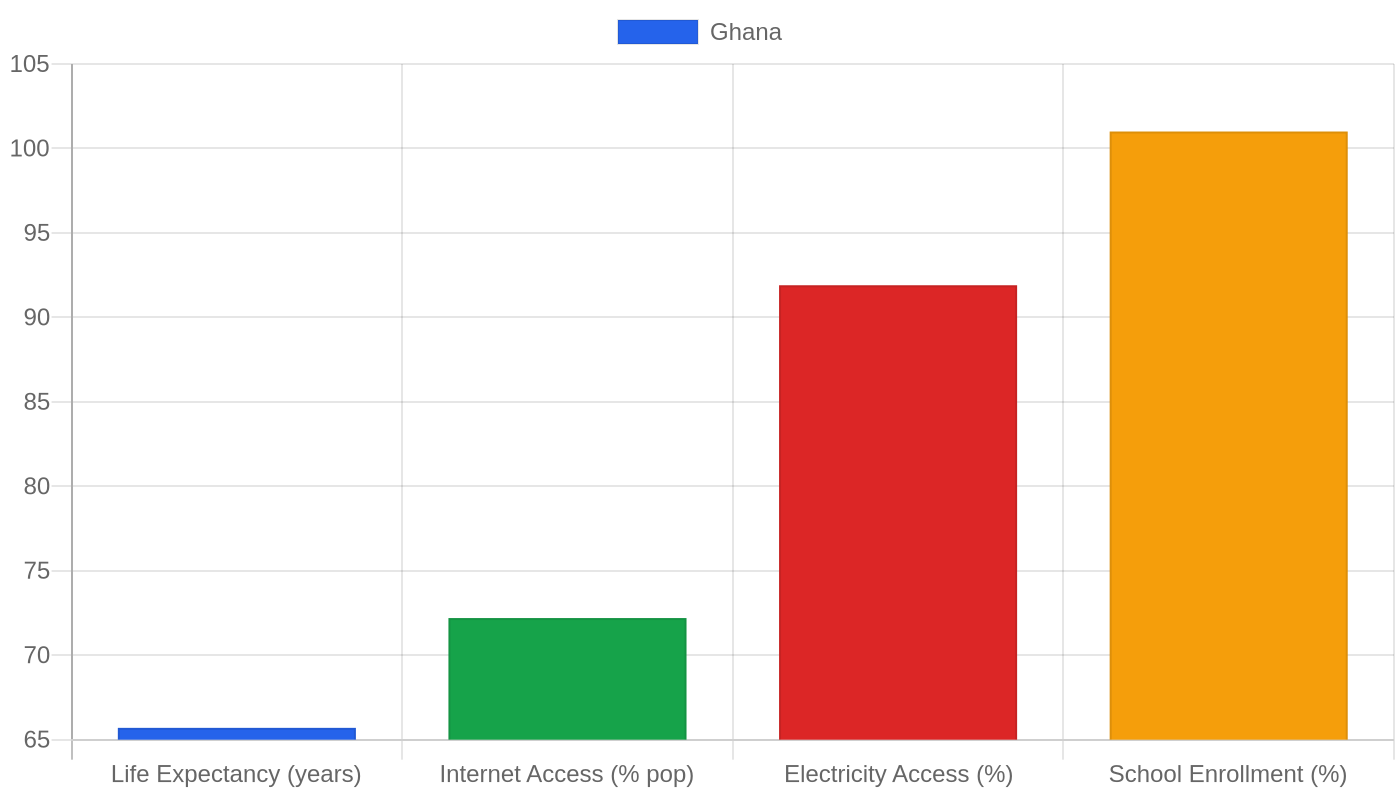
– Ghana’s economy is projected to grow at nearly 6% in 2025, according to World Bank data, marking one of the stronger rebounds in West Africa after recent debt restructuring.
– Inflation remains stubbornly high at over 14%, eroding household purchasing power and testing the resilience of the country’s consumer-driven economy.
– Unemployment stands at just under 3%, a remarkably low figure that masks significant underemployment in the informal sector.
– Ghana’s political landscape remains stable under its democratic Fourth Republic, with power alternating between the NDC and NPP in a system that has endured since 1993.
– Major listed companies span banking, aviation, brewing, and gold mining, reflecting a diversifying but still commodity-linked economic base.
Growth on Paper, Pressure on the Street
Ghana’s headline economic numbers tell a story of recovery. The World Bank projects GDP growth of 5.95% for 2025, a figure that would place Ghana among the faster-growing economies in sub-Saharan Africa. This expansion follows a painful period of debt restructuring and fiscal consolidation that saw the economy stall. The growth is broad-based, driven by gold exports, cocoa, and a slowly reviving services sector.
But the World Bank’s inflation figure of 14.2% casts a long shadow over that headline number. When prices rise at double the rate of many peer economies, the real income of Ghanaian households shrinks even as the national output expands.
The unemployment rate of just under 3% is enviable by global standards, but it requires careful interpretation. In Ghana, formal wage employment is limited; most workers operate in the informal economy, in markets, small-scale agriculture, and artisanal mining. The low official unemployment figure reflects a reality where almost everyone works, but many work in conditions of low productivity and earnings.
The GNI per capita of $2,630, as reported by the World Bank, places Ghana firmly in the lower-middle-income bracket. That figure has been under pressure from currency depreciation and import costs, meaning the dollar-denominated improvement in GDP does not always translate into better living standards on the ground.
The structure of Ghana’s economy is visible in its corporate landscape. The top companies listed in the data include Ashanti Goldfields Corporation in basic materials, reflecting the enduring importance of gold. Agricultural Development Bank of Ghana and AmalBank represent the financial sector, while Accra Brewery Company signals a consumer goods market that serves both domestic demand and regional exports.
The presence of multiple aviation companies—Aerogem Aviation, Afra Airlines, Africa World Airlines, and Antrak Air—is striking for a country of Ghana’s size, suggesting both business travel demand and the country’s role as a West African hub. These companies operate in an environment where the cost of capital remains high and the cedi’s volatility creates planning headaches for any business with imported inputs.
The Cost of Living — When the Cedi Doesn’t Stretch
For the average Ghanaian, the inflation rate of 14.2% is not a statistic but a daily reality. Food prices, transport fares, and rent have all risen sharply. The cost of imported goods—from rice to second-hand cars—has been amplified by currency depreciation. Housing in Accra, the capital, has become particularly expensive. A modest two-bedroom apartment in a decent neighborhood can consume more than half of a formal-sector salary.
Renting is the norm for most urban dwellers; buying property requires access to mortgage finance at interest rates that often exceed 25%, putting homeownership out of reach for all but the wealthy.
Utility costs add another layer of pressure. Electricity tariffs have been adjusted upward as part of the conditions attached to the International Monetary Fund program, and water prices have followed. For families living on the GNI per capita of $2,630, these fixed costs leave little room for savings or unexpected expenses. The comparison with other West African economies is telling: Ghana’s cost of living is higher than in Nigeria for many basic goods, though lower than in Côte d’Ivoire.
The result is a population that is working hard—the low unemployment figure attests to that—but feeling increasingly squeezed, a dynamic that has political consequences in a democracy where voters expect tangible improvements.
Business and Investment — Rebuilding Trust After the Default
Ghana’s investment climate is in a period of cautious repair. The country’s default on most of its external debt in 2022 sent shockwaves through the international investment community. The subsequent restructuring, negotiated under the G20 Common Framework, has restored some confidence, but scars remain. The World Bank data shows a corporate sector dominated by domestic banks and resource companies, with limited new foreign direct investment flowing into manufacturing or technology.
The companies listed—from African Champion Industries in basic materials to Aluworks in aluminum—are largely established players rather than new entrants, suggesting that the risk appetite for greenfield investment remains subdued.
The financial sector is a particular area of focus. Agricultural Development Bank of Ghana and AmalBank are central to the government’s strategy of channeling credit to productive sectors. But non-performing loans remain elevated, and the Bank of Ghana has maintained tight monetary policy to combat inflation. For any business considering Ghana, the key question is whether the growth rate of nearly 6% can be sustained without a renewed bout of inflation and currency instability.
The presence of multiple airlines in the corporate registry is a positive signal—it suggests that business travel and logistics are growing—but these companies operate on thin margins in a sector vulnerable to fuel price shocks and exchange rate swings.
Politics, Safety, and the Quality of Democratic Life
Ghana is a rare African success story in democratic governance. The political landscape, as described in the data, is a unitary presidential constitutional democracy with a parliamentary multi-party system dominated by the National Democratic Congress (NDC) and the New Patriotic Party (NPP). Since the transition to the Fourth Republic in January 1993, Ghana has held successive peaceful elections, with power changing hands multiple times. This stability is a genuine asset.
It means that investors and citizens alike can reasonably predict the rules of the political game, unlike in many neighboring countries where coups or constitutional crises upend the business environment.
The constitution divides powers among a commander-in-chief of the Ghana Armed Forces and elected civilian authorities, providing checks and balances that have largely held. Safety is a relative concept in West Africa, but Ghana consistently ranks as one of the least violent countries in the region.
There is no data provided on a specific crime index, but the general reputation is one of low levels of violent crime compared to regional peers, with petty crime and scams being the more common concerns for visitors and residents. The quality of life in Ghana is shaped by reliable electricity in urban areas, functional if overstretched public services, and a vibrant civil society.
The democratic system means that grievances—including over the high cost of living—can be channeled through elections, protests, and media debate, providing a safety valve that authoritarian systems lack.
The Present Moment — Inflation, Elections, and the IMF Tightrope
Right now, Ghana is navigating a delicate moment. The World Bank’s growth projection of nearly 6% for 2025 is welcome, but it comes against the backdrop of an inflation rate above 14% that the central bank is struggling to tame. The government is implementing the terms of its IMF program, which requires fiscal discipline, reduced subsidies, and higher tax revenues. These measures are necessary for debt sustainability but politically painful.
The next general election, due in 2024, will test whether the ruling party can convince voters that the austerity is temporary and that the growth will eventually trickle down.
The corporate sector is watching the currency closely. The cedi has experienced periodic sharp depreciations, and any renewed weakness would immediately feed into inflation, given Ghana’s reliance on imports for everything from refined petroleum to machinery. The presence of companies like Ashanti Goldfields is a buffer—gold exports generate foreign exchange—but the benefits of high gold prices are partially offset by rising production costs.
The aviation sector, represented by Africa World Airlines and others, is benefiting from increased regional travel demand but remains vulnerable to fuel costs. For the ordinary Ghanaian, the immediate concern is whether the 14% inflation will moderate in the coming months, or whether the growth numbers will remain a statistical abstraction while prices continue to rise.
The Bottom Line
Ghana is a country with genuine democratic credentials, a diversifying economy, and a growth trajectory that many peers envy. But the high inflation rate and the legacy of the debt default mean that the recovery is fragile. Investors should watch Ghana for its political stability and resource wealth, but they must price in currency risk and policy uncertainty.
For the Ghanaian people, the question is whether the nearly 6% growth can be transformed into tangible improvements in living standards, or whether the democratic system will face its most serious test from citizens who feel that the dividends of stability are not reaching their pockets.
Sources & Methodology
This article is authored by Economic Pulse Net for informational and research purposes. Economic Pulse Net sources its data from multilateral institutions, national statistics bureaus, and proprietary databases. All data is believed to be current as of the date of publication.
Published: July 20, 2026 | Category: Research — Ghana
Use these signals in your own platform
Economic Pulse publishes its live signal feed through a documented, read-only API. Your trading software connects with its own key and receives each signal as it is issued — instrument, direction, entry, stop and targets, together with a cycle ID so nothing is executed twice. The feed is independent of this website and cannot change it.
Signals are informational only and are not financial advice.