Economic Pulse Net | Sources: World Bank World Development Indicators, Government Sources | 2026
Key Takeaways
– Ghana’s economy is growing at nearly 6 percent in 2025, according to World Bank data, but double-digit inflation at 14.2 percent is eroding household purchasing power and testing the resilience of the country’s democratic institutions.
– Unemployment remains remarkably low at just under 3 percent, a figure that masks widespread underemployment in the informal sector and a youth population hungry for formal jobs.
– The political landscape is stable but fiercely competitive, with the National Democratic Congress and New Patriotic Party dominating a multi-party system that has held since the Fourth Republic was established in 1993.
– Ghana’s top publicly listed companies span aviation, banking, brewing, and basic materials, suggesting a diversifying private sector that remains heavily reliant on commodity-linked industries like gold and aluminium.
– The country’s unitary presidential system provides policy continuity, but the persistence of high inflation and cost-of-living pressures means the government faces growing public scrutiny over economic management.
Growth at a Crossroads — GDP, Inflation, and the Job Paradox
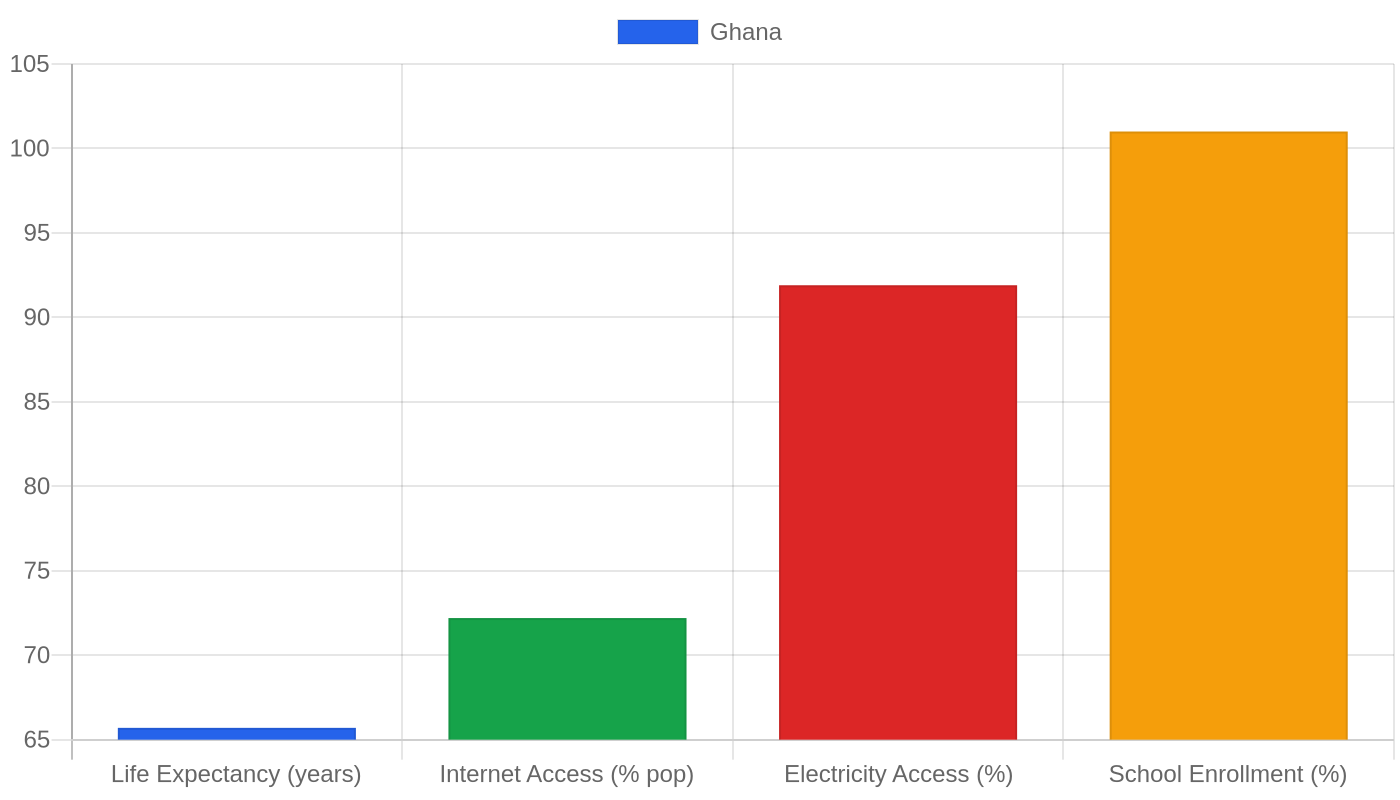
Ghana’s economy is posting a headline GDP growth rate of 5.95 percent in 2025, according to the World Bank. That figure places the West African nation among the faster-growing economies on the continent, recovering from the macroeconomic turbulence of recent years. But growth alone does not tell the full story. Consumer price inflation stands at 14.2 percent, meaning that the real purchasing power of the average Ghanaian is being squeezed even as the national output expands.
This is the classic growth-inflation dilemma: an economy that is running hot enough to generate jobs and activity, but not hot enough to outpace the rising cost of food, transport, and housing.
The unemployment rate, as reported by the World Bank, is a surprisingly low 2.98 percent. On the surface, that suggests near-full employment. But any economist familiar with Ghana’s labour market will caution that the headline figure obscures a vast informal economy where workers cycle between low-productivity activities — street vending, artisanal mining, small-scale farming — without the protections or benefits of formal employment.
The real challenge is not unemployment in the Western sense, but underemployment and the quality of work available. Young Ghanaians with secondary and tertiary degrees are increasingly finding that the formal sector cannot absorb them at the pace they expect.
The World Bank data does not provide GDP per capita or GNI per capita figures for this period, which makes it difficult to assess whether the growth is translating into rising living standards for the median citizen. What is clear is that Ghana’s economy remains structurally reliant on gold, cocoa, and oil — commodities whose prices are set in international markets beyond Accra’s control.
The manufacturing and services sectors are growing, but they have not yet reached the scale needed to absorb the country’s demographic dividend. For now, the story of Ghana’s economy is one of a fast-moving car with a leaky fuel tank: impressive speed, but persistent inefficiency.
The Cost of Daily Life — Housing, Markets, and the Squeeze on Families
The World Bank data provided does not include specific cost-of-living indices for Ghana, but the inflation figure of 14.2 percent speaks volumes about what households are experiencing at the market and the landlord’s office. When inflation runs in the double digits, the price of staple goods — maize, rice, cooking oil, tomatoes — rises faster than wages can adjust. For a family in Accra or Kumasi, this means making difficult choices each week: less protein, fewer school supplies, delayed medical visits.
Housing costs in Ghana’s urban centres have been rising steadily for years, driven by population growth, urban migration, and a construction sector that struggles to keep pace with demand. Rent in desirable neighbourhoods of Accra can consume a large share of a middle-class salary, while homeownership remains out of reach for many without access to mortgage financing or family land.
The rental market is largely informal, with landlords demanding one to two years of rent upfront — a barrier that forces many young professionals into shared accommodation or cheaper, more distant suburbs with long commutes.
Compared to regional peers, Ghana’s cost of living is moderate by West African standards, but the gap between urban and rural costs is widening. In the countryside, many families still rely on subsistence farming and kinship networks to cushion economic shocks. In the cities, the cash economy leaves little room for error.
The 14 percent inflation rate is not an abstract number; it is the slow erosion of savings, the shrinking of the dinner plate, and the reason why every political rally in Ghana eventually turns to the price of bread and petrol.
Business on the Gold Coast — Companies, Sectors, and the Investment Climate
Ghana’s corporate landscape, as reflected in the list of top companies, reveals an economy with deep roots in both traditional industries and emerging services. The presence of Ashanti Goldfields Corporation, now part of AngloGold Ashanti, underscores the enduring importance of gold mining to Ghana’s export earnings and foreign exchange reserves.
Alongside it, Aluworks and African Champion Industries point to a basic materials sector that includes aluminium processing and industrial manufacturing — sectors that could form the backbone of a more diversified industrial base if supported by reliable energy and infrastructure.
The aviation sector is notably well-represented among Ghana’s top companies. Africa World Airlines, Afra Airlines, Antrak Air, and Aerogem Aviation all appear on the list, suggesting that Ghana is positioning itself as a regional aviation hub. This is a logical strategy given Accra’s geographic centrality in West Africa and the country’s relatively stable political environment.
Consumer goods giant Accra Brewery Company, a subsidiary of AB InBev, reflects the strength of the domestic beverage market, while the Agricultural Development Bank of Ghana and AmalBank show that the financial sector is active in serving both rural and urban customers.
For investors, Ghana offers a business environment that is more predictable than many of its neighbours, thanks to the democratic continuity of the Fourth Republic. The rule of law is generally respected, and the courts function independently on commercial matters. However, the high cost of credit, currency volatility, and periodic energy shortages remain significant headwinds.
The cedi’s depreciation against major currencies has been a recurring challenge, eating into the returns of foreign investors and raising the cost of imported inputs for local manufacturers. Sectors to watch include agribusiness, fintech, renewable energy, and logistics — all areas where Ghana has natural advantages and a growing pool of skilled talent.
Democracy in the Tropics — Politics, Safety, and the Quality of Life
Ghana is a unitary presidential constitutional democracy with a parliamentary multi-party system, according to the country’s political profile. The two dominant parties — the National Democratic Congress and the New Patriotic Party — have alternated power peacefully since the transition to the Fourth Republic in 1993, following decades of military coups and civilian interruptions. This political stability is Ghana’s greatest asset.
In a region where elections often trigger violence and constitutional crises, Ghana’s democracy has become a model for the continent.
The 1992 constitution divides powers among a commander-in-chief of the Ghana Armed Forces and other branches of government, creating checks and balances that have largely held. Elections are competitive, the media is vibrant, and civil society is active. That said, the political landscape is not without its tensions.
The two-party system can feel exclusionary to smaller parties and independent voices, and elections are often decided by narrow margins, leading to high-stakes campaigning and occasional post-election disputes. The judiciary has generally resolved these disputes impartially, but the process tests the system each time.
The World Bank data provided does not include a crime index or safety index for Ghana, but the country is widely regarded as one of the safer destinations in West Africa. Violent crime is relatively low compared to regional neighbours, though petty crime and street-level fraud are concerns in urban areas, particularly in markets and transport hubs. Quality of life in Ghana is shaped by strong community ties, a rich cultural calendar, and a generally warm and hospitable population.
The challenges are infrastructural: unreliable electricity, traffic congestion in Accra, and limited access to quality healthcare in rural areas. For the Ghanaian middle class, life is a balancing act between the comforts of tradition and the frustrations of underfunded public services.
What’s Happening Now — Inflation, Policy, and the Mood on the Street
As of 2025, Ghana is navigating a delicate economic moment. The World Bank reports GDP growth at nearly 6 percent, which is welcome news after the debt restructuring and fiscal consolidation of the past few years. But the inflation rate of 14.2 percent remains stubbornly high, and the government is under pressure from both domestic voters and international creditors to bring it down.
The Bank of Ghana has maintained a tight monetary policy stance, using interest rates to cool demand and stabilise the cedi, but the trade-off is that borrowing costs for businesses and households remain elevated.
The political calendar is also a factor. With the NDC and NPP locked in a competitive two-party system, every economic decision is scrutinised through a partisan lens. The ruling party wants to show progress ahead of the next election, while the opposition points to the cost-of-living crisis as evidence of mismanagement. This dynamic creates a policy environment where short-term populist measures — subsidies, tax breaks, public sector wage increases — can clash with the long-term need for fiscal discipline.
On the business front, the presence of multiple aviation companies among Ghana’s top firms suggests that the government is betting on air transport as a growth sector. There are ongoing efforts to upgrade Kotoka International Airport and improve regional connectivity. Meanwhile, the agricultural sector is benefiting from renewed attention as the government seeks to reduce food imports and stabilise domestic prices. The mood on the street in Accra is cautiously optimistic but impatient.
Ghanaians know their country has the resources and the institutions to prosper. The question is whether the economic management can catch up to the democratic promise.
The Bottom Line
Ghana is a country to watch for anyone interested in the intersection of democracy and development in Africa. Its political stability, competitive elections, and growing private sector make it a relative safe harbour in a volatile region. But the high inflation, currency pressures, and structural challenges in the labour market mean that growth alone is not enough.
Investors should look at Ghana with a long-term lens, focusing on sectors like agribusiness, aviation, and financial services where the fundamentals are strong. For policymakers and development economists, Ghana remains a test case: can a mature democracy deliver the economic transformation that its young, ambitious population demands?
Sources & Methodology
This article is authored by Economic Pulse Net for informational and research purposes. Economic Pulse Net sources its data from multilateral institutions, national statistics bureaus, and proprietary databases. All data is believed to be current as of the date of publication.
Published: July 20, 2026 | Category: Research — Ghana
Use these signals in your own platform
Economic Pulse publishes its live signal feed through a documented, read-only API. Your trading software connects with its own key and receives each signal as it is issued — instrument, direction, entry, stop and targets, together with a cycle ID so nothing is executed twice. The feed is independent of this website and cannot change it.
Signals are informational only and are not financial advice.