Economic Pulse Net | Sources: World Bank World Development Indicators, Government Sources | 2026
Key Takeaways
– Ghana’s democracy remains one of Africa’s most stable, dominated by two parties—the National Democratic Congress (NDC) and the New Patriotic Party (NPP)—but the country has a history of military interruptions that ended only in 1993.
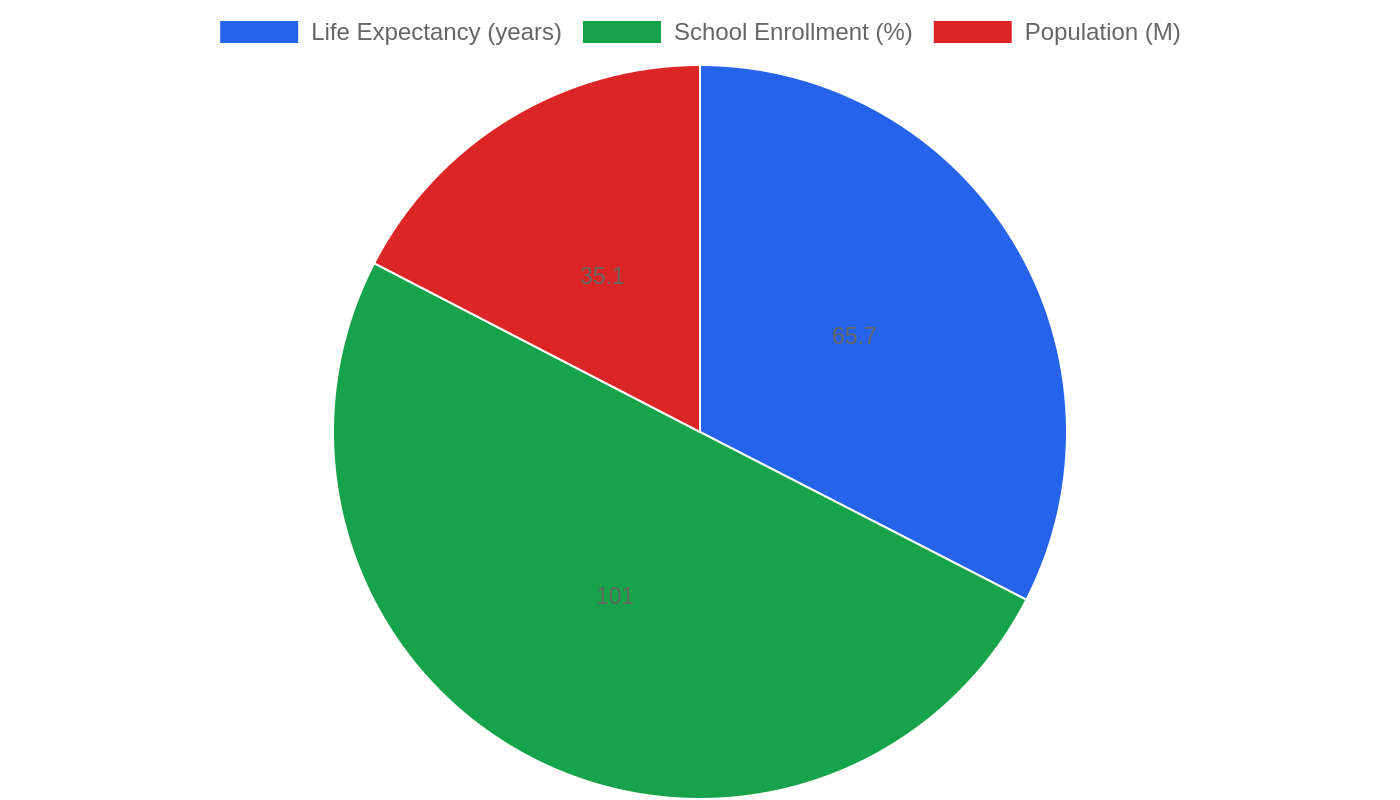
– With a GDP of $114.2 billion and a population exceeding 35 million, Ghana is a mid-sized West African economy, but its GNI per capita of just $2,630 signals significant income inequality.
– Unemployment stands at a remarkably low 2.979%, according to the World Bank, though this figure likely masks underemployment and informal sector dominance.
– The economy leans heavily on basic materials and financial services, with top companies spanning gold mining, banking, aviation, and brewing.
– Ghana’s political system, a unitary presidential constitutional democracy, has held steady since the Fourth Republic began in 1993, but the absence of recent GDP growth and inflation data leaves analysts guessing about the current economic trajectory.
The Growth Paradox — An Economy Waiting for a Number
The World Bank provides a snapshot of Ghana’s economy that is simultaneously detailed and frustratingly incomplete. The country’s GDP stands at approximately $114.2 billion, placing it among the larger economies in sub-Saharan Africa. Yet the “latest” GDP growth figure is listed as N/A—a glaring gap that speaks volumes about the data challenges facing even relatively well-tracked African economies.
What we do know is that Ghana’s GDP per capita, measured by purchasing power parity, is $8,610. That figure suggests a middle-income country, but the GNI per capita of just $2,630 tells a different story: the average Ghanaian earns less than $3,000 per year, and the gap between national output and personal income hints at significant foreign ownership of assets or profit repatriation.
Inflation, another critical indicator, is also listed as N/A by the World Bank. For a country that has historically wrestled with currency depreciation and price volatility, this absence is concerning. Ghana’s economy has traditionally been anchored by gold, cocoa, and more recently oil, but the data provided does not list main industries explicitly. However, the roster of top companies offers a clear window into the economic structure.
Ashanti Goldfields Corporation, a name synonymous with West African mining, leads the basic materials sector. Agricultural Development Bank of Ghana and AmalBank anchor the financials. The presence of four aviation companies—Aerogem Aviation, Afra Airlines, Africa World Airlines, and Antrak Air—suggests a sector that has grown to serve both domestic connectivity and regional trade. Accra Brewery Company, a consumer goods stalwart, points to a domestic market large enough to sustain manufacturing.
The unemployment figure of 2.979% is strikingly low by global standards. In most economies, such a number would signal a labor market at full employment. But in Ghana’s context, this figure likely reflects a narrow definition of unemployment that does not capture the vast informal economy—street vendors, small-scale farmers, and casual laborers who work but lack formal contracts, benefits, or stable incomes. The real story is not joblessness but underemployment and the struggle for quality work.
The Cost of Living — Where the Cedi Meets the Market
Without specific cost-of-living data from the World Bank, we must look at what the available numbers imply. A GNI per capita of $2,630 means the average Ghanaian lives on roughly $7.20 per day. Housing, food, transportation, and healthcare must all fit within that slender envelope. In Accra, the capital, rents have historically consumed a large share of household income, particularly in neighborhoods close to commercial centers.
The presence of a major brewery—Accra Brewery Company—suggests that consumer goods manufacturing is alive and well, but it also hints at the discretionary spending power of urban Ghanaians who can afford packaged beverages.
Compared to other West African economies, Ghana’s cost of living has often been elevated by imported inflation. The country imports a significant portion of its food and manufactured goods, and when the cedi weakens—as it has periodically—prices rise sharply for ordinary households. Rent versus buy decisions in Ghana are heavily skewed toward renting, as mortgage financing remains limited and land ownership is complicated by customary tenure systems.
For the majority of Ghanaians, housing is not a market choice but a family inheritance or a long-term savings project. The absence of formal housing data here underscores a broader challenge: the economy’s official statistics often fail to capture how most people actually live.
Investment and Business Climate — Gold, Banks, and the Skies
Ghana’s top companies list reads like a who’s who of the country’s economic pillars. Ashanti Goldfields Corporation, now part of AngloGold Ashanti, remains a heavyweight in basic materials and a major foreign exchange earner. The financial sector is well-represented by Agricultural Development Bank of Ghana and AmalBank, both of which serve a population that remains underbanked by global standards.
The aviation sector is unusually prominent for a country of Ghana’s size—four airlines on the top companies list suggests that air travel has become a critical artery for business and diaspora connections.
The business environment in Ghana has historically been considered one of the more favorable in West Africa. The country’s political stability, compared to neighbors like Côte d’Ivoire or Nigeria, has attracted foreign direct investment, particularly in mining and oil. However, the data does not provide recent indicators on ease of doing business, corruption perceptions, or regulatory quality.
What is clear is that the economy remains concentrated in a few sectors: basic materials (mining), financials (banking), and consumer services (aviation and brewing). For investors, the sectors to watch would logically be those where Ghana has natural advantages—gold, cocoa, and increasingly, technology services. But the absence of a tech company on the top ten list suggests that the digital economy, while growing, has not yet reached the scale of traditional industries.
Safety, Politics, and Quality of Life — Democracy’s Long March
Ghana’s political landscape, as described in the data, is a story of hard-won stability. The country is a unitary presidential constitutional democracy with a parliamentary multi-party system dominated by the NDC and NPP. The critical detail is that Ghana alternated between civilian and military governments until January 1993, when the military government finally gave way to the Fourth Republic.
That means Ghana has now enjoyed over three decades of uninterrupted civilian rule—a rare achievement in a region where coups have made a comeback in recent years.
The 1992 constitution divides powers among a commander-in-chief of the Ghana Armed Forces and other branches, establishing checks and balances that have held through multiple peaceful transfers of power. The two-party dominance of NDC and NPP has its drawbacks—it can marginalize smaller voices—but it has also provided predictability. Elections are fiercely contested but generally credible, and losing parties have accepted defeat.
This political stability is arguably Ghana’s greatest economic asset, providing the predictability that investors crave.
The data does not provide a crime index or safety index, so we cannot quantify security concerns. However, Ghana has historically been considered one of the safer countries in West Africa, with lower rates of violent crime than many peers. Petty crime in urban areas is a concern, but the country has not experienced the kind of insurgency or communal violence that has plagued parts of the Sahel.
Quality of life, for those with formal employment, is shaped by access to reliable electricity—still intermittent in many areas—and by a healthcare system that is under strain but improving. The absence of happiness or well-being data here is a gap, but anecdotal evidence from travelers and expatriates often highlights Ghana’s reputation for hospitality and social cohesion.
What’s Happening Now — A Democracy in Testing Times
The most striking feature of the current moment is what the data does not tell us. With GDP growth and inflation both listed as N/A by the World Bank, we are left to infer that Ghana is either in a period of statistical recalibration or facing data collection challenges that themselves signal economic strain. The country has faced significant headwinds in recent years: a debt restructuring program, currency depreciation, and the aftershocks of global commodity price swings.
Ghana defaulted on its external debt in late 2022 and has been negotiating with the International Monetary Fund for a bailout program. The data provided does not include these recent developments, but any informed observer would note that the absence of growth and inflation figures is itself a red flag.
The political calendar adds urgency. With elections scheduled, the NDC and NPP are gearing up for another contest. The outcome will determine whether Ghana continues its path of fiscal consolidation under IMF guidance or pivots toward more expansionary policies. The presence of four airlines on the top companies list suggests that domestic and regional travel is robust, but aviation is also a sector that suffers quickly when fuel prices rise or the currency weakens.
For the average Ghanaian, the immediate concern is the cost of living—and the lack of official inflation data makes it difficult to know whether the situation is improving or worsening.
The Bottom Line
Ghana remains one of Africa’s most important democracies and a bellwether for the continent’s economic prospects. Its low unemployment figure, stable political system, and diversified corporate sector—from gold mining to aviation—provide a foundation for growth. But the gaps in the data are telling: without recent GDP growth or inflation numbers, it is impossible to say with confidence whether Ghana is recovering, stagnating, or sliding backward.
Investors should watch this country for its political stability and resource wealth, but they should also demand better data. Citizens and policymakers alike need to know where the economy actually stands—because in the absence of numbers, perception becomes reality, and perception can be far more volatile.
Sources & Methodology
This article is authored by Economic Pulse Net for informational and research purposes. Economic Pulse Net sources its data from multilateral institutions, national statistics bureaus, and proprietary databases. All data is believed to be current as of the date of publication.
Published: July 23, 2026 | Category: Research — Ghana
Use these signals in your own platform
Economic Pulse publishes its live signal feed through a documented, read-only API. Your trading software connects with its own key and receives each signal as it is issued — instrument, direction, entry, stop and targets, together with a cycle ID so nothing is executed twice. The feed is independent of this website and cannot change it.
Signals are informational only and are not financial advice.