Economic Pulse Net | Sources: World Bank World Development Indicators, Government Sources | 2026
Key Takeaways
– Solomon Islands operates as a constitutional monarchy under King Charles III, with a parliamentary system that can dissolve itself before completing its four-year term, creating periodic political volatility.
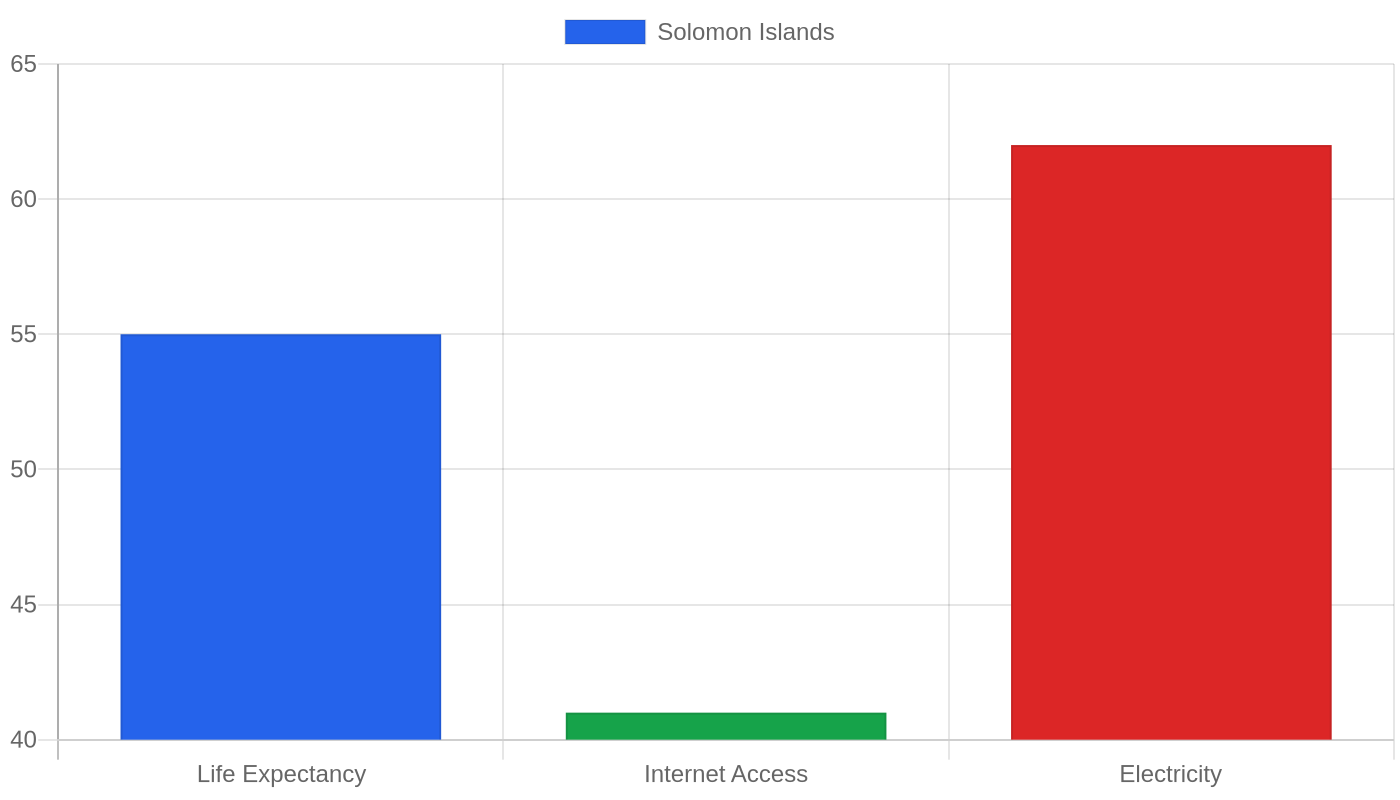
– The country’s economic data remains largely opaque to international observers, with the World Bank reporting no current figures on GDP growth, inflation, unemployment, or per capita income.
– As a Pacific Island nation, Solomon Islands faces structural challenges common to small island developing states: geographic isolation, vulnerability to climate shocks, and a narrow economic base.
– The country’s political landscape has drawn increasing international attention as it navigates competing influences between traditional Western partners and emerging Asian powers.
The Missing Numbers — Reading Between the Data Gaps
The World Bank’s economic database for Solomon Islands presents a curious case: virtually every standard metric—GDP growth, inflation, unemployment, GDP in dollar terms, GDP per capita, GNI per capita, and population—is listed as unavailable. For an economic journalist, this absence of data is itself a story.
It speaks to a country where statistical infrastructure is weak, where informal economic activity likely dwarfs formal sector reporting, and where international financial institutions struggle to maintain reliable tracking.
What we know from the structure of the economy is that Solomon Islands relies heavily on natural resources. Forestry, fisheries, and agriculture form the backbone of livelihoods for the vast majority of the population. Logging has been a dominant export sector for decades, though concerns about sustainability and depletion have long been raised by environmental observers. The country’s waters are rich in tuna, making fishing licenses and processing a significant revenue source.
Gold mining at the Gold Ridge mine has also contributed to export earnings, though operations have been intermittent due to both operational challenges and social conflicts.
The absence of inflation data does not mean prices are stable. In small island economies with high import dependence, inflation tends to be volatile and heavily influenced by global commodity prices, shipping costs, and exchange rate movements. Similarly, the lack of unemployment figures likely masks severe underemployment, particularly among youth in rural areas where subsistence agriculture remains the primary economic activity.
The Cost of Living — Remote Island Economics
Without specific cost-of-living indices from the provided data, we can draw on the structural realities of life in Solomon Islands. As a remote Pacific archipelago, the country imports the vast majority of manufactured goods, fuel, and processed foods. This import dependence means that prices in Honiara, the capital, are significantly higher than in regional hubs like Port Moresby or Suva, let alone Southeast Asian cities.
Housing in Honiara presents a particular challenge. Urban migration has outpaced formal housing development, leading to the growth of informal settlements on customary land around the capital. Rental costs in formal housing are high relative to local incomes, driven by limited supply and demand from expatriate workers and the small local elite.
For most Solomon Islanders, homeownership remains tied to customary land tenure systems, where access to land is governed by traditional clan structures rather than formal property markets. This creates a dual economy: a small formal property market in urban areas and a vast customary system where housing costs are measured in social obligations rather than cash.
Daily expenses for food are heavily influenced by seasonality and weather. When domestic gardens produce well and fishing is good, market prices fall. When cyclones or droughts disrupt local production, prices spike as imports fill the gap. This volatility makes household budgeting difficult and contributes to food insecurity for lower-income families.
Investment and Business Climate — Small Market, Big Stakes
The data provided does not list major companies operating in Solomon Islands, but the business environment can be understood through the lens of its economic structure. The formal private sector is dominated by a handful of large players in natural resources, retail, and banking. Foreign investment has historically come from Australia, New Zealand, and increasingly from China, particularly in logging, fishing, and infrastructure development.
The business climate faces well-documented challenges. The World Bank’s now-discontinued Doing Business index previously ranked Solomon Islands poorly on contract enforcement, property registration, and getting electricity. The legal system, which combines formal courts with customary dispute resolution, can be unpredictable for investors.
Land tenure complexity remains perhaps the single biggest barrier to investment: because 87% of land is held under customary ownership, securing land for commercial projects requires navigating complex clan politics and obtaining consensus from multiple stakeholders.
Sectors to watch include fisheries, where the country’s tuna resources continue to attract international processing and transshipment investment. Tourism remains underdeveloped relative to potential, held back by infrastructure gaps and limited international air connectivity. Telecommunications has seen improvement with the arrival of competing mobile networks, but internet penetration and speed still lag regional averages.
Safety, Politics, and Quality of Life — Navigating the Parliamentary Maze
Crime and safety indices are listed as unavailable in the provided data, but Solomon Islands has a reputation as a relatively safe country by regional standards, particularly outside Honiara. Violent crime is not widespread, though opportunistic theft and domestic violence remain concerns.
The Royal Solomon Islands Police Force has been rebuilt with substantial international assistance following the ethnic tensions of the early 2000s, when a period of civil conflict known as “the Tensions” led to a breakdown in law and order and an intervention by the Regional Assistance Mission to Solomon Islands (RAMSI).
The political landscape is defined by the constitutional structure described in the data. Solomon Islands is a constitutional monarchy with King Charles III as head of state, represented locally by a Governor-General chosen by Parliament for a five-year term. The unicameral Parliament has 50 members elected for four-year terms, with the crucial provision that Parliament may be dissolved by majority vote before completing its term. This mechanism has been used frequently, contributing to political instability.
No government in Solomon Islands’ history has served a full four-year term. Elections rarely produce clear majorities, leading to coalition governments that are inherently fragile and prone to defections.
This political fluidity has direct economic consequences. Policy continuity is difficult when governments change frequently. Major infrastructure projects and reform initiatives often stall or are reversed when new coalitions take power. The system also encourages patronage politics, where MPs prioritize delivering benefits to their constituencies over national economic management.
What’s Happening Now — The Geopolitical Tightrope
The most significant current development in Solomon Islands is the country’s shifting geopolitical alignment. In 2022, Solomon Islands signed a security pact with China, breaking with its traditional reliance on Australia for security cooperation. This agreement sent shockwaves through the Pacific region and beyond, raising concerns about potential Chinese military presence in the South Pacific and the implications for regional security architecture.
Domestically, the government of Prime Minister Manasseh Sogavare has pursued what it calls a “look north” policy, seeking closer economic and diplomatic ties with Beijing. This has brought significant Chinese infrastructure investment, including a new stadium for the 2023 Pacific Games and upgrades to telecommunications networks. However, it has also raised questions about debt sustainability, transparency of agreements, and the social impact of Chinese workers in the country.
The Pacific Games, hosted in Honiara in November 2023, represented a major milestone for the country. The event required massive infrastructure investment, including the new stadium, upgraded roads, and expanded accommodation. While the games showcased Solomon Islands to the region, questions remain about the maintenance costs of these facilities and whether they will generate lasting economic benefits beyond the event itself.
Meanwhile, climate change remains an existential threat. Rising sea levels, more intense cyclones, and changing rainfall patterns directly affect agriculture, fisheries, and coastal communities. The government has been active in international climate negotiations, advocating for the interests of vulnerable small island states. But domestic adaptation efforts are constrained by limited fiscal resources and technical capacity.
The Bottom Line
Solomon Islands is a country that matters far more than its economic size would suggest. Its location at the intersection of Pacific geopolitics, its resource wealth, and its fragile political system make it a bellwether for the broader dynamics shaping the region. Investors and diplomats watching the Pacific should pay close attention to Honiara: the choices made here about security partnerships, resource management, and political reform will have ripple effects across the region.
For the casual observer, Solomon Islands offers a window into the challenges and opportunities facing small island developing states in an era of great power competition and climate crisis.
Sources & Methodology
This article is authored by Economic Pulse Net for informational and research purposes. Economic Pulse Net sources its data from multilateral institutions, national statistics bureaus, and proprietary databases. All data is believed to be current as of the date of publication.
Published: July 23, 2026 | Category: Research — Solomon Islands
Use these signals in your own platform
Economic Pulse publishes its live signal feed through a documented, read-only API. Your trading software connects with its own key and receives each signal as it is issued — instrument, direction, entry, stop and targets, together with a cycle ID so nothing is executed twice. The feed is independent of this website and cannot change it.
Signals are informational only and are not financial advice.