Economic Pulse Net | Sources: World Bank World Development Indicators, Government Sources | 2026
Key Takeaways
* High Inflation Pressure: Consumer prices are rising sharply, with the CPI hovering around 14.2%, signaling significant cost-of-living challenges for households and businesses alike.
Resilient Democratic Framework: As a unitary presidential constitutional democracy, Ghana maintains political stability through a two-party system dominated by the National Democratic Congress (NDC) and the New Patriotic Party (NPP), having transitioned to civilian rule in 1993.
Diversified Industrial Base: The economy is supported by key sectors including consumer goods, aviation, basic materials, and financial services, anchored by major players like Ashanti Goldfields Corporation and Accra Brewery Company.
Economic Scale: With a GDP of approximately $114.2 billion and a GNI per capita of $2,630, Ghana presents a mid-sized emerging market opportunity, though income disparities remain evident when compared to PPP-adjusted metrics.
Economic Pulse: Navigating High Inflation
Ghana’s economic landscape is currently defined by the tension between its substantial output and the erosive effects of high inflation. According to World Bank data, the country’s Gross Domestic Product stands at roughly $114.2 billion, indicating a robust aggregate economic engine. However, this scale masks the immediate pressures faced by consumers, as the Consumer Price Index (CPI) has reached 14.2046755548989%.
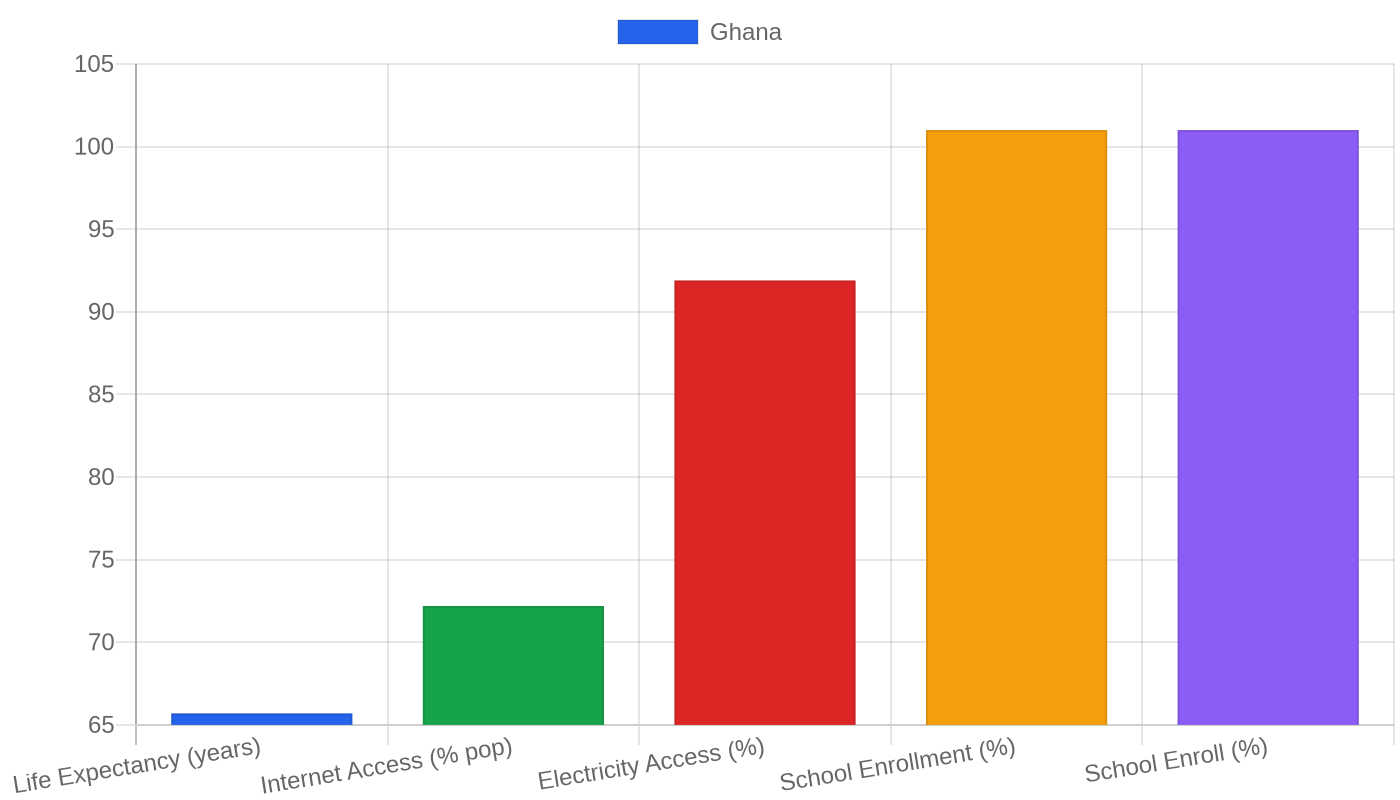
This double-digit inflation rate suggests that the purchasing power of the average citizen is under significant strain, potentially dampening domestic consumption and savings rates. While the GDP per capita adjusted for Purchasing Power Parity (PPP) sits at $8,610.28, reflecting a higher standard of living relative to nominal costs, the nominal GNI per capita remains lower at $2,630.
This discrepancy highlights the importance of contextualizing wealth; while goods may be relatively affordable in local currency terms due to PPP adjustments, the broader macroeconomic environment is volatile. The absence of current unemployment data and specific population figures limits a complete labor market analysis, but the inflation metric alone serves as a critical warning sign for monetary policy effectiveness.
Investors and policymakers must therefore prioritize price stability measures to protect the real value of the nation’s economic output.
Living Costs: The Burden on Households
The daily reality for residents in Ghana is increasingly shaped by the steep rise in the cost of living. With inflation clocking in at over 14%, the expense of basic necessities, housing, and utilities is likely absorbing a larger portion of household budgets than in previous years. Although specific rental yield data or housing index figures are not provided in the current dataset, the general trend of high CPI implies that both renting and buying property have become more expensive relative to income levels.
For expatriates and local families alike, managing cash flow requires careful budgeting, as the gap between nominal wages and actual purchasing power widens. The lack of detailed crime indices prevents a full assessment of how safety concerns might influence housing premiums in certain neighborhoods, but the economic pressure is uniform across the board.
Businesses operating in the consumer sector must navigate these margins carefully, as price sensitivity among consumers increases during periods of such rapid inflation. Consequently, the affordability of daily life remains a central concern for social stability and long-term economic health.
Investment & Business Climate: Anchors of Industry
Despite macroeconomic headwinds, Ghana’s business ecosystem is anchored by a diverse array of established companies and industries. The corporate landscape features significant players in the consumer goods sector, such as Accra Brewery Company, which continues to serve a vital role in the local market. The industrial and aviation sectors are represented by entities like Aerogem Aviation, Afra Airlines, Africa World Airlines, and Antrak Air, indicating a active, albeit competitive, transport network.
Furthermore, the basic materials sector is bolstered by African Champion Industries, Aluworks, and the historically significant Ashanti Goldfields Corporation, underscoring the enduring importance of mining and manufacturing. On the financial front, institutions like the Agricultural Development Bank of Ghana and AmalBank provide essential credit and banking services to support agricultural and commercial activities.
These companies represent stable pillars within the economy, offering potential investment opportunities even amidst inflationary pressures. Their presence suggests a mature corporate environment where established brands and infrastructure can withstand short-term economic volatility.
Safety, Politics & Quality of Life: A Stable Foundation
Ghana distinguishes itself in the region through its consistent adherence to democratic principles and political continuity. The country operates as a unitary presidential constitutional democracy with a parliamentary multi-party system, a structure that has ensured peaceful transitions of power since the establishment of the Fourth Republic in January 1993.
Political discourse is largely dominated by two major parties—the National Democratic Congress (NDC) and the New Patriotic Party (NPP)—which alternates governance and provides a clear framework for political engagement. Prior to 1993, Ghana experienced alternating periods of civilian and military rule, but the current constitution clearly divides powers among the executive, legislative, and judicial branches, with the President serving as commander-in-chief of the Ghana Armed Forces.
While specific crime and safety indices are listed as N/A in the provided data, the political stability and strong institutional framework suggest a relatively secure environment for residents and investors. The transition from military to civilian control decades ago laid the groundwork for the current quality of life, characterized by civil liberties and regular elections. This political maturity reduces the risk of sudden upheaval, making Ghana a safer haven compared to some regional peers.
What’s Happening Now: Policy and Market Dynamics
The current economic narrative in Ghana is heavily focused on managing the repercussions of elevated inflation and maintaining fiscal discipline. With the CPI recorded at 14.2046755548989%, the government and central bank are likely implementing tightening measures to curb price growth and stabilize the currency.
The recent history of shifting from military to civilian rule in 1992/1993 sets a precedent for adaptive governance, suggesting that current policies will be refined through democratic processes rather than abrupt decrees. Companies in the aviation and consumer sectors are adjusting strategies to cope with reduced consumer spending power, focusing on efficiency and core product offerings.
The ongoing dominance of the NDC and NPP ensures that any major economic reforms will be subject to parliamentary debate and public scrutiny, adding a layer of transparency to policy shifts. Meanwhile, the financial sector, led by banks like AmalBank and the Agricultural Development Bank, plays a crucial role in providing liquidity to keep businesses afloat during this inflationary period.
The focus remains on preserving the gains of the Fourth Republic while addressing the immediate cost-of-living crisis facing the populace.
The Bottom Line
Ghana offers a compelling mix of political stability and economic complexity for observers and investors. The country’s strong democratic credentials and diversified industrial base provide a solid foundation for long-term engagement. However, the high inflation rate of 14.2% demands caution and strategic planning from those looking to operate within its markets.
Those who can navigate the cost-of-living pressures while leveraging the established corporate infrastructure are well-positioned to benefit from Ghana’s resilient economic trajectory.
Sources & Methodology
This article is authored by Economic Pulse Net for informational and research purposes. Economic Pulse Net sources its data from multilateral institutions, national statistics bureaus, and proprietary databases. All data is believed to be current as of the date of publication.
Published: October 12, 2026 | Category: Research — Ghana
Use these signals in your own platform
Economic Pulse publishes its live signal feed through a documented, read-only API. Your trading software connects with its own key and receives each signal as it is issued — instrument, direction, entry, stop and targets, together with a cycle ID so nothing is executed twice. The feed is independent of this website and cannot change it.
Signals are informational only and are not financial advice.