Economic Pulse Net | Sources: World Bank World Development Indicators, Government Sources | 2026
Key Takeaways
* Robust Growth Trajectory: Ghana’s economy is projected to expand by nearly 6% in 2025, signaling a strong recovery phase despite lingering macroeconomic pressures.
Inflationary Pressure Persists: With CPI inflation hovering around 14.2%, the cost of living remains a significant challenge for households and consumers across the nation.
Low Unemployment Rate: The labor market shows remarkable tightness, with an unemployment rate of just under 3%, indicating high labor participation or structural shifts in employment dynamics.
Stable Democratic Framework: As a unitary presidential constitutional democracy, Ghana continues to operate under the Fourth Republic’s framework, alternating power between the NDC and NPP since 1993.
Economic Engine: Growth vs. Price Stability
Ghana’s economic landscape in 2025 presents a complex picture of robust expansion tempered by persistent price instability. According to World Bank data, the country’s GDP growth is projected at 5.95%, a figure that underscores a resilient economic engine capable of generating substantial output. However, this growth occurs against the backdrop of a high inflation rate, with the Consumer Price Index (CPI) recorded at approximately 14.2%.
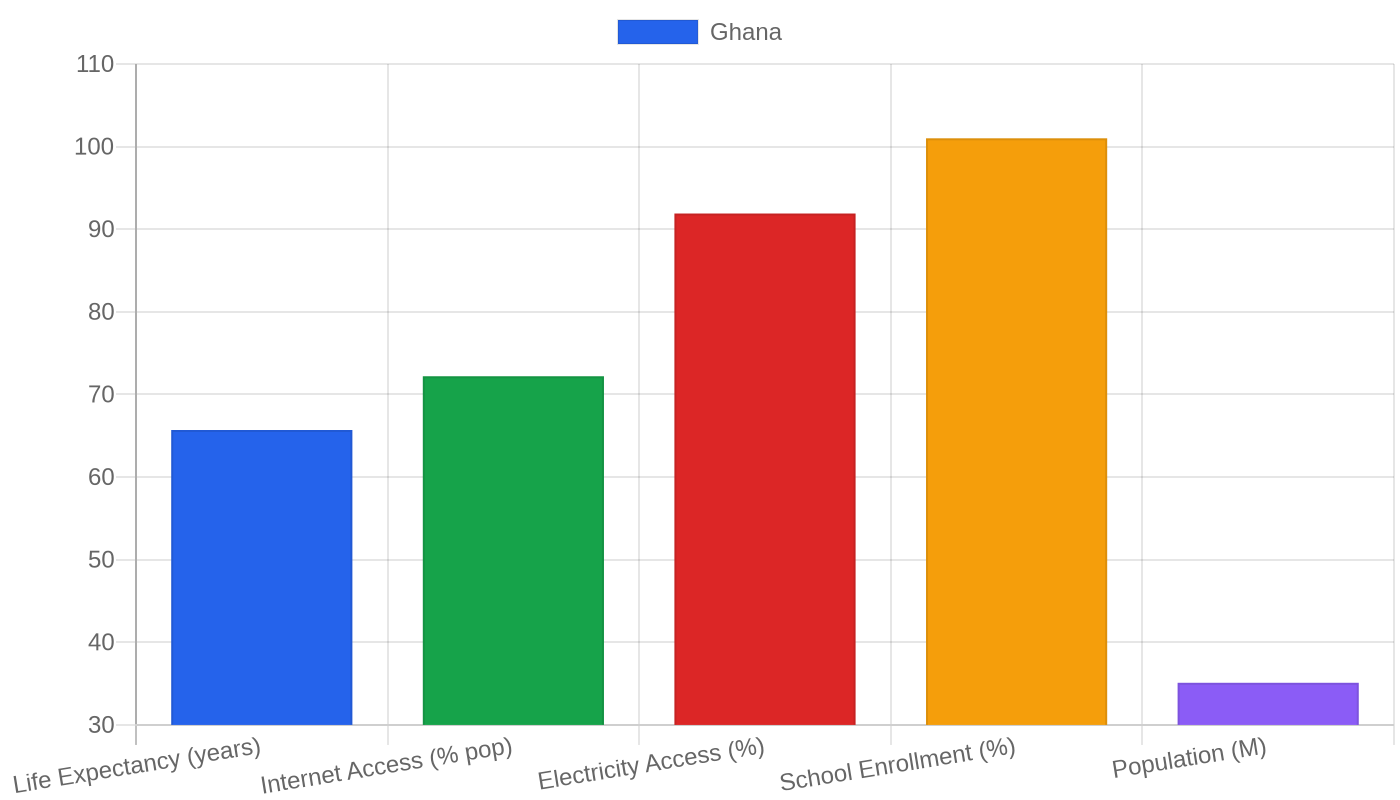
This disparity suggests that while the economy is expanding, the purchasing power of its citizens is being eroded by rising costs. The total GDP stands at roughly $114.2 billion USD, reflecting a mid-sized emerging market economy. On a per capita basis, the Gross National Income is listed at $2,630, highlighting the income levels of the population of over 35 million people.
While the unemployment rate is notably low at 2.98%, this statistic must be viewed alongside the high inflation; low joblessness does not necessarily equate to improved affordability if wages do not keep pace with the 14.2% inflation rate. These numbers indicate an economy that is producing more but facing significant challenges in maintaining real value for its workers and consumers.
Daily Realities: The Cost of Living Challenge
For the average Ghanaian resident, the economic headline figures translate into daily financial strain driven primarily by inflation. With the CPI at 14.2%, the cost of essential goods and services has risen sharply, impacting household budgets significantly. While specific housing cost metrics are not detailed in the current dataset, the general trend of high inflation invariably affects rent and property values, making homeownership and rental agreements more expensive for families.
The GDP per capita based on Purchasing Power Parity (PPP) is estimated at $8,610, which provides a snapshot of the standard of living relative to local prices, yet it sits in contrast to the GNI per capita of $2,630. This gap highlights the complexity of measuring wealth in Ghana, where informal sectors and local purchasing power differ from global nominal incomes. For businesses operating within this environment, pricing strategies must be agile to cope with the volatile cost structure.
Consumers are likely navigating a landscape where daily expenses consume a larger portion of their income than in previous years, necessitating careful budgeting amidst the 5.95% overall economic growth.
Investment & Business Climate: Industrial Foundations
The investment landscape in Ghana is anchored by a diverse array of established companies spanning consumer goods, aviation, and basic materials. Major entities such as Accra Brewery Company dominate the consumer goods sector, providing stability in the face of inflationary pressures through brand loyalty and scale.
In the industrial and aviation sectors, firms like Aerogem Aviation, Afra Airlines, Africa World Airlines, and Antrak Air illustrate the country’s connectivity and service-oriented economic activities. The presence of African Champion Industries and Aluworks points to a growing interest in basic materials and manufacturing, suggesting potential upstream opportunities for investors.
Financial stability is supported by institutions like the Agricultural Development Bank of Ghana and AmalBank, which facilitate credit flow to various parts of the economy. Notably, the Ashanti Goldfields Corporation remains a key player in the basic materials sector, leveraging Ghana’s historical strength in gold mining.
These top companies represent a mix of consumer-facing and industrial players, offering a diversified entry point for foreign and domestic capital looking to engage with Ghana’s structured corporate environment.
Safety, Politics & Quality of Life: A Stable Democracy
Ghana’s political environment remains one of its strongest assets, characterized by a unitary presidential constitutional democracy with a parliamentary multi-party system. Since the transition to the Fourth Republic in January 1993, following the end of military rule, the country has maintained a stable democratic framework dominated by two major parties: the National Democratic Congress (NDC) and the New Patriotic Party (NPP).
This alternation of power between civilian governments ensures a degree of political predictability crucial for long-term business planning. The 1992 constitution clearly divides powers among the executive, legislative, and judicial branches, with the President serving as both head of state and commander-in-chief of the Ghana Armed Forces. Regarding safety, specific crime and safety indices are currently listed as N/A, meaning precise statistical comparisons cannot be made.
However, the historical context of peaceful political transitions and the absence of recent civil unrest suggest a generally secure environment for residents and expatriates alike. The quality of life is thus underpinned by institutional stability, even as economic indicators like inflation pose daily challenges.
What’s Happening Now: Navigating the Transition
Currently, Ghana is navigating a period of economic recalibration marked by the interplay between strong GDP growth and high inflationary trends. The 5.95% growth projection for 2025 indicates that policy measures are likely supporting production and consumption, even as the 14.2% CPI reflects ongoing monetary pressures. Investors and policymakers are closely watching how the government manages the balance between stimulating growth and curbing price increases.
The dominance of the NDC and NPP in the political landscape means that any major economic reforms will need bipartisan support or strong executive leadership to pass effectively. With unemployment remaining low at 2.98%, the focus may be shifting toward wage growth and productivity enhancements rather than job creation alone. The performance of key industries, particularly in aviation and basic materials, will serve as leading indicators for the broader economic health.
As the year progresses, the ability of Ghana to sustain its double-digit inflation below the single-digit target range will be critical for restoring consumer confidence and attracting further foreign direct investment.
The Bottom Line
Ghana presents a compelling case for observers interested in stable democracies with emerging market growth potential. The juxtaposition of nearly 6% GDP growth against 14% inflation creates a nuanced investment environment where risk and reward are closely balanced. Investors should watch how the country leverages its industrial base and political stability to manage inflationary pressures in the coming years.
For those seeking exposure to West African markets, Ghana offers a structured, albeit challenging, economic landscape worth monitoring.
Sources & Methodology
This article is authored by Economic Pulse Net for informational and research purposes. Economic Pulse Net sources its data from multilateral institutions, national statistics bureaus, and proprietary databases. All data is believed to be current as of the date of publication.
Published: September 24, 2026 | Category: Research — Ghana
Use these signals in your own platform
Economic Pulse publishes its live signal feed through a documented, read-only API. Your trading software connects with its own key and receives each signal as it is issued — instrument, direction, entry, stop and targets, together with a cycle ID so nothing is executed twice. The feed is independent of this website and cannot change it.
Signals are informational only and are not financial advice.