Economic Pulse Net | Sources: World Bank World Development Indicators, Government Sources | 2026
Key Takeaways
– Eritrea remains one of the world’s most isolated economies, with no official GDP, inflation, or employment figures published for years.
– The country has never held national elections since independence in 1993, with President Isaias Afwerki in power for over three decades.
– The People’s Front for Democracy and Justice (PFDJ) is the only legal political party, and opposition groups are banned from organizing.
– A constitution providing for multi-party politics was adopted in 1997 but has never been implemented.
– With no reliable economic data, analysts must piece together the country’s trajectory from political developments and regional context.
The Numbers That Don’t Exist: Reading Eritrea’s Economic Silence
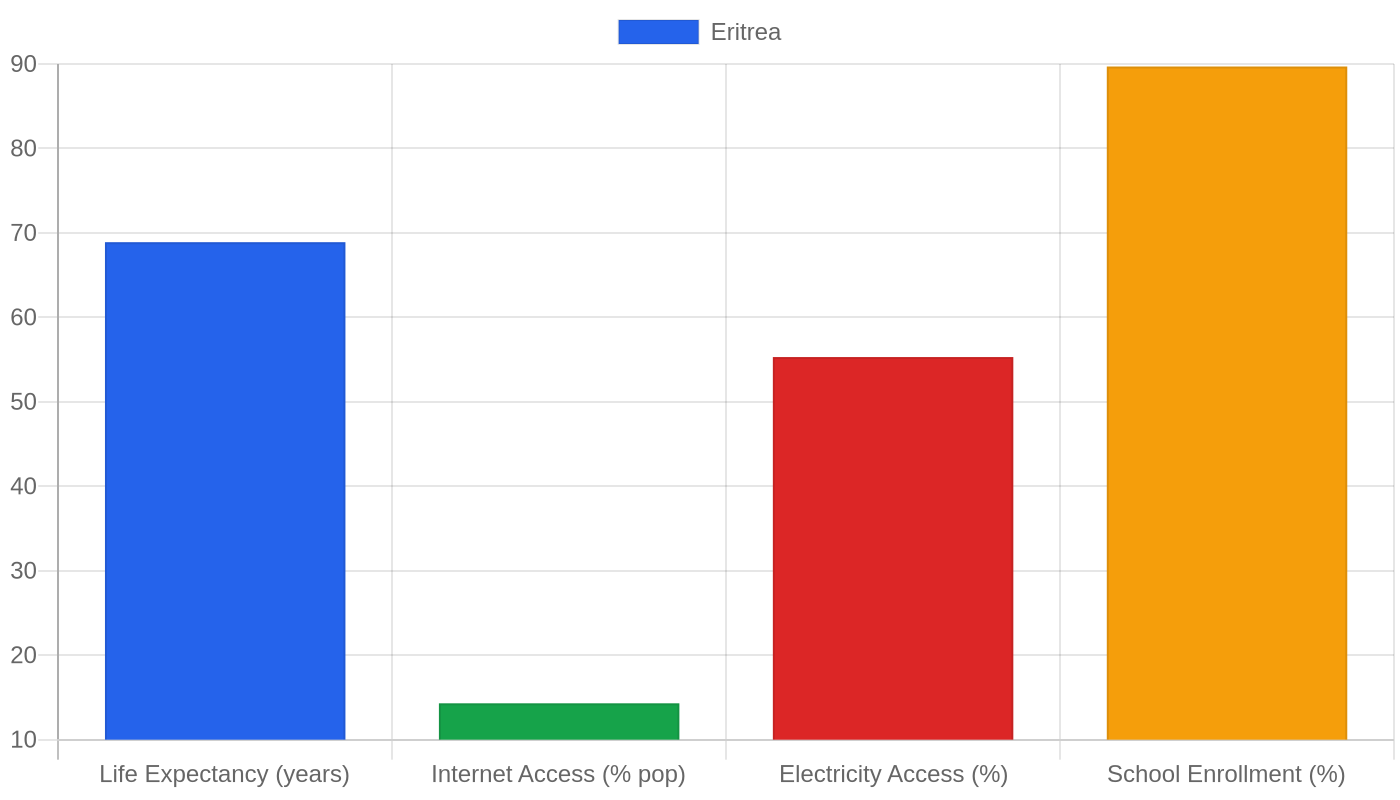
The World Bank’s latest dataset on Eritrea is striking for what it does not contain. GDP growth: not available. Inflation: not available. Unemployment: not available. GDP per capita: not available. Even the population figure is listed as not available. For most countries, economic statistics are the vital signs that tell analysts whether the patient is thriving or failing.
For Eritrea, the absence of data is itself the diagnosis — this is an economy that has effectively disappeared from international monitoring.
This statistical black hole is not accidental. Since independence in 1993, the Eritrean government has maintained an extraordinary level of opacity about its economic affairs. The country does not regularly report to international financial institutions, and independent economic research is virtually impossible to conduct within its borders.
What analysts know is that Eritrea’s economy has historically relied on agriculture, mining, and remittances from its large diaspora — but even these sectors’ contributions cannot be quantified with any confidence.
The lack of data matters beyond academic curiosity. International investors cannot price risk without information, aid organizations cannot target assistance without needs assessments, and policymakers cannot design reforms without baselines. Eritrea’s economic silence has effectively excluded it from global capital markets and most multilateral development programs.
The country operates, in economic terms, as a closed system — with all the inefficiencies, shortages, and distortions that such isolation typically produces.
What little is known suggests an economy under severe strain. The government has maintained mandatory national service policies that critics say function as forced labor, while young Eritreans continue to flee the country in large numbers. The mining sector has attracted some foreign investment, particularly in gold and other minerals, but the overall business environment remains one of the most restrictive in the world.
Without official data, these observations remain anecdotal — but they are consistent with the pattern of a state that prioritizes control over growth.
The Price of Everything, The Value of Nothing: Living Costs in a Data Vacuum
For the ordinary Eritrean, the cost of living is an immediate and pressing concern, even if international databases record nothing about it. The country’s economy has been characterized by chronic shortages of basic goods, high prices for imported commodities, and a currency that has been subject to repeated devaluations. Housing, particularly in the capital Asmara, is scarce and expensive relative to local incomes, with many families relying on extended kinship networks to secure shelter.
The absence of reliable inflation data is particularly troubling. Eritrea has experienced episodes of severe price instability in the past, and the government’s tight control over foreign exchange and imports suggests that inflationary pressures are managed through administrative means rather than market mechanisms. This approach typically results in queuing, rationing, and the emergence of parallel markets — all of which impose hidden costs on households that official statistics would not capture anyway.
Compared to regional neighbors, Eritrea’s living standards are widely believed to be lower, though the lack of comparable data makes definitive statements impossible. The country’s development indicators, where they exist at all, point to significant challenges in health, education, and infrastructure. For most Eritreans, daily life involves navigating a system where goods are scarce, opportunities are limited, and the state’s presence is pervasive.
Business Behind Closed Doors: Investment in a One-Party State
The investment climate in Eritrea is defined by the dominance of the ruling party’s business interests. The PFDJ controls a sprawling network of companies that operate across key sectors of the economy, from construction and transportation to import-export trade. This arrangement creates a fundamentally uneven playing field, where private businesses must compete against entities that have access to state resources, foreign exchange, and regulatory protection.
Foreign investment has been limited and carefully controlled. The mining sector has attracted the most attention, with several international companies operating gold and base metal projects in the country. These ventures have been controversial, with human rights groups raising concerns about the use of forced labor and the opaque terms of government partnerships.
Despite these concerns, the potential for mineral wealth remains significant, and the sector continues to draw interest from companies willing to navigate Eritrea’s challenging environment.
For domestic entrepreneurs, the barriers to entry are formidable. Starting a business requires navigating a bureaucratic system that is slow, unpredictable, and often corrupt. Access to credit is extremely limited, as the banking sector is small and state-dominated. The government’s policy of self-reliance, while rhetorically appealing, has in practice meant that the private sector is starved of the capital, technology, and expertise needed to grow.
The result is an economy that is stagnant, with few opportunities for legitimate business expansion.
Safety, Surveillance, and the Long Shadow of 1993
Crime statistics for Eritrea are as unavailable as economic data, but the country’s security situation is shaped less by ordinary criminality than by the pervasive presence of the state. The government maintains extensive surveillance networks, and political expression is tightly controlled. The National Assembly, with its 150 seats, exists on paper, but national elections have been periodically scheduled and cancelled since independence — none have ever been held.
President Isaias Afwerki has been in office since 1993, making him one of the longest-serving leaders in Africa. The 1997 constitution, which would have provided for multi-party politics, remains unimplemented. The PFDJ is the only legal party, and other political groups are not allowed to organize. This political landscape has profound implications for quality of life, as citizens cannot freely express dissent, organize collectively, or hold their leaders accountable through electoral processes.
The lack of political freedom has contributed to a steady exodus of Eritreans seeking refuge abroad. The diaspora is large and active, sending remittances that are believed to be a crucial source of foreign exchange — though official figures are not available. For those who remain, the trade-off between security and freedom is starkly skewed toward control. The country is generally peaceful in terms of internal conflict, but this peace is maintained through repression rather than consent.
The Frozen State: What’s Happening in Eritrea Right Now
As of 2025, Eritrea remains locked in a political and economic stasis that shows no signs of breaking. The government continues to resist international pressure for political reform, insisting that the country’s unique circumstances require a different developmental path. There have been no recent signs of movement toward elections, constitutional implementation, or opening of the political space.
The country’s regional position remains tense, with unresolved border issues and periodic diplomatic spats with neighbors. The government’s foreign policy has been characterized by a prickly independence, often alienating potential partners and donors. This isolation has economic consequences, as Eritrea cannot access the international financing that might support development projects or provide a cushion against external shocks.
The mining sector continues to operate, representing one of the few bright spots in an otherwise dim economic picture. However, the benefits of mineral extraction are believed to accrue primarily to the state and its partners, with limited spillover to the broader population. There are no signs of economic reform, no indications that the government is considering opening the economy, and no evidence that the leadership is preparing for a post-Isaias transition.
The Bottom Line
Eritrea is a country that time forgot — or, more precisely, a country whose leadership has deliberately frozen time to preserve its grip on power. With no economic data, no elections, and no political liberalization, it offers almost nothing to conventional investors or development partners. The country is primarily of interest to those tracking authoritarian governance, forced labor, and the consequences of international isolation.
For Eritreans, the costs of this stagnation are measured in lost opportunities, suppressed freedoms, and the steady erosion of hope. The only question is how long the freeze can last — and what happens when it thaws.
Sources & Methodology
This article is authored by Economic Pulse Net for informational and research purposes. Economic Pulse Net sources its data from multilateral institutions, national statistics bureaus, and proprietary databases. All data is believed to be current as of the date of publication.
Published: July 31, 2026 | Category: Research — Eritrea
Use these signals in your own platform
Economic Pulse publishes its live signal feed through a documented, read-only API. Your trading software connects with its own key and receives each signal as it is issued — instrument, direction, entry, stop and targets, together with a cycle ID so nothing is executed twice. The feed is independent of this website and cannot change it.
Signals are informational only and are not financial advice.