Economic Pulse Net | Sources: World Bank World Development Indicators, Government Sources | 2026
Key Takeaways
* Political Monolith: Eritrea remains under the absolute control of the People’s Front for Democracy and Justice (PFDJ), with no national elections held since independence in 1993 despite a constitution that allows for multi-party politics.
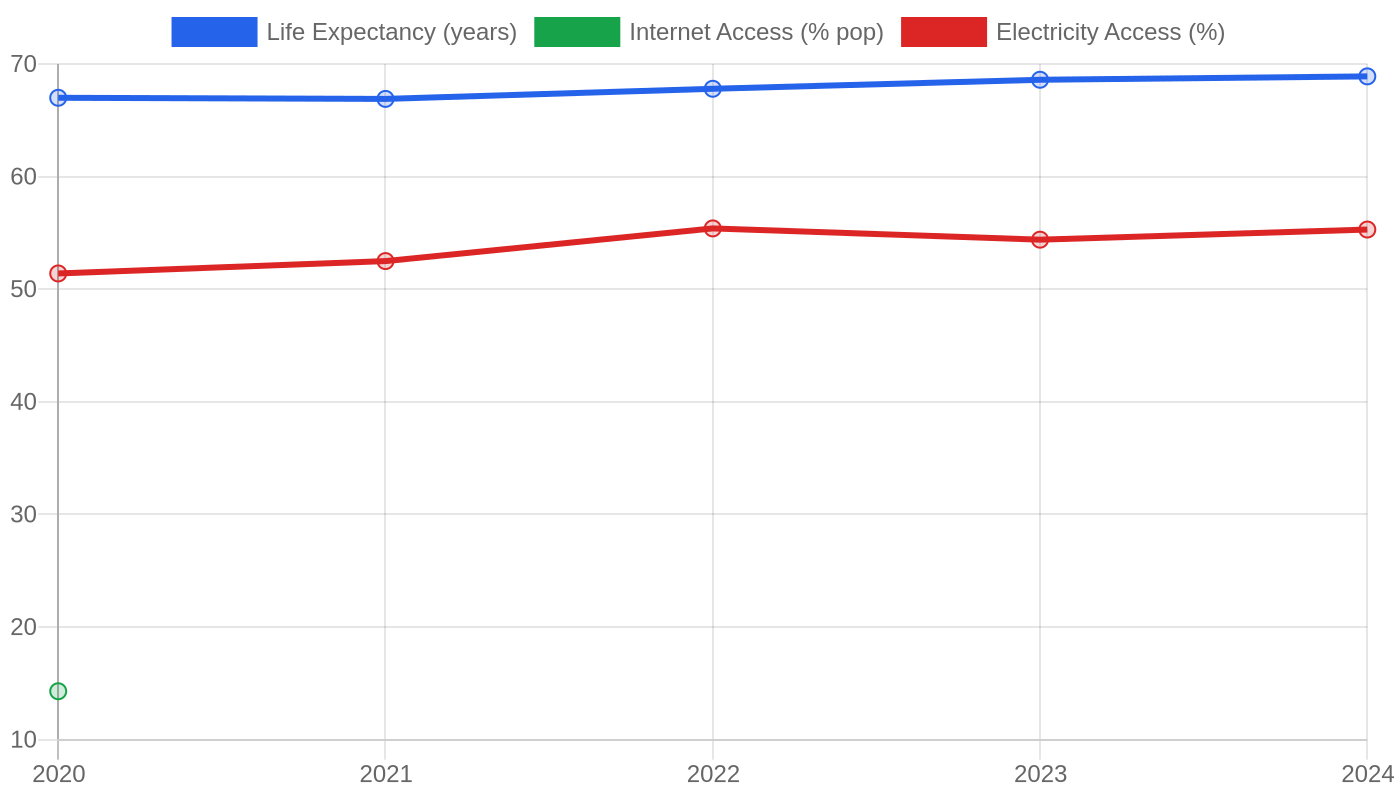
Data Vacuum: Critical economic indicators, including GDP growth, inflation, unemployment, and population figures, are currently unavailable from major international bodies like the World Bank, reflecting the country’s opacity.
Industrial Ambiguity: While specific industry breakdowns and top corporate entities are not detailed in current datasets, the economy operates within a highly restricted environment where state control is paramount.
Safety and Rights: With crime and safety indices unreported, the primary risk factor for residents and investors is political rather than criminal, defined by the absence of legal opposition parties and indefinite national service.
Stagnant Governance: President Isaias Afwerki has maintained power since 1993, creating a stable but isolated political landscape that discourages foreign direct investment and transparency.
The Economic Void
The most striking feature of Eritrea’s economic profile in 2026 is not what is growing, but what is missing. According to the latest data from the World Bank, key macroeconomic indicators such as GDP growth, inflation rates, unemployment figures, and total GDP in USD are listed as “N/A.” This statistical blackout is not merely an administrative oversight; it is a structural characteristic of an economy that refuses to integrate into global monitoring systems.
Without official figures on GDP per capita or Gross National Income (GNI), analysts cannot assess the standard of living or the purchasing power parity of the Eritrean citizenry. Similarly, the lack of population data makes it impossible to calculate labor force participation or demographic shifts accurately. For an outside observer, this creates a blind spot where traditional economic models fail because the input variables do not exist.
The absence of these numbers suggests a closed-loop system where economic activity is either informal, state-managed without public reporting, or simply too sensitive to disclose. Consequently, any attempt to gauge the health of the Eritrean economy must rely on qualitative assessments rather than quantitative metrics, leaving investors and policymakers navigating in the dark.
Cost of Living and Daily Realities
In the absence of official consumer price index (CPI) data, the cost of living in Eritrea remains an opaque subject for international comparison. The provided dataset indicates that specific cost-of-living metrics are not available, which prevents a direct calculation of housing costs, rental yields, or daily expense ratios against regional neighbors.
Typically, in economies with such limited transparency, prices for basic goods are heavily influenced by state subsidies or black-market exchange rates rather than free market dynamics. Without verifiable data on rent versus buy ratios, potential expatriates or long-term residents cannot benchmark their financial planning against known standards.
This lack of clarity extends to essential services, where the true cost of utilities, transportation, and food is often hidden behind complex bureaucratic hurdles or informal payments. While we cannot cite specific dollar amounts for a loaf of bread or a square meter of apartment space, the general consensus among those familiar with the region suggests that affordability is tightly controlled by the state.
The inability to access reliable housing or retail pricing data further isolates the local population from global economic trends, forcing reliance on internal networks for survival and trade.
Investment and Business Climate
The business environment in Eritrea is defined by its extreme restriction and lack of private sector dynamism. The dataset reveals that information regarding top companies and main industries is largely absent, indicating that there is no visible roster of publicly traded firms or dominant private conglomerates driving the economy. In such a context, major economic activities are likely concentrated in state-owned enterprises or small-scale informal ventures that do not appear in global business registries.
For foreign investors, the lack of identifiable corporate structures presents a significant barrier to entry, as due diligence becomes nearly impossible without transparent financial records. There are no clear sectors highlighted for immediate watch-listing, suggesting that opportunities are either non-existent or strictly reserved for government allies.
The political landscape, dominated by a single party, means that commercial success is inextricably linked to political loyalty rather than competitive efficiency. This environment discourages innovation and entrepreneurship, as the rewards for business are determined by proximity to power rather than market performance. Consequently, the investment climate is best described as frozen, with minimal room for organic growth or external capital infusion.
Safety, Politics, and Quality of Life
Quality of life in Eritrea is heavily dictated by the rigid political framework established by the People’s Front for Democracy and Justice (PFDJ). As the only legal political party, the PFDJ maintains total control over the National Assembly, which holds 150 seats, yet no national elections have ever been conducted since independence in 1993.
President Isaias Afwerki has remained in office continuously since that year, operating under an unimplemented 1997 Constitution that theoretically permits multi-party politics but does not allow them in practice. Regarding personal safety, both the Crime Index and Safety Index are reported as N/A, making it difficult to quantify physical security risks using standard international benchmarks.
However, the political stability provided by this authoritarian regime comes at the cost of civil liberties and personal freedom. The absence of democratic processes and the suppression of other political groups create a society where dissent is not tolerated, leading to a unique form of safety based on compliance rather than law enforcement efficacy. For residents, the primary concern is not street crime but rather the pervasive surveillance and control exerted by the state apparatus.
Current Affairs and Political Stagnation
As of 2025, the political situation in Eritrea remains static, with no progress toward the scheduled national elections that have been repeatedly cancelled over the past three decades. The National Assembly continues to function under the sole authority of the PFDJ, with no new political groups allowed to organize or challenge the status quo. This stagnation means that there are no recent policy shifts, reforms, or legislative changes that would alter the economic or social landscape in the near future.
The live indicators for the country suggest a continued isolation from global diplomatic and economic engagements, reinforcing the data vacuum seen in World Bank statistics. Without upcoming elections or constitutional reviews, the trajectory of the country remains unchanged, with President Afwerki retaining full executive power.
This lack of political evolution translates directly into economic predictability, albeit a negative one, as businesses and citizens operate under the same set of restrictive rules indefinitely. The current affairs section of Eritrea’s story is essentially a narrative of continuity, where the absence of change is the defining characteristic of the present moment.
The Bottom Line
Eritrea represents a unique case study in economic and political isolation, where the lack of data is itself a critical data point. Investors and researchers should view the country not as a emerging market with untapped potential, but as a closed system with negligible integration into the global economy. The absence of GDP figures, corporate listings, and safety indices signals that the risks far outweigh any theoretical opportunities.
For those monitoring the Horn of Africa, Eritrea serves as a reminder of how political rigidity can stifle economic visibility and development. It is a country to observe for its geopolitical stance, but not for its economic promise.
Sources & Methodology
This article is authored by Economic Pulse Net for informational and research purposes. Economic Pulse Net sources its data from multilateral institutions, national statistics bureaus, and proprietary databases. All data is believed to be current as of the date of publication.
Published: September 26, 2026 | Category: Research — Eritrea
Use these signals in your own platform
Economic Pulse publishes its live signal feed through a documented, read-only API. Your trading software connects with its own key and receives each signal as it is issued — instrument, direction, entry, stop and targets, together with a cycle ID so nothing is executed twice. The feed is independent of this website and cannot change it.
Signals are informational only and are not financial advice.