Economic Pulse Net | Sources: World Bank World Development Indicators, Government Sources | 2026
Key Takeaways
* Political Stagnation: Eritrea remains a one-party state under President Isaias Afwerki, with no national elections held since independence in 1993 despite a ratified constitution.
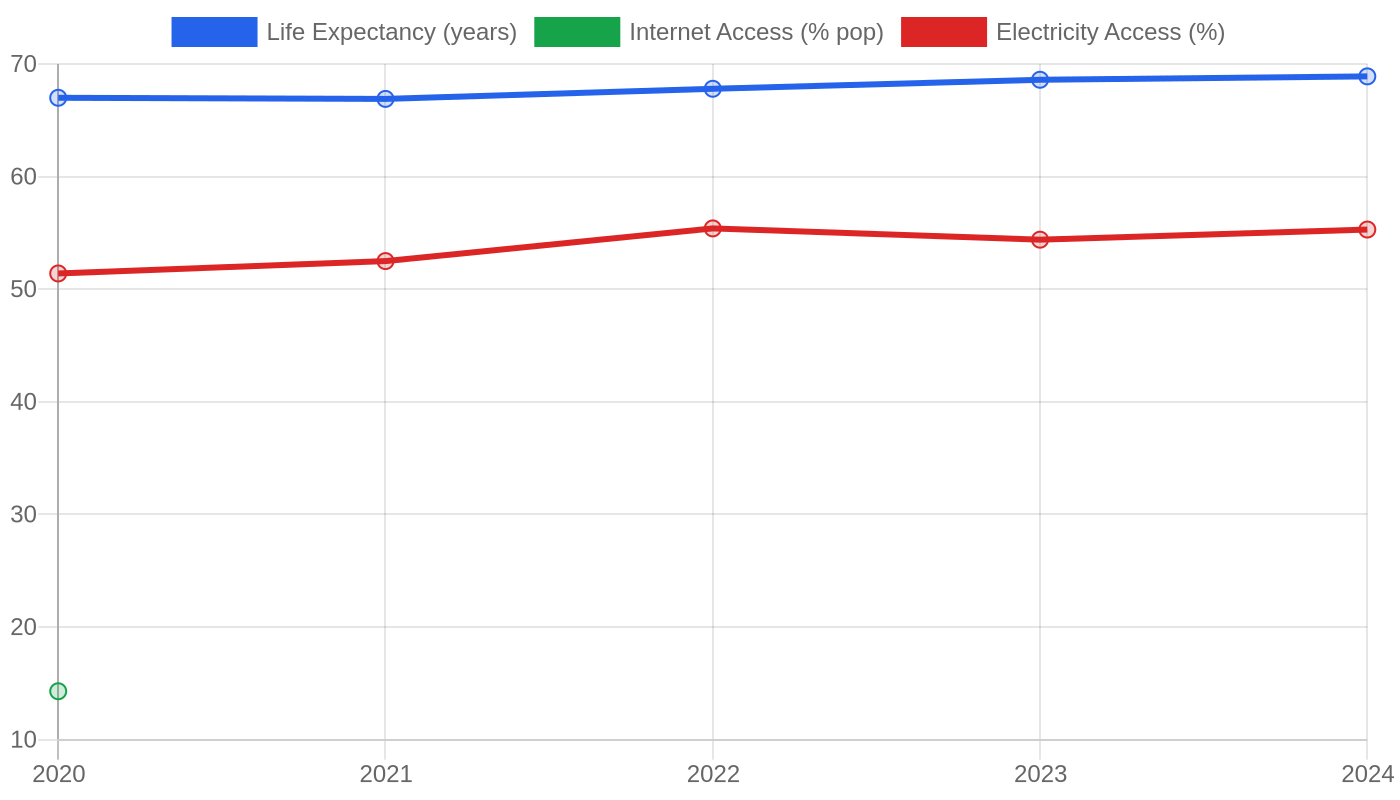
Data Vacuum: Critical economic indicators such as GDP growth, inflation, and unemployment are officially unreported (N/A), creating a significant blind spot for international investors and analysts.
Isolated Economy: The lack of transparency extends to major industries, top companies, and cost-of-living metrics, making traditional financial due diligence nearly impossible.
Security Concerns: Standard crime and safety indices are unavailable, reflecting the country’s isolation from global security databases and open civil society reporting.
Long-term Leadership: President Afwerki has maintained uninterrupted power since the nation’s independence, shaping a political landscape where the People’s Front for Democracy and Justice (PFDJ) is the sole legal entity.
The Economic Black Box
Eritrea presents a unique challenge to modern economic journalism: it is a sovereign nation with virtually no publicly available macroeconomic data. According to the World Bank, key metrics including GDP growth, inflation CPI, unemployment rates, and total GDP in USD are listed as N/A. This absence of data is not merely a statistical gap; it is a structural feature of the country’s isolation.
Without official figures on GDP per capita or GNI, it is impossible to gauge the standard of living or the true scale of economic output using conventional tools. For an economy that does not publish its balance sheets, the “invisible” nature of the market becomes the defining characteristic. Investors cannot rely on historical trends because there is no historical record to analyze.
Consequently, any assessment of Eritrean economic health must be qualitative rather than quantitative, relying on anecdotal evidence and geopolitical context rather than hard numbers. The lack of data suggests an economy that operates outside the mainstream global financial system, shielded from the scrutiny that typically drives reform or attracts foreign direct investment. In this vacuum, the silence itself speaks volumes about the government’s preference for opacity over integration.
Life Behind Closed Doors
Assessing the cost of living in Eritrea is akin to trying to measure water in a sieve. The provided data indicates that specific costs for housing, rent versus buy scenarios, and daily expenses are not cataloged in accessible international databases. Without a Consumer Price Index (CPI) or comparable regional benchmarks, we cannot determine if goods are cheaper or more expensive than in neighboring Ethiopia or Djibouti.
This lack of transparency makes it difficult for expatriates, aid workers, or potential business owners to budget effectively. Typically, in closed economies, the cost of living is distorted by import restrictions, currency controls, and a dual-market system where official prices differ wildly from black-market rates. However, without explicit data points, these remain theoretical constructs.
The inability to compare Eritrea’s living costs to regional averages leaves residents and visitors navigating their daily expenses based on local knowledge alone. This obscurity protects the state from external criticism regarding inflation but also discourages tourism and casual trade, which thrive on price transparency.
An Opaque Business Environment
The corporate landscape of Eritrea is equally shrouded in mystery. The data provided lists no “Top Companies,” leaving the dominant players in the mining, agriculture, or service sectors unnamed. In most emerging markets, identifying the leading conglomerates is the first step in understanding the investment climate; here, that step is blocked. The main industries are similarly undefined in the dataset, preventing a clear view of where value is created or where opportunities might lie.
This lack of visibility into the private sector suggests a heavy reliance on state-owned enterprises or informal family-run businesses that do not register in international directories. For a foreign investor, the absence of a known corporate hierarchy means there is no clear partner to negotiate with and no established track record to evaluate. The business environment appears to be controlled tightly by the state, with little room for the private enterprise dynamism seen in other African nations.
Without knowing who the major players are, it is impossible to assess competition, market share, or supply chain reliability.
Politics, Safety, and Social Stability
The political and social fabric of Eritrea is defined by absolute control and minimal public discourse. The People’s Front for Democracy and Justice (PFDJ) stands as the only legal political party, a fact that fundamentally shapes every aspect of civic life. Other political groups are prohibited from organizing, and while the Constitution of 1997 theoretically allows for multi-party politics, it remains unimplemented.
The National Assembly, comprising 150 seats, exists but has not facilitated democratic change. President Isaias Afwerki has remained in office since independence in 1993, and notably, national elections have been periodically scheduled and then cancelled; as of 2025, no elections have ever been held in the country. This perpetual suspension of democracy creates a stable but rigid political environment. Regarding safety, both the Crime Index and Safety Index are reported as N/A.
This absence of data often correlates with countries where civil society organizations that track safety metrics are banned or non-existent. The combination of a single-party state and unreported safety indices suggests a society where order is maintained through strict governance rather than organic community policing. Quality of life, therefore, is likely dictated by proximity to power and access to scarce resources rather than by rule of law protections.
Current Affairs and Geopolitical Context
As we look at the current affairs in Eritrea, the narrative is one of continuity rather than change. The political landscape remains static, with President Afwerki firmly entrenched and no movement toward the implementation of the 1997 Constitution. The cancellation of elections continues to be a recurring theme, reinforcing the perception of a frozen political timeline.
There are no recent reports of significant economic reforms or policy shifts, largely because the mechanisms for announcing such changes are opaque. The lack of live indicators or recent news items in the dataset underscores the country’s disengagement from global diplomatic and economic forums. While neighboring regions may experience volatility or reform, Eritrea maintains a status quo that prioritizes regime survival over economic liberalization.
Any developments that do occur are likely managed internally without public disclosure. This isolationist approach means that “what is happening now” is primarily defined by what is *not* being said or published. The world watches Eritrea with curiosity and concern, but the country offers few clues as to its next move, maintaining a strategic ambiguity that serves its leadership well.
The Bottom Line
Eritrea is a country that defies standard economic analysis due to its extreme data opacity and political rigidity. It should be watched primarily by geopolitical strategists and humanitarian organizations rather than traditional commercial investors. The lack of GDP, inflation, and corporate data makes it a high-risk, low-transparency environment unsuitable for standard portfolio allocation.
However, its strategic location and mineral resources may hold latent value that could emerge if the country ever chooses to engage more openly with the global community. Until then, Eritrea remains a study in isolation, where the most important economic indicator is the silence itself.
Sources & Methodology
This article is authored by Economic Pulse Net for informational and research purposes. Economic Pulse Net sources its data from multilateral institutions, national statistics bureaus, and proprietary databases. All data is believed to be current as of the date of publication.
Published: October 29, 2026 | Category: Research — Eritrea
Use these signals in your own platform
Economic Pulse publishes its live signal feed through a documented, read-only API. Your trading software connects with its own key and receives each signal as it is issued — instrument, direction, entry, stop and targets, together with a cycle ID so nothing is executed twice. The feed is independent of this website and cannot change it.
Signals are informational only and are not financial advice.