Economic Pulse Net | Sources: World Bank World Development Indicators, Government Sources | 2026
Key Takeaways
* Executive Dominance: The 2023 constitutional referendum has solidified a presidential republic where President Mahamat Déby holds overwhelming control over the judiciary, military, and state-owned enterprises.
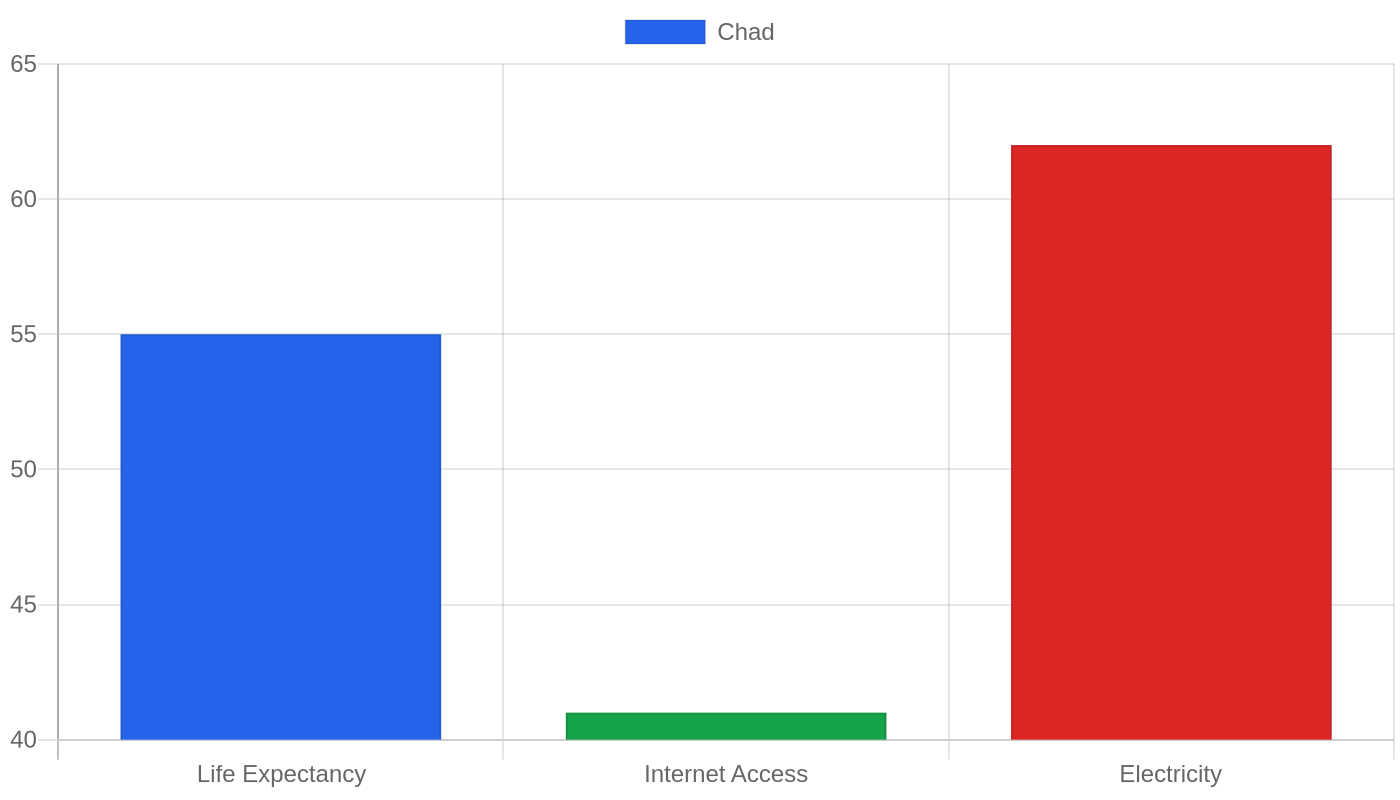
Data Gaps Mask Reality: Critical macroeconomic indicators, including GDP growth, inflation rates, and unemployment figures, are currently reported as N/A by the World Bank, suggesting significant challenges in data transparency or collection.
Strategic Corporate Landscape: The economy is anchored by key players in financial services, textiles, logistics, and telecommunications, with Cotontchad and Commercial Bank Chad serving as pillars of their respective sectors.
Security Ambiguity: Official crime and safety indices are unavailable, leaving investors and residents to navigate an environment where security perceptions are not quantified by standard global metrics.
Political Stability vs.
Liberty: While the current administration provides a centralized political structure, the concentration of power raises questions about checks and balances in governance and economic policy implementation.
Economic Structure and the Data Void
The economic narrative of Chad is currently defined as much by what is missing as by what is present. According to the latest World Bank data, critical metrics such as GDP growth, inflation CPI, unemployment rates, and even the total GDP in USD remain unreported (N/A). This absence of hard statistical data creates a challenging landscape for international analysts attempting to gauge the precise velocity of the Chadian economy.
Without clear figures on GDP per capita (PPP) or GNI per capita, it is difficult to assess the average citizen’s purchasing power or the overall wealth distribution within the nation. However, the industrial base offers clues to the economic engine driving the country. The presence of major entities like Cotontchad in basic materials suggests that agriculture, particularly cotton, remains a vital export and employment sector.
Similarly, the activity of Mid Express Tchad in industrials points to a functioning logistics network essential for moving goods across this landlocked nation. These industries operate within a framework where official statistical reporting is opaque, forcing observers to rely on corporate performance rather than national accounts to infer economic health.
The lack of unemployment data further complicates labor market analysis, leaving the true extent of job creation or loss in the hands of speculation rather than empirical evidence. Consequently, the economic story of Chad is one of potential obscured by a veil of statistical silence.
Cost of Living and Daily Expenses
Assessing the cost of living in Chad presents a unique challenge due to the scarcity of comprehensive consumer price data. With no specific inflation CPI figures available from the World Bank, determining the exact erosion of purchasing power over time is impossible through standard economic models. This data void means that comparisons to regional averages cannot be made with precision, as there are no baseline numbers to anchor such analyses.
Residents and expatriates likely face a cost structure driven by local supply chains and import dependencies, given the country’s landlocked geography. Housing costs, rent versus buy dynamics, and daily expenses are therefore inferred rather than calculated, relying on anecdotal evidence and the operational costs of top companies like SotelTchad for telecommunications infrastructure.
The absence of a formal Safety Index or Crime Index further impacts quality of life calculations, as security measures often dictate additional household expenditures. In such an environment, the true cost of living is not just about prices but also about the premium paid for stability and access to reliable services. Without transparent data, the everyday economic reality for Chadians remains a black box, known only to those navigating its complexities firsthand.
Investment & Business Climate
For investors looking at Chad, the business climate is characterized by a handful of dominant firms that shape the commercial landscape. The top companies list reveals a diversified but concentrated market, with Commercial Bank Chad leading in financials, providing the necessary credit infrastructure for business operations. Cotontchad stands out in basic materials, indicating that agricultural processing and raw material extraction remain core investment themes.
In the industrial sector, Mid Express Tchad and Société tchadienne des postes et de l’épargne highlight the importance of logistics and postal services in connecting remote areas to urban centers. Meanwhile, SotelTchad in telecommunications and Toumaï Air Tchad in consumer services underscore the growing need for connectivity and mobility in the modern Chadian economy.
These entities operate under a political system where the president exercises considerable influence over para-statal firms and provincial officials, creating a business environment where government relations are paramount. For foreign direct investment, understanding this hierarchy is crucial, as appointments to heads of these firms are heavily influenced by the executive branch.
The lack of independent regulatory data makes it difficult to assess fair competition, placing a premium on local partnerships and political insight for successful market entry.
Safety, Politics & Quality of Life
The political landscape of Chad has undergone a significant transformation following the 2023 constitutional referendum, establishing a presidential republic with a strong executive branch. President Mahamat Déby now dominates the political system, possessing the power to appoint the prime minister, the cabinet, judges, generals, and heads of para-statal firms.
This centralization of authority means that political risk is tightly linked to the decisions of a single individual, reducing institutional checks and balances. In terms of safety, both the Crime Index and Safety Index are reported as N/A, leaving no quantitative measure of personal security for residents or visitors. This lack of data does not necessarily imply safety or danger, but rather an absence of standardized reporting mechanisms.
The quality of life is thus shaped more by political stability and administrative efficiency than by measurable crime statistics. Citizens navigate a system where judicial independence and military leadership are directly tied to presidential appointment, influencing the broader social contract. For international observers, the political rigidity suggests a stable but rigid environment, where change is top-down and slow.
What’s Happening Now / Current Affairs
The most pressing development in Chad is the consolidation of power under President Mahamat Déby following the 2023 constitutional changes. The new constitution grants the president extensive powers, including the ability to act in cases of grave and immediate threat, which allows for rapid executive decision-making but limits legislative oversight. This shift has redefined the relationship between the state and the judiciary, with judges now appointed through a process heavily influenced by the executive.
Economically, the continued absence of World Bank data for key indicators like GDP and inflation suggests that statistical capacity building remains a low priority or faces significant hurdles. Businesses are adapting to this new political reality by aligning closely with state interests, particularly in sectors dominated by para-statal firms. The focus of current affairs is on how this centralized model will impact long-term economic reforms and foreign investment flows.
Analysts are watching to see if the strong executive branch can deliver stability without stifling private sector innovation. The live indicators point to a period of political entrenchment rather than liberalization, making governance the primary variable for future economic trends.
The Bottom Line
Chad presents a complex picture for stakeholders: a politically centralized state with a concentrated corporate sector but a severe lack of transparent economic data. Investors should watch this country primarily for opportunities in agriculture, logistics, and telecommunications, provided they can navigate the highly influential executive branch.
The absence of crime and safety indices, along with missing macroeconomic figures, requires a cautious approach and reliance on on-the-ground intelligence rather than published reports. Ultimately, Chad is a market where political connections are as valuable as capital, and where the rule of law is deeply intertwined with presidential authority.
Sources & Methodology
This article is authored by Economic Pulse Net for informational and research purposes. Economic Pulse Net sources its data from multilateral institutions, national statistics bureaus, and proprietary databases. All data is believed to be current as of the date of publication.
Published: September 26, 2026 | Category: Research — Chad
Use these signals in your own platform
Economic Pulse publishes its live signal feed through a documented, read-only API. Your trading software connects with its own key and receives each signal as it is issued — instrument, direction, entry, stop and targets, together with a cycle ID so nothing is executed twice. The feed is independent of this website and cannot change it.
Signals are informational only and are not financial advice.