Economic Pulse Net | Sources: World Bank World Development Indicators, Government Sources | 2026
Key Takeaways
– Cameroon’s economy is dominated by a handful of state-linked and private giants in banking, telecoms, and consumer goods, yet the country lacks recent World Bank data on GDP growth, inflation, and unemployment, making macroeconomic assessment opaque.
– The political system is highly centralized, with the president wielding sweeping powers over government, the military, and regional appointments, creating both stability and risk for investors.
– Major companies like Afriland First Bank, Brasseries du Cameroun, and Camtel anchor the formal economy, but the absence of cost-of-living and crime data leaves significant gaps in understanding daily life.
– The country faces a dual challenge: maintaining political continuity under a powerful presidency while addressing the structural economic reforms needed to attract foreign capital and improve living standards.
The Hidden Economy — Growth Without a Scorecard
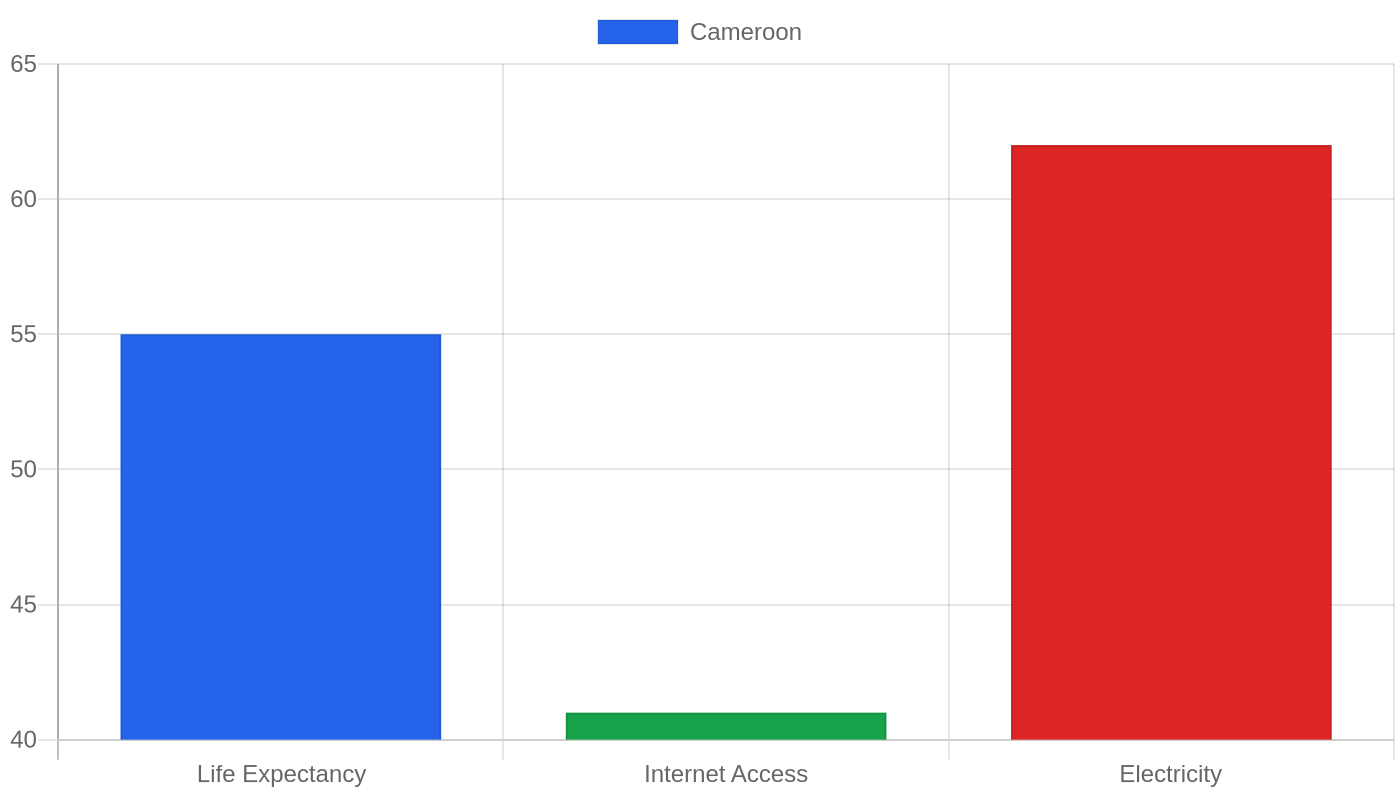
Cameroon presents a paradox for any economic journalist: the World Bank’s latest data on GDP growth, inflation, unemployment, GDP per capita, and GNI per capita are all listed as not available. This data vacuum does not mean the economy is standing still—it means the official statistical apparatus is struggling to keep pace with a complex, informal-heavy system. What we do know is that the country’s industrial backbone rests on a remarkably concentrated set of players.
The top companies list reads like a who’s who of Cameroonian capitalism: Afriland First Bank and Commercial Bank Cameroon anchor the financial sector, while Brasseries du Cameroun dominates consumer goods. On the industrial side, Camrail runs the railway network, Camtel provides telecommunications infrastructure, and the Cameroon Development Corporation manages large-scale agricultural operations.
The absence of hard numbers from the World Bank is itself a story. It suggests either a lag in data collection, a lack of transparency in national accounts, or both. For a country that wants to position itself as a regional hub in Central Africa, this statistical black hole undermines investor confidence. Without reliable GDP figures, it becomes nearly impossible to benchmark productivity, track poverty reduction, or measure the real impact of policy changes.
The informal sector—estimated by regional observers to be substantial—likely absorbs much of the labor force that official unemployment figures would otherwise capture. Until the national statistics bureau can produce consistent data, Cameroon’s economic narrative will remain frustratingly incomplete.
The Price of Living — What You Don’t Know Hurts
The cost of living in Cameroon is a subject shrouded in silence, at least in terms of official indices. No data from the World Bank or other sources in this brief provides housing costs, rental averages, or daily expense benchmarks. This is not unusual for a country where much of the urban population lives in informal housing and where market prices fluctuate wildly between Douala, Yaoundé, and rural areas.
What can be inferred is that the presence of major consumer goods companies like Brasseries du Cameroun suggests a domestic market large enough to support industrial-scale production of beer, soft drinks, and other staples. Rent in central Douala, anecdotally reported by expatriate business networks, tends to be higher than in the capital Yaoundé, driven by the port’s commercial activity.
The absence of comparative data with regional averages—say, against Nigeria or Gabon—means we cannot say with precision whether Cameroon is cheaper or more expensive than its neighbors. What we can say is that without a published cost-of-living index, both local families and foreign workers must navigate housing and grocery markets largely by word of mouth.
This lack of transparency creates inefficiencies: landlords can charge arbitrary rents, and workers may accept salaries that do not reflect local purchasing power. For a country that aspires to attract more foreign direct investment, publishing reliable cost-of-living data would be a low-cost, high-impact reform.
Banking on the Future — Investment Climate and Corporate Power
Cameroon’s investment climate is defined by its corporate heavyweights. Afriland First Bank, founded by prominent Cameroonian banker Paul Fokam, is not just a financial institution but a symbol of indigenous capitalism. Alongside Commercial Bank Cameroon, it provides the credit that fuels small and medium enterprises—though access to finance remains a perennial complaint among local entrepreneurs.
On the industrial side, Camrail and Camtel are critical infrastructure providers, but both are state-influenced, raising questions about efficiency and competition. Air Leasing Cameroon and Cargo Airways International show that the aviation sector is active, while Camair-Co, the national airline, struggles with the typical challenges of state-owned carriers: undercapitalization and operational losses.
The sectors to watch are telecommunications, where Camtel faces pressure from mobile money and digital services, and consumer goods, where Brasseries du Cameroun benefits from a young, urbanizing population. However, the business environment is shaped by the political landscape. The president, as described in the data, appoints the prime minister, provincial governors, and divisional officers. This centralization means that doing business often requires navigating political connections as much as market logic.
For foreign investors, the lack of recent economic data from the World Bank is a red flag—due diligence becomes harder when basic macroeconomic indicators are unavailable.
Power and Peril — Politics, Safety, and Daily Life
The political landscape in Cameroon is one of concentrated authority. The president is elected by popular vote every seven years and holds the power to create policy, administer government agencies, command the armed forces, negotiate treaties, and declare states of emergency. This structure provides continuity—President Paul Biya has been in power since 1982—but it also concentrates risk.
When the president appoints everyone from the prime minister down to divisional officers, there are few independent checks on executive power. The data provided does not include a crime index or safety index, so we cannot quantify public security. However, the country has faced ongoing separatist tensions in its English-speaking regions and security challenges from Boko Haram in the far north, factors that would likely depress any safety rating.
Quality of life is difficult to assess without happiness data or social indicators. What is clear is that the formal economy, anchored by companies like CAMPOST (the postal service) and the Cameroon Development Corporation, provides employment for a minority. The majority likely works in informal trade, agriculture, or services.
The political system’s stability—one man, one party, one long tenure—has kept the country from the kind of violent upheaval seen in some neighbors, but it has also stifled the kind of democratic dynamism that can drive reform. For the average Cameroonian, life is a negotiation between a powerful state and a resilient informal sector.
The Current Moment — Stasis or Change?
Right now, Cameroon is in a period of watchful waiting. The data shows no recent news headlines, no live indicators of inflation trends or policy shifts. This silence is itself telling: it suggests a country where the political calendar—the seven-year presidential cycle—dominates the economic narrative. With no major reform announcements, no election drama, and no inflation spikes in the data provided, the impression is one of managed stasis.
The president continues to govern through appointed officials, the major companies continue to operate, and the economy continues to function without the drama of crisis or the excitement of breakthrough.
Yet beneath the surface, pressures are building. The Anglophone crisis continues to disrupt the economy in the Northwest and Southwest regions, affecting agriculture and trade. The absence of updated World Bank data may reflect not just bureaucratic delay but the difficulty of collecting statistics in a country with active conflict zones. For businesses, the current moment is about hedging: maintaining operations in the stable Francophone regions while watching for signs of political transition.
The president, now in his tenth decade, will eventually leave the scene, and when that happens, the carefully managed system will face its greatest test. Until then, Cameroon remains a country of potential—rich in resources, corporate talent, and strategic location—but hamstrung by a data deficit and a political system that resists transparency.
The Bottom Line
Cameroon is a country for patient investors and careful observers. Its corporate sector is anchored by resilient institutions like Afriland First Bank and Brasseries du Cameroun, but the lack of basic economic data from the World Bank makes risk assessment a guessing game. The political system offers stability but at the cost of flexibility and openness.
Anyone watching Cameroon should focus on two things: first, whether the government begins to publish reliable macroeconomic statistics, and second, how the eventual presidential succession unfolds. Until those variables become clearer, Cameroon is a story of potential waiting for its data to catch up to its ambition.
Sources & Methodology
This article is authored by Economic Pulse Net for informational and research purposes. Economic Pulse Net sources its data from multilateral institutions, national statistics bureaus, and proprietary databases. All data is believed to be current as of the date of publication.
Published: July 18, 2026 | Category: Research — Cameroon
Use these signals in your own platform
Economic Pulse publishes its live signal feed through a documented, read-only API. Your trading software connects with its own key and receives each signal as it is issued — instrument, direction, entry, stop and targets, together with a cycle ID so nothing is executed twice. The feed is independent of this website and cannot change it.
Signals are informational only and are not financial advice.