Economic Pulse Net | Sources: World Bank World Development Indicators, Government Sources | 2026
🇧🇮 Burundi 2026 — A Multi-Party Democracy Navigating an Opaque Economic Landscape
Key Takeaways
* Political Framework: Burundi operates as a presidential representative democratic republic with a multi-party system, featuring 21 registered political parties and a constitutional history dating back to 1992.
Corporate Landscape: The business environment is anchored by key players in telecommunications, mining, and financial services, including Africell Burundi, African Mining Burundi, and Bancobu.
Data Transparency Gap: Current macroeconomic indicators such as GDP growth, inflation, and unemployment figures are not currently available from the World Bank, necessitating a focus on structural and institutional analysis rather than quantitative trends.
Sectoral Focus: Investment interest is concentrated in consumer services, mining, and telecommunications, reflecting the country’s primary industrial outputs despite the lack of comprehensive national income data.
Structural Foundations Amid Data Gaps
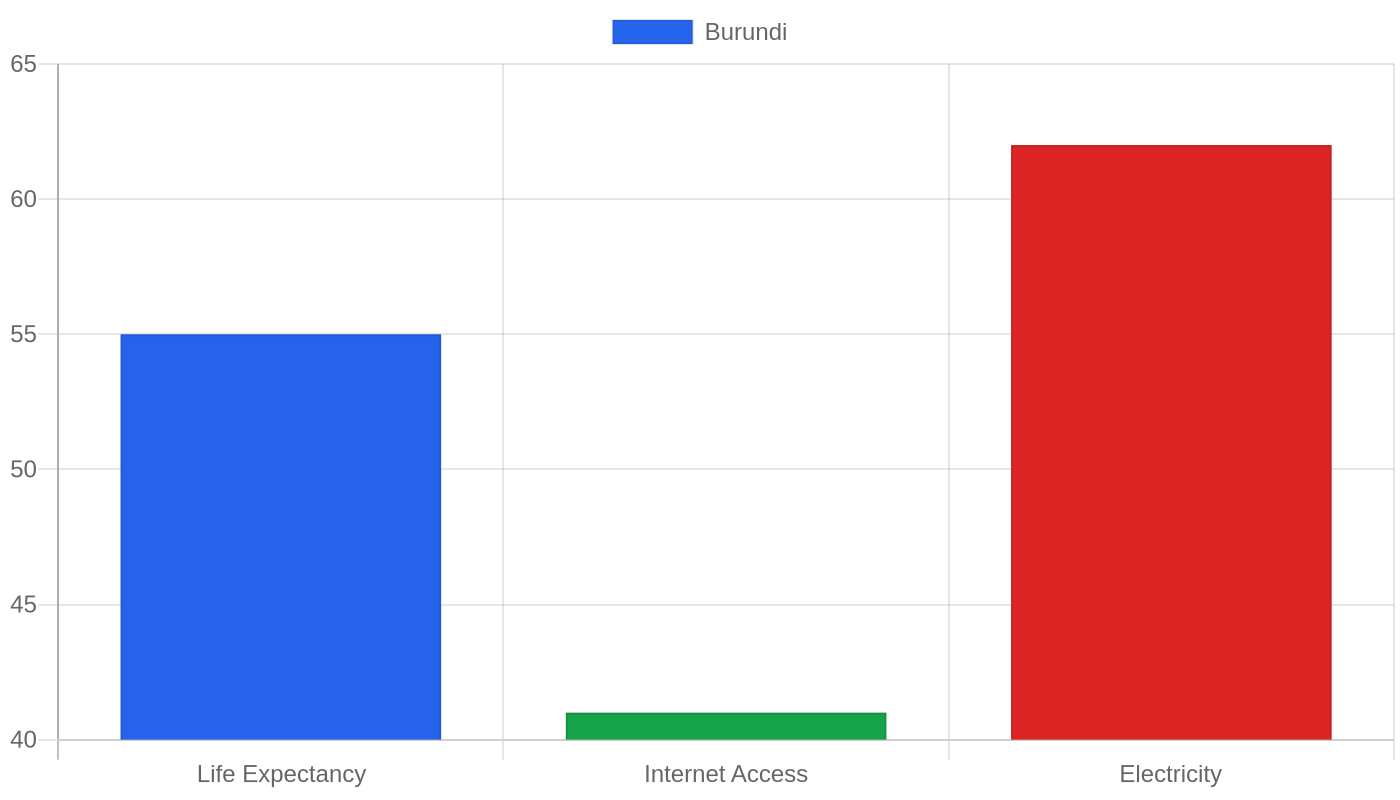
Burundi’s economic narrative is currently defined less by hard statistical metrics and more by its institutional framework and sectoral composition. According to the World Bank, specific data points for GDP growth, inflation CPI, unemployment, total GDP in USD, GDP per capita (PPP), GNI per capita, and population are listed as N/A.
This absence of granular macroeconomic data presents a significant challenge for traditional economic forecasting, forcing analysts to look at the underlying structures of the economy rather than headline growth rates. Without clear figures on inflation or unemployment, the standard tools for assessing economic health—such as comparing purchasing power parity or tracking labor market participation—are unavailable.
However, the existence of distinct main industries provides a clearer picture of where value is generated within the nation. The economy relies heavily on sectors that serve both domestic consumption and resource extraction, suggesting a reliance on internal demand and natural capital. In the absence of GDP per capita figures, the scale of individual economic contribution remains opaque, yet the presence of established corporate entities indicates a functioning, albeit small-scale, commercial ecosystem.
Understanding Burundi requires looking past the missing numbers to see the active participants shaping daily economic life.
Cost of Living and Daily Realities
The cost of living in Burundi is difficult to quantify precisely without current Consumer Price Index (CPI) data from the World Bank. With inflation rates marked as N/A%, it is impossible to determine whether prices for essential goods and services are rising, falling, or remaining stable over time. This lack of price transparency makes it challenging for residents and expatriates to budget effectively or compare living expenses against regional averages.
Housing costs and rental markets are similarly obscured by the lack of broader economic context, leaving potential investors and residents without reliable benchmarks for real estate valuation. While general industry lists provide some insight into consumer goods availability through companies like Afritextile, they do not offer specific pricing data for everyday items. Consequently, the true affordability of life in Burundi remains a matter of anecdotal evidence rather than statistical certainty.
For those considering relocation or long-term stays, the inability to track inflation trends adds a layer of financial uncertainty that complicates personal economic planning.
Investment Opportunities and Corporate Players
Despite the scarcity of macroeconomic data, Burundi hosts a recognizable roster of major companies that drive specific sectors of the economy. The business climate is characterized by a mix of consumer services, telecommunications, mining, and financial institutions. In the telecommunications sector, Africell Burundi plays a pivotal role in connecting the population and facilitating digital commerce.
The mining industry is represented by African Mining Burundi, highlighting the country’s potential in natural resource extraction. Financial services are supported by established entities such as Bancobu, the Bank of the Republic of Burundi, and Banque de commerce et de développement, which form the backbone of local credit and banking operations.
Consumer services and transport are served by companies like Afra Airways, Air Burundi, Agence de Location du Matériel, and ARNOLAC, indicating active movement of people and goods. Additionally, Afritextile contributes to the consumer goods sector, providing tangible products to the domestic market.
These companies operate within a multi-party political state, which theoretically offers a regulated environment for business activity, although the lack of recent news indicators limits our understanding of their current operational challenges. Investors must therefore rely on the stability of these existing corporate structures rather than projected economic growth rates.
Safety, Politics, and Quality of Life
Burundi’s political landscape is structured as a presidential representative democratic republic based on a multi-party state. The president serves as both the head of state and head of government, holding significant executive power. The political system allows for competition among 21 registered parties, reflecting a degree of pluralism in the governance structure.
Historical constitutional frameworks, including the 1992 constitution and the 1998 amendments, have shaped this political process by establishing multi-party competition and broadening the National Assembly’s seats. The 1998 constitution specifically made provisions for two vice-presidents, adding complexity to the executive branch. Regarding safety and quality of life, current Crime and Safety Indices are listed as N/A, meaning there is no standardized metric to assess personal security risks.
Without these indices, it is difficult to gauge the level of crime or the overall safety of urban and rural areas. The interplay between the formal political structure and the undefined safety metrics creates a unique environment where political stability may coexist with uncertain day-to-day security conditions. Residents and visitors must navigate this landscape with an awareness of the formal democratic processes while remaining cautious due to the lack of verified safety data.
What’s Happening Now: Institutional Continuity
The most prominent feature of Burundi’s current affairs is the continuity of its political and institutional framework rather than sudden economic shocks or reforms. The country maintains its status as a multi-party state with 21 registered parties, suggesting an ongoing, albeit perhaps quiet, political engagement. The constitutional foundations laid in 1992 and refined in 1998 continue to define the relationship between the president, the vice-presidents, and the National Assembly.
There are no recent news indicators provided regarding specific policy shifts, election cycles, or new legislative acts, implying that the current period is one of steady-state governance. The absence of live economic indicators means that any “happening now” narrative is driven by the persistence of existing corporate and political structures.
Companies like Africell Burundi and African Mining Burundi continue to operate, signaling that commercial activities proceed despite the lack of transparent macroeconomic reporting. The political system remains anchored in its presidential representative democratic model, with the president retaining dual roles as head of state and government. This stability in structure contrasts with the opacity of economic data, creating an environment where institutional memory outweighs immediate statistical visibility.
The Bottom Line
Burundi presents a complex case for observers, offering a clear view of its political and corporate structures while withholding critical economic data. Potential investors and analysts should focus on the established companies in mining, telecommunications, and finance, as these represent the tangible engines of the economy. The multi-party political system provides a framework for governance, though the lack of safety indices and inflation data introduces significant uncertainty.
This country is best watched for its institutional resilience and sectoral specifics rather than for broad macroeconomic trends. Those interested in Burundi must be prepared to make decisions based on qualitative factors and corporate presence rather than quantitative economic forecasts.
Sources & Methodology
This article is authored by Economic Pulse Net for informational and research purposes. Economic Pulse Net sources its data from multilateral institutions, national statistics bureaus, and proprietary databases. All data is believed to be current as of the date of publication.
Published: October 11, 2026 | Category: Research — Burundi
Use these signals in your own platform
Economic Pulse publishes its live signal feed through a documented, read-only API. Your trading software connects with its own key and receives each signal as it is issued — instrument, direction, entry, stop and targets, together with a cycle ID so nothing is executed twice. The feed is independent of this website and cannot change it.
Signals are informational only and are not financial advice.