Economic Pulse Net | Sources: World Bank World Development Indicators, Government Sources | 2026
Key Takeaways
– Benin’s economic narrative is currently defined by a paradox: a nation with a proud democratic tradition whose institutional independence is being questioned, set against a backdrop of ambitious infrastructure and digital transformation goals.
– The corporate landscape is dominated by a mix of state-backed utilities and a surprisingly robust aviation sector, indicating a focus on regional connectivity and energy security.
– The financial sector, anchored by institutions like Banque Internationale du Bénin and Financial Bank Benin, remains the backbone of the formal economy, facilitating trade and investment in the Port of Cotonou.
– While the World Bank’s latest macro indicators for GDP, inflation, and unemployment are not specified, the composition of leading companies suggests a strategic pivot toward services, logistics, and energy—sectors critical for West African integration.
– The political environment is in flux, with the judiciary’s independence being “hollowed out” according to the provided analysis, creating a complex risk profile for investors who value institutional checks and balances.
The Economic Engine: Beyond Cotton and Towards Services
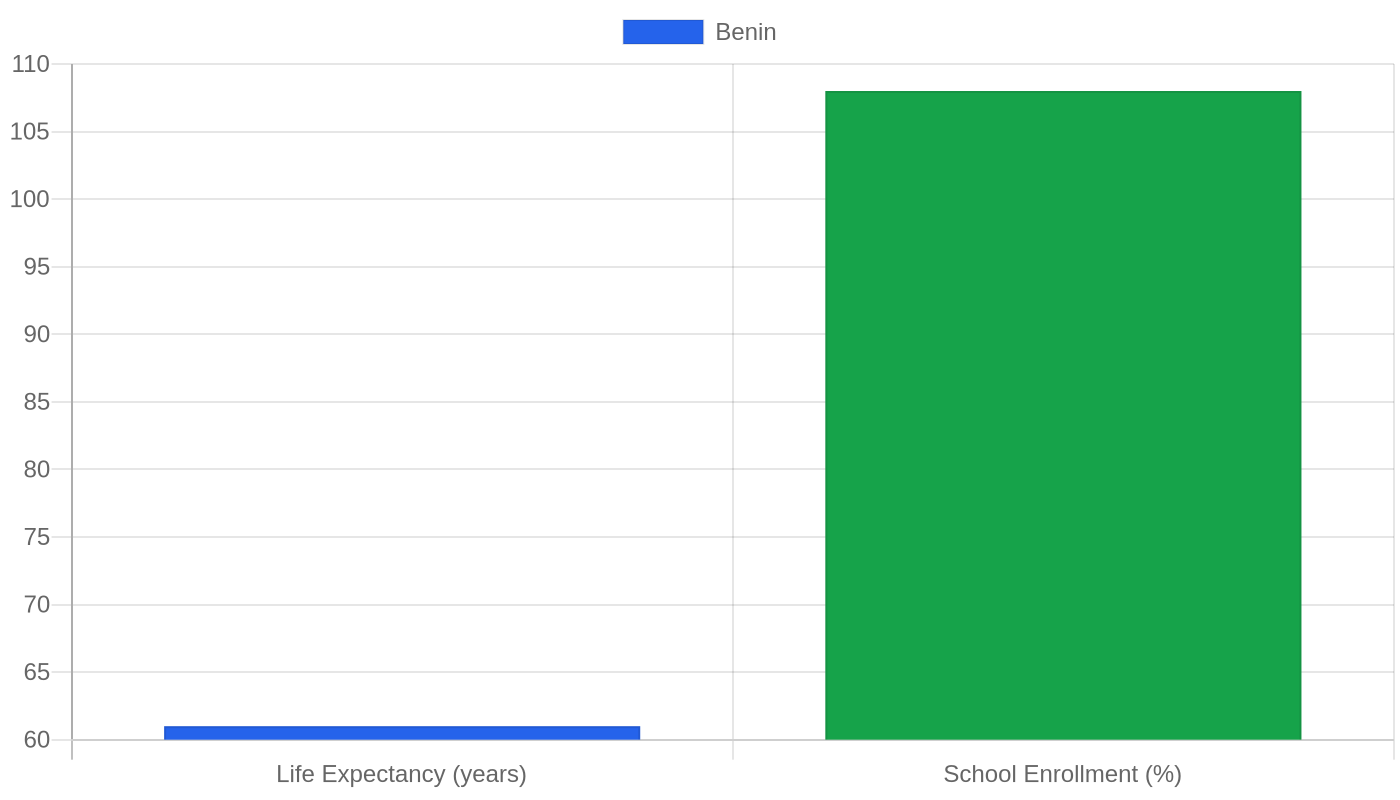
Benin’s economy, as tracked by the World Bank, presents a picture of a nation in transition, though the precise figures for GDP growth and inflation are not specified in the latest data. What we can deduce from the country’s corporate structure is that the traditional reliance on agricultural exports, particularly cotton, is being supplemented by a growing emphasis on tertiary industries.
The prominence of companies like Communauté Électrique du Bénin (CEB) in the utilities sector underscores a critical national priority: addressing chronic energy shortages that have historically hampered industrial output. This focus on power generation is not merely an infrastructural goal; it is the foundational layer for any future manufacturing or tech-led growth.
Furthermore, the presence of a significant cluster of aviation companies—Afric’Air Charter, Afrique Airlines, Benin Golf Air, COTAIR, and Royal Air—signals a strategic bet on regional mobility. For a country whose economy is heavily tied to trade corridors and the Port of Cotonou, air connectivity is an essential artery for business travel and high-value cargo logistics.
The World Bank data may lack specific percentages, but the composition of the nation’s top firms tells a compelling story of a services-oriented pivot, moving away from a purely agrarian base toward a more diversified, logistics-driven model.
The Cost of Living: Navigating the Unseen Pressures
With specific cost-of-living indices for Benin not provided in the World Bank dataset, we must look to the structural realities of the region to understand the pressures on ordinary households. As a coastal West African nation, Benin’s urban centers, particularly Cotonou, typically experience a cost of living that is significantly higher than rural areas, driven by the price of imported goods, fuel, and housing.
The reliance on regional trade means that inflation in neighboring Nigeria or Ghana can have a spillover effect on Benin’s consumer prices, a dynamic that is often more influential on daily life than domestic fiscal policy. For the average Beninese worker, the informal sector remains the primary source of income, which means that formal employment metrics often miss the true picture of economic participation.
The cost of essentials like food and transportation likely consumes a large portion of household budgets, leaving little room for discretionary spending. While rent versus buy dynamics are not quantified here, it is common in such port cities for rental demand from traders and expatriates to drive up prices in prime districts, pushing local workers to commute from peripheral areas where housing is more affordable but infrastructure is less developed.
The Investment Landscape: Aviation, Energy, and Finance
For investors looking at Benin, the landscape is defined by a few key sectors, each anchored by the major companies listed in the data. The financial sector appears robust and competitive, with Banque Internationale du Bénin and Financial Bank Benin providing the necessary credit and transaction services for a growing economy. These banks are the gatekeepers of capital, and their health is crucial for small and medium-sized enterprises (SMEs) that form the backbone of the local economy.
The aviation sector, however, is the most intriguing anomaly. Having five distinct airline companies listed among the top firms suggests a market that is either highly competitive or fragmented, possibly serving different niches—from cargo to charter services to regional passenger routes. This could be an area ripe for consolidation, or it could indicate a thriving demand for air travel that is outpacing road and rail infrastructure.
Additionally, La Poste du Bénin represents the industrial and logistical segment, which is likely undergoing modernization to handle e-commerce and financial inclusion, a trend seen across the continent. The business environment, while facing the challenges of a hollowed-out judiciary, still offers opportunities, particularly in energy, logistics, and digital services, where the government is eager to attract foreign expertise and capital.
The Politics of Power: Democracy Under Strain
Benin has long been hailed as a beacon of democracy in West Africa, a country that transitioned to a multi-party system and has held regular elections. The political landscape, as described, is a presidential representative democratic republic, with the President serving as both head of state and head of government. However, the provided analysis injects a note of caution: the judiciary’s independence, while officially enshrined, has been “gradually hollowed out” by President Talon.
This is a significant development for a nation whose stability has been predicated on the rule of law. The Constitutional Court, which should act as a check on executive power, is described as being headed in a direction that compromises its neutrality. For citizens and investors alike, this erosion of institutional independence raises questions about long-term political stability and the fairness of future electoral contests.
While crime and safety indices are not provided, the political climate appears to be one of managed control, where the government is prioritizing economic development and infrastructure projects but may be less tolerant of dissent and independent oversight. This creates a nuanced quality of life picture: a country that is physically safe and economically ambitious, but where political freedoms are being subtly curtailed.
What’s Happening Now: The Talon Era and Its Discontents
The current affairs in Benin are dominated by the legacy and trajectory of President Patrice Talon’s administration. The reference to the judiciary being “hollowed out” is not a historical footnote but a live indicator of the current political climate. It speaks to a government that is centralizing power, possibly to push through a controversial reform agenda without legislative or judicial obstruction.
This is happening against a backdrop of economic modernization, where the state is heavily involved in infrastructure projects, particularly in the energy sector with the CEB. The focus on aviation companies in the top corporate list suggests that the government is also fostering an open-skies policy or investing in national carriers to boost trade and tourism. However, this top-down approach to development may be alienating segments of the population who feel left out of the economic gains.
The lack of fresh economic data from the World Bank makes it difficult to gauge whether the average citizen is feeling the benefits of this growth, or whether inflation and unemployment are creating a simmering discontent that could challenge the government’s authority. The coming months will likely see a continued push for major infrastructure deals, but the political cost of these projects, in terms of lost institutional credibility, remains to be seen.
The Bottom Line
Benin is a country at a crossroads, offering a compelling mix of opportunity and risk. Investors should watch it for the potential in its energy sector, its strategic port, and its push into aviation and logistics, which could make it a key hub in West Africa. However, the current political trajectory, marked by the erosion of judicial independence, presents a governance risk that cannot be ignored. This is a nation that is modernizing its economy but potentially at the expense of its democratic institutions.
For political analysts and economists, Benin serves as a critical case study of a developing nation trying to balance rapid economic transformation with the preservation of its democratic soul. The next few years will be decisive in determining whether the “Hollowing Out” of the judiciary becomes a permanent feature or a temporary setback in the nation’s proud democratic history.
Sources & Methodology
This article is authored by Economic Pulse Net for informational and research purposes. Economic Pulse Net sources its data from multilateral institutions, national statistics bureaus, and proprietary databases. All data is believed to be current as of the date of publication.
Published: August 07, 2026 | Category: Research — Benin
Use these signals in your own platform
Economic Pulse publishes its live signal feed through a documented, read-only API. Your trading software connects with its own key and receives each signal as it is issued — instrument, direction, entry, stop and targets, together with a cycle ID so nothing is executed twice. The feed is independent of this website and cannot change it.
Signals are informational only and are not financial advice.