Economic Pulse Net | Sources: World Bank World Development Indicators, Government Sources | 2026
Key Takeaways
* Institutional Hollowing: While Benin maintains a formal multi-party democratic structure, judicial independence is increasingly compromised by executive influence under President Talon, signaling potential governance risks for long-term stability.
Service-Led Economy: The corporate landscape is dominated by consumer services, financial institutions, and utilities, with key players like Afrique Airlines and Financial Bank Benin anchoring the private sector.
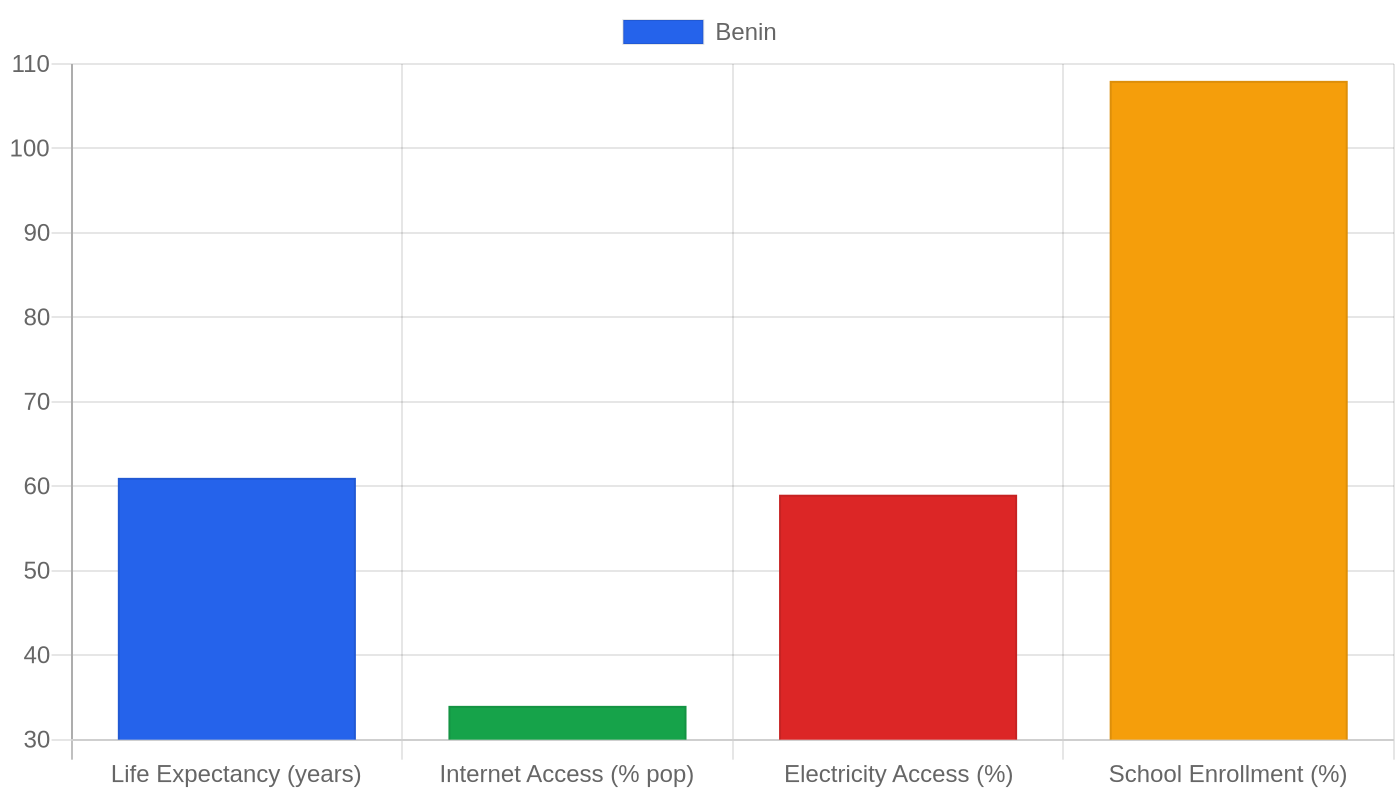
Data Transparency Gap: Critical macroeconomic indicators such as GDP growth, inflation rates, and unemployment figures are currently unavailable in standard World Bank datasets, complicating precise economic forecasting.
Safety Uncertainty: Without current crime or safety indices, investors and expatriates must rely on qualitative assessments rather than quantitative metrics to gauge personal security and operational risk.
The Architecture of Power and Policy
Benin’s political economy operates within a framework that appears robust on paper but faces significant strain in practice. The country is structured as a presidential representative democratic republic, where the President serves as both head of state and head of government, wielding substantial executive power.
Legislative authority is shared between the executive branch and a bicameral parliament, creating a complex system of checks and balances that is theoretically designed to prevent authoritarian overreach. However, the practical reality diverges sharply from this constitutional ideal; while the judiciary is officially independent of the executive and legislative branches, observers note that its autonomy has been gradually hollowed out by former President Talon.
This erosion of judicial independence poses a critical question for international stakeholders: can rule of law be maintained when the courts are perceived as extensions of political will? For foreign entities considering engagement, the concentration of power suggests that regulatory changes may occur rapidly without traditional legislative friction, offering speed in decision-making but at the cost of predictable legal recourse.
Corporate Landscape and Industrial Focus
The industrial profile of Benin reveals an economy heavily weighted toward service provision rather than heavy manufacturing or resource extraction. A review of the top companies indicates a vibrant sector dedicated to logistics, finance, and public utilities. In the realm of consumer services, airlines play a pivotal role in connecting the nation globally and regionally, with entities such as Afrique Airlines, Benin Golf Air, COTAIR, and Royal Air facilitating travel and trade.
These aviation firms underscore the importance of mobility in Benin’s commercial strategy. Simultaneously, the financial sector is anchored by major institutions like Banque Internationale du Bénin and Financial Bank Benin, which provide the necessary credit infrastructure for business expansion. On the utility front, the Communauté Électrique du Bénin ensures energy distribution, a foundational requirement for any growing economy.
Additionally, the Société Nationale de Commercialisation des Produits Pétroliers controls oil and gas distribution, highlighting the state’s continued involvement in strategic energy reserves. Meanwhile, the Compagnie Béninoise de Négoce et de Distribution handles broader consumer goods, suggesting a domestic market that relies on organized import and retail networks.
Cost of Living and Housing Dynamics
Assessing the daily economic reality for residents and expatriates in Benin requires navigating a landscape where specific cost-of-living data points are not currently quantified in global databases. Without explicit figures for housing rents, property purchase prices, or general expense indices, it is difficult to benchmark Benin against regional averages with precision.
However, the presence of established utility providers like La Poste du Bénin and the Communauté Électrique du Bénin implies a structured, albeit potentially expensive, infrastructure network that households must maintain. For businesses, the dominance of consumer service companies suggests that labor costs and operational expenses are tied closely to the informal and semi-formal service sectors rather than rigid industrial wage scales.
Potential investors should anticipate that daily expenses may fluctuate based on local supply chain efficiencies, particularly given the reliance on imported goods distributed by firms like the Compagnie Béninoise de Négoce et de Distribution. Until more granular data emerges, budgeting for living costs in Benin should prioritize flexibility and contingency planning for variable utility and transport fees.
Safety, Political Climate, and Quality of Life
The intersection of safety and politics in Benin presents a nuanced picture for quality of life assessment. Currently, there are no available Crime Index or Safety Index scores, leaving a blind spot in understanding the day-to-day security environment for citizens and visitors alike. This lack of quantitative safety data necessitates a cautious approach, relying instead on the broader political context to infer stability.
Politically, the gradual hollowing out of the judiciary by President Talon creates an atmosphere where legal protections may be inconsistent, potentially affecting dispute resolution and contract enforcement. For expatriates and business owners, this political centralization means that compliance with local regulations is paramount, as judicial remedies for grievances may be limited.
The absence of clear safety metrics combined with a tightening political grip suggests that while overt instability may not be visible, underlying tensions could impact social cohesion and personal security unpredictably. Stakeholders must therefore prioritize relationship-based risk management over reliance on institutional safeguards.
What’s Happening Now — Governance Under Pressure
The most pressing narrative in Benin today revolves around the consolidation of executive power and its impact on democratic institutions. Recent developments highlight how the judiciary, once a pillar of separation of powers, is experiencing a steady erosion of independence under the administration of former President Talon. This shift is not merely a political footnote but a structural change that affects the entire business climate, as legal predictability is a cornerstone of investment confidence.
With legislative power vested in both the government and a bicameral parliament, one might expect checks on executive authority, yet the practical application of these checks appears weakened. This environment creates a unique dynamic where policy reforms can be implemented swiftly, bypassing prolonged parliamentary debate, but at the risk of alienating opposition groups and civil society.
For international observers, the current moment is defined by this tension between efficient governance and democratic backsliding. The focus remains on whether the judiciary can reclaim its autonomy or if it will continue to serve as an arm of the executive, shaping the future rule of law in Benin.
The Bottom Line
Benin represents a paradox of structured corporate activity amidst evolving political risks. Investors and analysts should watch this country closely due to the clear dominance of service-sector giants and the strategic importance of its logistical hubs, yet they must proceed with caution regarding governance transparency. The lack of hard economic data (GDP, inflation) and safety metrics makes traditional quantitative analysis challenging, requiring a reliance on qualitative political risk assessment.
Ultimately, Benin is a case study in how executive consolidation can reshape the business environment, offering opportunities for rapid implementation but demanding rigorous due diligence on legal and political fronts.
Sources & Methodology
This article is authored by Economic Pulse Net for informational and research purposes. Economic Pulse Net sources its data from multilateral institutions, national statistics bureaus, and proprietary databases. All data is believed to be current as of the date of publication.
Published: October 28, 2026 | Category: Research — Benin
Use these signals in your own platform
Economic Pulse publishes its live signal feed through a documented, read-only API. Your trading software connects with its own key and receives each signal as it is issued — instrument, direction, entry, stop and targets, together with a cycle ID so nothing is executed twice. The feed is independent of this website and cannot change it.
Signals are informational only and are not financial advice.