Economic Pulse Net | Sources: World Bank World Development Indicators, Government Sources | 2026
Key Takeaways
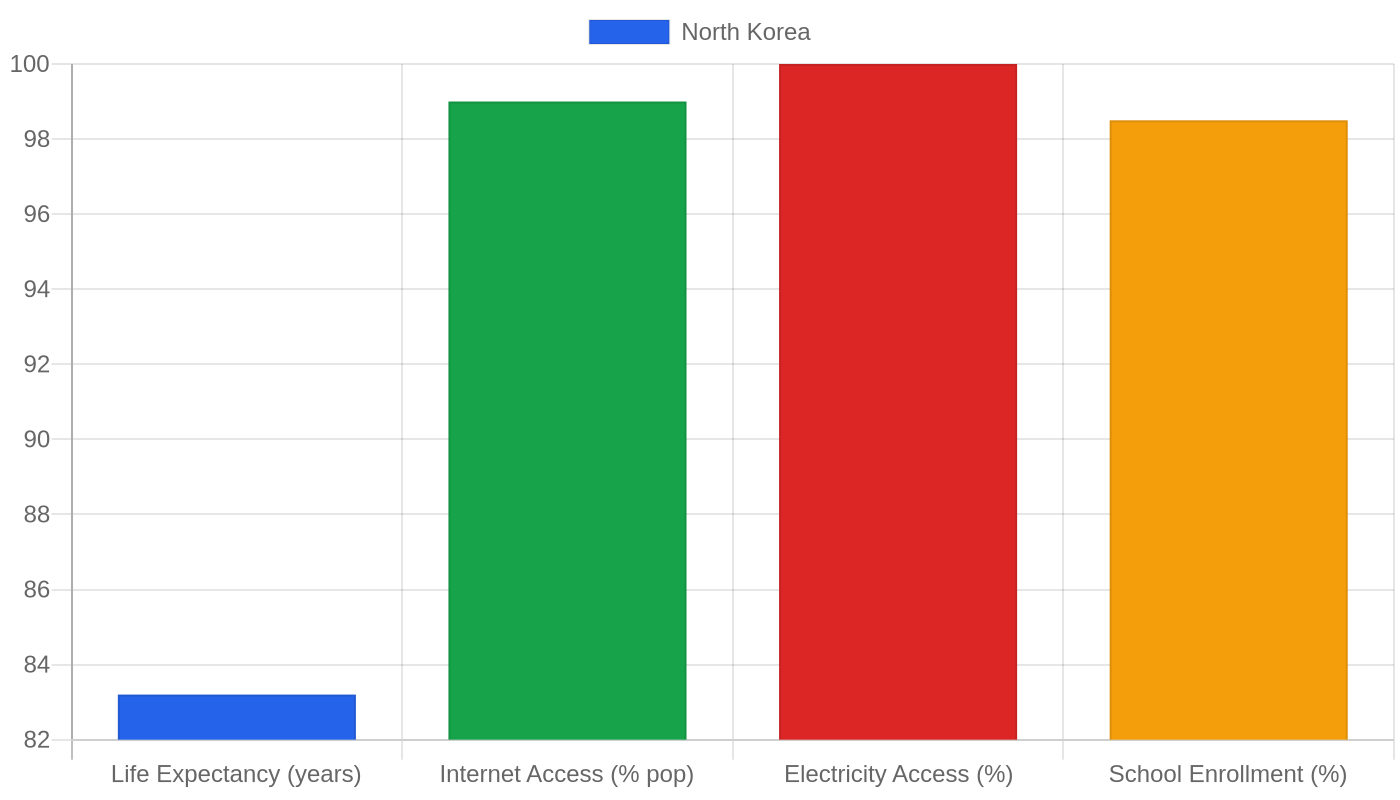
– North Korea’s economy remains a statistical black box, with the World Bank listing no official data on GDP growth, inflation, or unemployment — making it one of the least transparent economies on Earth.
– The country’s industrial backbone is dominated by state-run enterprises spanning locomotives, telecommunications, and chemical trading, with the Foreign Trade Bank and Central Bank serving as the financial pillars.
– Despite international sanctions and self-imposed isolation, North Korea maintains a functioning corporate ecosystem, including Air Koryo, the national carrier, and the Korea Computer Center, a tech hub.
– The absence of reliable economic indicators means analysts must rely on satellite imagery, defector testimony, and trade data from neighboring countries to piece together the picture.
– For investors and policymakers, North Korea represents the ultimate frontier market — potentially rich in minerals and labor, but fraught with political risk and opacity.
The Statistical Void — Reading Between the Lines of a Hidden Economy
When the World Bank publishes its annual economic profiles, most countries receive pages of data points: GDP growth rates, inflation trajectories, unemployment curves, and per-capita income figures. North Korea receives none of that. The latest World Bank data shows “N/A” across every major indicator — no GDP, no inflation CPI, no unemployment rate, no GDP per capita, and no GNI per capita.
This is not an oversight; it is a reflection of a state that has chosen to operate outside the global statistical architecture.
What does this mean in practical terms? Economists cannot calculate North Korea’s GDP with any confidence because the government does not publish national accounts, and international organizations have no access to primary data. The last credible estimates, pieced together by South Korean institutions and academic researchers, suggest a small, centrally planned economy that has experienced periods of contraction and modest recovery — but those are extrapolations, not measurements.
The absence of inflation data is equally telling. In a command economy, prices are often set by decree rather than market forces, making CPI calculations nearly meaningless. Unemployment, too, is a slippery concept in a system where the state guarantees employment but not necessarily productive work.
What the World Bank data does reveal is the extent of North Korea’s isolation. The country has essentially opted out of the global economic conversation. Yet this is not a static situation. The industries that do exist — magnesia clinker production, chemical trading, electric locomotive manufacturing — suggest a state that still believes in industrial self-reliance, even as the rest of the world has moved toward integrated supply chains.
The challenge for any analyst is separating the propaganda from the reality. North Korea may claim self-sufficiency, but satellite imagery of idled factories and reports of chronic energy shortages tell a different story. The economy, such as it is, runs on a combination of state planning, informal markets, and remittances from workers abroad — none of which appear in any official database.
The Price of Everything, the Value of Nothing — Living in a Non-Market Economy
Cost of living data for North Korea is virtually nonexistent, and for good reason: the concept of “cost” operates differently in a system where goods are rationed, wages are set by the state, and foreign currency plays an outsized role. The World Bank provides no figures for housing costs, food prices, or daily expenses.
What is known from anecdotal sources — defector testimonies, humanitarian reports, and diplomatic accounts — is that Pyongyang operates on a dual economy: official rations for the privileged and a parallel market for everything else.
In the capital, a small apartment in a newly constructed high-rise might be allocated through the state housing system, but the black market for real estate has grown in recent years. Prices, when they exist, are often quoted in dollars or Chinese yuan rather than the North Korean won, reflecting a currency that has suffered repeated devaluations. Food prices are equally volatile.
The Public Distribution System, which once provided subsidized staples, has weakened since the famine years of the 1990s, forcing most households to purchase food from informal markets where prices can spike dramatically. For ordinary North Koreans, “cost of living” is not an academic metric but a daily negotiation with scarcity.
Compared to regional neighbors, the quality of life in North Korea is starkly different. While South Korea, China, and Japan have developed sophisticated consumer economies, North Korea remains a place where basic goods are often unavailable through official channels.
The lack of reliable data makes precise comparison impossible, but the anecdotal evidence is consistent: most North Koreans spend a significant portion of their income — or their bartering power — on food, often in informal markets that operate outside state control. The cost of living, in other words, is not just an economic indicator; it is a survival metric.
The Corporate Kingdom — State Enterprises and the Business of Survival
The list of North Korea’s top companies reads like a directory of the command economy: Air Koryo, the state airline; the Central Bank of the Democratic People’s Republic of Korea; the Foreign Trade Bank; Kangsong NET, a telecommunications provider; Kim Chong-t’ae Electric Locomotive Works; the Korea Computer Center; Korea General Chemicals Trading; Korea General Machinery Trading Corporation; and Korea General Magnesia Clinker Industry Group.
These are not private enterprises in any meaningful sense; they are organs of the state, tasked with generating foreign currency, maintaining strategic industries, and projecting technological capability.
Yet even within this rigid structure, there are signs of adaptation. Air Koryo, for instance, operates a small fleet of aircraft serving limited international routes — mostly to China and Russia — and has survived decades of sanctions. The Korea Computer Center, established in the 1980s, has developed software and operating systems tailored to the Korean language, suggesting a state that recognizes the importance of technology even as it restricts internet access for its citizens.
The magnesia clinker industry is particularly notable: North Korea possesses significant deposits of magnesite, and the export of processed magnesia clinker to steelmakers in China and elsewhere has been a rare source of legitimate foreign revenue.
For potential investors, the business climate is forbidding. Sanctions imposed by the United Nations and individual countries restrict nearly all forms of trade and investment. The legal framework is opaque, contracts are difficult to enforce, and the state retains the right to expropriate assets at will. Yet the existence of these companies — and their continued operation despite decades of isolation — suggests a certain resilience. North Korea is not a market economy, but it is not a static one either.
The state has shown a pragmatic willingness to engage in trade when it suits its interests, particularly with China, which accounts for the overwhelming majority of North Korea’s official trade. For the intrepid investor, the potential rewards are immense — cheap labor, natural resources, and a market of 25 million people — but the risks are equally profound.
The Security State and the Quality of Life Question
Crime and safety indices for North Korea are listed as “N/A” in the World Bank data, which is perhaps the most revealing statistic of all. In most countries, crime data is collected through police reports, victimization surveys, and court records. In North Korea, such data does not exist in any usable form, both because the state controls information and because crime is defined differently in a system where political dissent is treated as a criminal offense.
The political landscape is similarly opaque. The World Bank provides no governance indicators for North Korea, and international organizations have limited access to the country. What is known is that the state, led by Kim Jong Un, maintains a monopoly on political power, with no opposition parties, no free press, and no independent judiciary. The legal system is an instrument of state control, and due process is not a guaranteed right. This has profound implications for quality of life.
While crime rates for conventional offenses — theft, assault, murder — may be relatively low due to strict state surveillance and harsh penalties, the broader concept of safety is compromised by the threat of arbitrary detention, forced labor, and political persecution.
For ordinary North Koreans, life is a careful balancing act. The state provides basic education and healthcare, but the quality is poor by regional standards. Housing is allocated through the state, but maintenance is often neglected. Freedom of movement is restricted, with internal travel requiring permits. The concept of “happiness” as measured by international indices does not apply in a context where individual well-being is subordinated to collective — read: state — goals.
The lack of data on crime and safety is not an oversight; it is a reflection of a system that does not recognize the individual as a unit of measurement.
The Current Moment — Sanctions, Diplomacy, and the Struggle for Relevance
As of the latest reporting, North Korea remains one of the most sanctioned countries in the world, with the United Nations Security Council having imposed multiple rounds of restrictions on its ballistic missile and nuclear programs. The economic impact has been severe, but the country has shown a remarkable ability to adapt. Trade with China, while reduced, continues, and there are reports of increased economic activity along the border.
The Russia-North Korea relationship has also deepened, with diplomatic visits and discussions of economic cooperation, though the full extent of this partnership remains unclear.
Domestically, the state has continued to pursue its “self-reliant” economic strategy, emphasizing domestic production and technological development. The launch of the “Kangsong NET” telecommunications service and the continued operation of the Korea Computer Center suggest a state that is selective in its engagement with the digital world — willing to develop technology for domestic use while maintaining strict controls over information.
The Kim Jong Un government has also shown a pragmatic willingness to allow limited market activities, particularly in agriculture and small-scale trade, as a means of relieving pressure on the state distribution system.
What does this mean for the economy? The absence of World Bank data makes it impossible to quantify the current trajectory, but the qualitative signals are mixed. On one hand, the state continues to invest in symbolic industrial projects, such as the electric locomotive works and chemical trading corporations, signaling a commitment to heavy industry. On the other hand, the persistence of informal markets and the reliance on remittances suggest that the official economy cannot meet the needs of the population.
The Kim Jong Un government has acknowledged the need for economic reform, but any substantive change remains constrained by the political system’s resistance to opening up. The current moment is one of tension — between the state’s desire for control and the population’s need for economic opportunity, between international isolation and the necessity of foreign exchange, between the rhetoric of self-reliance and the reality of dependence on China.
The Bottom Line
North Korea is not a market for conventional investors, nor is it a country where economic data provides useful guidance. It is, however, a country that cannot be ignored. For geopolitical analysts, it represents a persistent source of instability and a test case for the effectiveness of sanctions. For humanitarian organizations, it is a population in need of assistance, even if the data to quantify that need is unavailable.
And for economists, it is a reminder that the tools of modern analysis have limits — that there are still places in the world where the numbers do not tell the story, where the absence of data is itself the most important data point. Watch North Korea not for its GDP, but for its capacity to surprise — and to remind us that the global economy is not as integrated, nor as inevitable, as it often appears.
Sources & Methodology
This article is authored by Economic Pulse Net for informational and research purposes. Economic Pulse Net sources its data from multilateral institutions, national statistics bureaus, and proprietary databases. All data is believed to be current as of the date of publication.
Published: August 01, 2026 | Category: Research — North Korea
Use these signals in your own platform
Economic Pulse publishes its live signal feed through a documented, read-only API. Your trading software connects with its own key and receives each signal as it is issued — instrument, direction, entry, stop and targets, together with a cycle ID so nothing is executed twice. The feed is independent of this website and cannot change it.
Signals are informational only and are not financial advice.