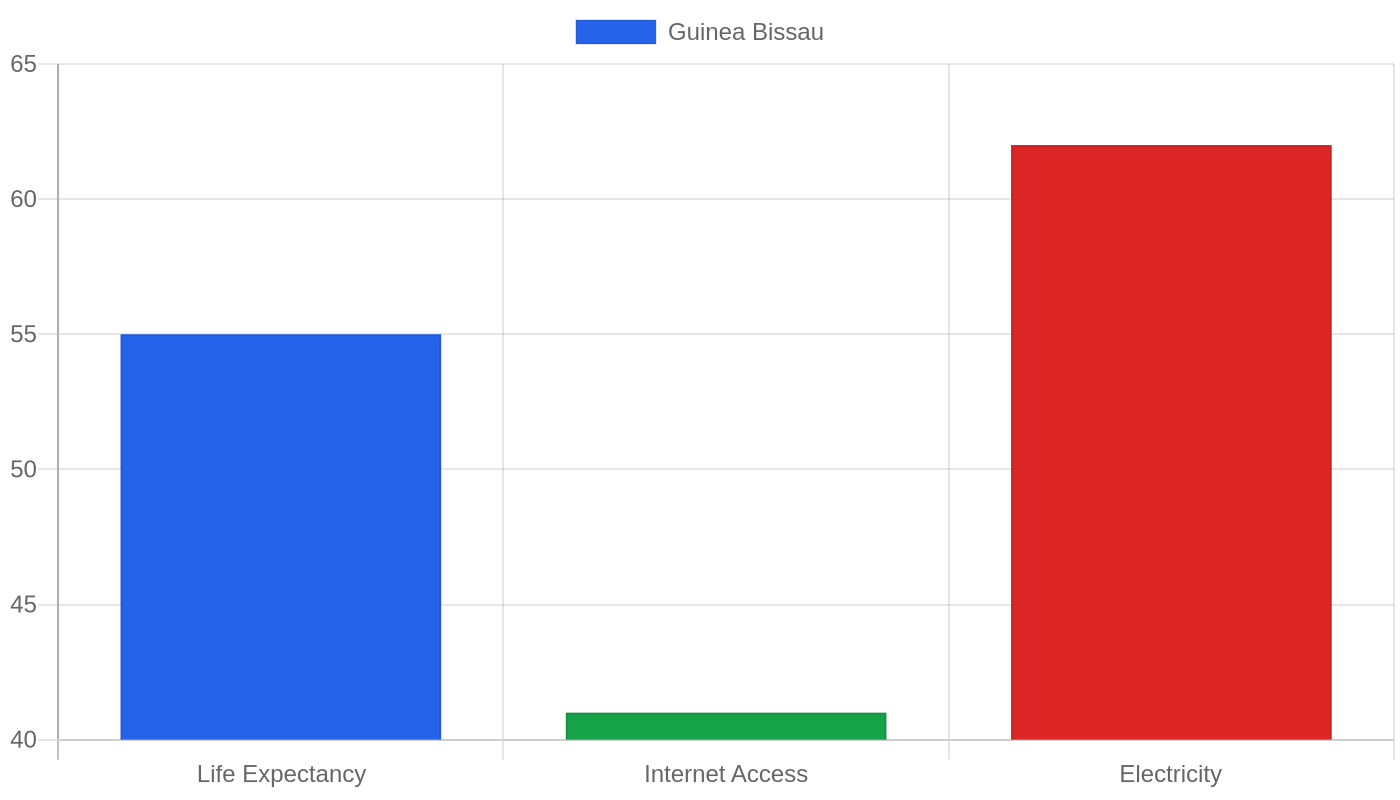
Economic Pulse Net | Sources: World Bank World Development Indicators, Government Sources | 2026
Key Takeaways
– Guinea-Bissau has never had a democratically elected president complete a full five-year term since independence in 1974, creating a cycle of political and economic paralysis.
– The country’s economic data is so sparse that the World Bank reports no figures for GDP growth, inflation, unemployment, or GDP per capita — a telling indicator of institutional fragility.
– Multi-party governance was not established until mid-1991, meaning the country’s democratic institutions are barely three decades old and remain highly fragile.
– The political system operates as a semi-presidential republic, but chronic instability between the president and prime minister has repeatedly derailed governance and investor confidence.
– For a country with virtually no reliable economic metrics, the single most important data point may be this: no leader has finished a full term in nearly 50 years.
The Ghost Economy — When the Data Says Nothing
When the World Bank publishes a country profile with empty cells for GDP growth, inflation, unemployment, GDP per capita, and GNI per capita, it is not a data-entry error. It is a statement. Guinea-Bissau, a small West African nation of roughly two million people, has become something of a statistical phantom — a country so beset by chronic instability that even the most basic economic measurements are either unavailable or unreliable.
The absence of data is itself the story. The World Bank, which tracks economic indicators for nearly every country on earth, cannot provide a GDP growth figure for Guinea-Bissau’s latest period. It cannot report the inflation rate. It cannot tell us the unemployment rate. This is not because the economy is too small to measure — it is because the institutional capacity to collect, verify, and publish such data has been repeatedly shattered by political turmoil.
Since independence from Portugal in 1974, the country has experienced a pattern so consistent it borders on tragic predictability. As the political landscape data notes, from independence until José Mário Vaz ended his five-year term as president on 24 June 2019, no president successfully served a full five-year term. That is nearly half a century of truncated presidencies, army mutinies, assassinations, and extra-constitutional transfers of power.
The economy does not grow under such conditions — it survives, barely.
The political system is a republic with a semi-presidential structure. The president serves as head of state, while the prime minister acts as head of government. In theory, this creates a balance of powers. In practice, it has created a battleground. The government had been highly centralized in the past, and the transition to multi-party governance did not arrive until mid-1991.
For context, that is only 33 years ago — roughly the same period in which countries like Poland and the Baltic states have joined the European Union and built modern economies. Guinea-Bissau, by contrast, has spent those decades in a revolving door of political crisis.
The economic consequences are severe but difficult to quantify precisely. Without GDP data, we cannot say whether the economy is growing or shrinking. Without inflation figures, we cannot know whether ordinary citizens are seeing their purchasing power erode. Without unemployment numbers, we cannot measure the scale of the informal economy that almost certainly dominates daily life.
What we can say is this: when a country cannot produce basic economic statistics, it cannot attract serious foreign investment, cannot design effective policy, and cannot provide its citizens with the most fundamental tool of economic citizenship — information.
Cashew Nuts and Concrete Ceilings — The Cost of Living in a Data Void
Any discussion of the cost of living in Guinea-Bissau must begin with an uncomfortable admission: the data simply does not exist in the available sources. There are no official figures on housing costs, rental markets, or daily expenses. There are no comparisons to regional averages. This absence is not an oversight — it is a reflection of an economy that operates largely outside formal channels.
What can be inferred from the political and economic context is sobering. In a country where the state cannot reliably collect GDP data, it almost certainly cannot regulate housing markets, enforce rental contracts, or provide public services that would reduce household expenses. The cost of living is likely shaped by the informal economy — small-scale agriculture, cross-border trade, and remittances from the diaspora.
The dominant export crop, cashew nuts, creates a boom-and-bust cycle that determines whether families eat well or struggle.
For the average citizen, daily expenses probably revolve around food, transportation, and basic goods, with housing representing a variable cost depending on whether one owns land or rents in the capital, Bissau. The absence of reliable inflation data means that no one — not policymakers, not businesses, not families — can plan for the future with any confidence.
In an environment where the price of rice or cooking oil can shift dramatically without warning, economic life becomes a matter of daily improvisation rather than long-term strategy.
The Business Climate — Investing Where Governments Don’t Last
The list of top companies in Guinea-Bissau is, like so much else about the country, unavailable. This is not because no businesses exist — it is because the formal corporate sector is so small and so fragile that it has not produced a stable roster of major players recognizable to international data collectors.
The sectors to watch are those that can function despite political chaos. Agriculture, particularly cashew production, remains the backbone. Fishing licenses in the rich Atlantic waters off the coast provide revenue, though much of it is believed to leak through corruption. Telecommunications and mobile money have shown resilience, as they do in many fragile states where the formal banking system is weak.
But the business environment faces a fundamental obstacle that no amount of tax incentives or regulatory reform can fix: political risk. When no president has served a full term in nearly 50 years, contracts signed with one government may not be honored by the next. Licenses granted by one administration may be revoked by its successor. Investors cannot plan five-year strategies in a country where five-year presidencies have historically been unattainable.
The political landscape data notes that the government had been highly centralized in the past. This centralization, combined with instability, means that business success often depends on personal relationships with whoever holds power at the moment — a precarious foundation for any enterprise. Until the political system demonstrates that it can sustain orderly transitions of power and complete constitutional terms, Guinea-Bissau will remain one of the world’s most difficult places to do business.
The Coup Trap — Politics, Safety, and the Quality of Life
The safety and crime indices for Guinea-Bissau are, predictably, unavailable. But the political data tells a more revealing story than any crime statistic could. The country is a republic with a history of highly centralized governance that did not transition to multi-party politics until mid-1991. The pattern since then has been one of chronic instability, with no president completing a full term until José Mário Vaz in 2019.
That single achievement — a president finishing his term — was treated as a milestone, and for good reason. It broke a streak of failure that stretched back to 1974. But one successful term does not constitute a democratic tradition. The underlying drivers of instability — a military with political ambitions, weak institutions, a fragmented party system, and an economy that cannot provide stable livelihoods — remain in place.
For ordinary citizens, the quality of life is shaped less by crime statistics and more by the unpredictable rhythms of national politics. A coup attempt can shut down the capital. A contested election can trigger violence. A dispute between the president and prime minister can paralyze the government for months. In such an environment, daily life becomes a matter of navigating not just poverty but uncertainty — the knowledge that the rules of the game can change overnight.
There is no happiness data available, but it is difficult to imagine that chronic instability and economic precarity produce high levels of life satisfaction. The country’s repeated failure to complete political terms is not just a governance problem — it is a human development crisis that affects every aspect of life, from health care to education to the simple ability to plan for next week.
The Long Wait for a Full Term — Guinea-Bissau After the Vaz Precedent
The most significant political development in recent years was not a dramatic event but the absence of one. When José Mário Vaz ended his five-year term as president on 24 June 2019, he did something no predecessor had managed since independence in 1974. He left office on time, through constitutional means, without being overthrown, assassinated, or forced into exile.
This is the lens through which all current affairs in Guinea-Bissau must be viewed. The country is still in the early stages of proving that it can sustain democratic governance. The question hanging over every election, every government formation, and every political crisis is whether the Vaz precedent will become the norm or remain the exception.
The political landscape data describes a republic with a semi-presidential system, where the president is head of state and the prime minister is head of government. This arrangement has historically been a source of conflict rather than cooperation. The constitution creates two centers of power, and in Guinea-Bissau’s political culture, those centers have tended to clash rather than coordinate.
For the economy, the stakes could not be higher. If the country can string together two or three consecutive full presidential terms, it might begin to attract the kind of investment that has eluded it for decades. International financial institutions might resume normal data collection. The World Bank might once again publish GDP figures. Businesses might start to plan beyond the next election cycle.
But that is a future that has not yet arrived. For now, Guinea-Bissau remains a country defined by what it lacks: complete data, stable governance, and the basic institutional continuity that most nations take for granted. The 2019 transition was a step forward, but it was only one step. The journey to normalcy is measured in decades, not years.
The Bottom Line
Guinea-Bissau is a country for the patient and the risk-tolerant — and even they should think twice. Development economists, regional security analysts, and investors specializing in frontier markets should watch this country closely, not for what it is today but for what it could become if the political system finally stabilizes. The raw ingredients are there: a strategic coastal location, agricultural potential, and a young population.
But until the country proves it can complete consecutive terms without crisis, Guinea-Bissau will remain what it has been for nearly 50 years — a cautionary tale about the economic cost of political instability.
Sources & Methodology
This article is authored by Economic Pulse Net for informational and research purposes. Economic Pulse Net sources its data from multilateral institutions, national statistics bureaus, and proprietary databases. All data is believed to be current as of the date of publication.
Published: July 22, 2026 | Category: Research — Guinea Bissau
Use these signals in your own platform
Economic Pulse publishes its live signal feed through a documented, read-only API. Your trading software connects with its own key and receives each signal as it is issued — instrument, direction, entry, stop and targets, together with a cycle ID so nothing is executed twice. The feed is independent of this website and cannot change it.
Signals are informational only and are not financial advice.