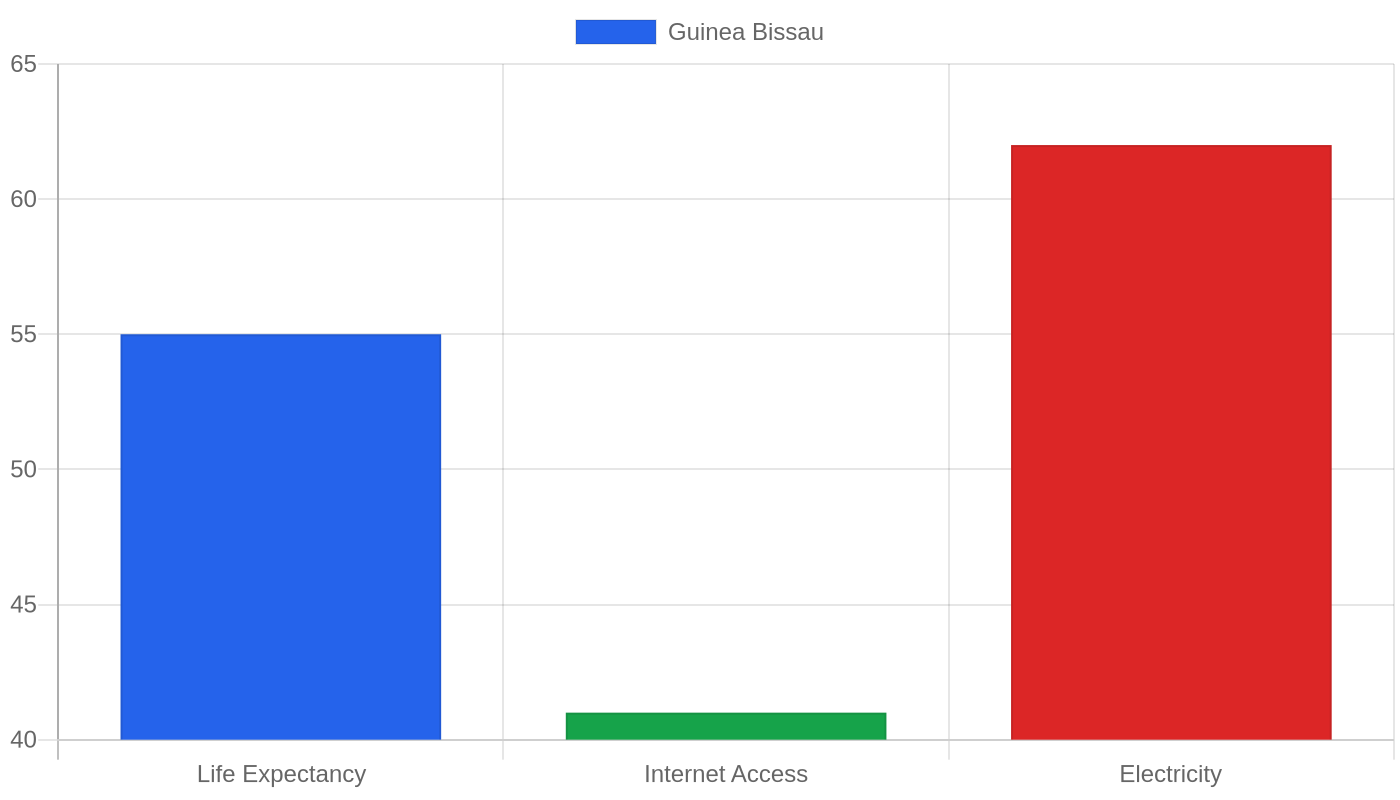
Economic Pulse Net | Sources: World Bank World Development Indicators, Government Sources | 2026
Key Takeaways
– Guinea-Bissau has historically been one of the world’s most politically unstable nations, with no president completing a full five-year term from independence in 1974 until José Mário Vaz finally broke that streak in 2019.
– The country operates as a republic with a semi-presidential system, but the centralization of power has historically undermined institutional resilience.
– Despite chronic instability, Guinea-Bissau possesses significant economic potential, particularly in agriculture and fisheries, though data gaps make precise economic assessment difficult.
– The World Bank provides no current GDP growth, inflation, unemployment, or per capita income figures for the country, underscoring the severity of data collection challenges.
– Political fragility remains the single greatest barrier to economic development, with multi-party governance only established in mid-1991.
The Phantom Economy — Growth Without Numbers
To write about Guinea-Bissau’s economy is to confront a profound silence. The World Bank, the world’s premier economic data institution, reports no figures for GDP growth, inflation, unemployment, total GDP, GDP per capita based on purchasing power parity, or GNI per capita. This is not an oversight. It is a statement.
When an entire national economy disappears from the statistical record, it tells you something about the depth of institutional collapse and the difficulty of gathering reliable information in a country where the state’s reach is limited.
What we do know is that Guinea-Bissau is a small West African nation whose economy has traditionally rested on cashew nuts, fishing, and subsistence agriculture. The cashew sector alone has historically accounted for the vast majority of export earnings, making the country dangerously dependent on a single commodity whose price fluctuates wildly on international markets.
Without GDP figures from the World Bank, we cannot say whether the economy is growing or shrinking, whether inflation is eroding purchasing power, or whether unemployment is rising or falling. The absence of data is itself the most important economic indicator: it signals a state that cannot count its own citizens, measure its own output, or track its own prices.
The implications are stark. International investors require data to make decisions. Aid agencies need benchmarks to measure progress. Policymakers need statistics to design interventions. Guinea-Bissau’s data vacuum creates a vicious cycle: without reliable numbers, the country cannot attract investment; without investment, it cannot generate the economic activity that would produce reliable numbers.
The World Bank’s silence is not merely a technical gap—it is a mirror reflecting the structural weakness of the entire economic apparatus.
Living Without a Ledger — The Cost of Survival in a Cash Economy
Housing costs, daily expenses, and the cost of living in Guinea-Bissau are similarly undocumented by the data provided. This absence is not unusual for a country where the majority of economic activity takes place outside formal channels.
In the absence of World Bank figures, we can infer that most transactions occur in cash, that subsistence farming provides the primary food source for much of the population, and that housing ranges from traditional mud-brick structures in rural villages to concrete buildings in the capital, Bissau.
Rent versus buy calculations, which dominate housing discussions in developed economies, are largely irrelevant in a context where most people build their own homes or inherit family compounds. The informal economy—unmeasured, untaxed, undocumented—is not a marginal sector in Guinea-Bissau; it is the economy.
Comparing costs to regional averages is impossible without baseline data, but what can be said with confidence is that poverty is widespread and that the absence of formal wage employment means most families survive through a combination of small-scale agriculture, petty trade, and remittances from relatives abroad.
The lack of cost-of-living data from the World Bank reinforces a broader truth: Guinea-Bissau is a country where the state does not track the daily economic realities of its people. This is not merely an administrative failure. It is a governance failure that leaves policymakers flying blind and citizens invisible to the institutions that are supposed to serve them.
Where Business Goes to Wait — Investment in a Political Minefield
The data provided lists no top companies, no major industries beyond the general knowledge of cashew production and fishing, and no business climate rankings. This is not because Guinea-Bissau lacks economic activity. It is because formal, registered, tax-paying businesses are rare in an environment where political instability has historically made long-term investment a gamble of the highest order.
The sectors to watch remain agriculture, particularly cashew nuts, and fisheries, which benefit from the country’s Atlantic coastline and rich marine resources. But watching is not the same as investing. Without data on company performance, regulatory frameworks, or market size, potential investors are left with more questions than answers.
The business environment is shaped not by incentives but by survival strategies: companies that endure in Guinea-Bissau are those that have learned to navigate political uncertainty, supply chain disruptions, and a state that struggles to provide basic services like electricity and roads.
For the investor willing to accept extreme risk, the potential rewards could be significant. Guinea-Bissau’s agricultural land is underutilized, its fishing waters are rich, and its population is young. But the absence of data from the World Bank and other sources means that any investment decision is made in the dark. In the world of international business, information is the currency of confidence—and Guinea-Bissau is effectively bankrupt.
The Presidency Curse — Politics as the National Sport
The political landscape of Guinea-Bissau is defined by a single, devastating statistic: from independence in 1974 until José Mário Vaz ended his five-year term as president on 24 June 2019, no president successfully served a full five-year term. This is not a footnote. It is the central fact of national life.
Guinea-Bissau is a republic, and according to the political data provided, the government had historically been highly centralized. Multi-party governance was not established until mid-1991, meaning that for the first 17 years of independence, the country operated under a system that concentrated power at the top. The president serves as head of state, while the prime minister is head of government. In theory, this is a semi-presidential system. In practice, it has been a recipe for perpetual crisis.
The coup d’état has been a recurring feature of Guinea-Bissau’s political life. The inability of any president to complete a full term before Vaz reflects deep-seated problems: a military that has historically seen itself as a political actor, a weak civil society that cannot hold leaders accountable, and a political elite more interested in controlling state resources than in governing.
The Crime Index and Safety Index are listed as not available, but the political data tells its own story about safety. When presidents cannot finish their terms, when power changes hands through violence rather than ballots, the security of ordinary citizens is fundamentally compromised.
The quality of life in Guinea-Bissau cannot be separated from this political reality. No happiness data is provided, but it is reasonable to conclude that a country where political instability is the norm, where economic data is absent, and where institutions are fragile, is not a country where life is easy. The resilience of the Guinean people, who continue to farm, trade, and raise families amid chronic uncertainty, is perhaps the country’s greatest—and most invisible—asset.
Breaking the Curse — The Vaz Precedent and What Comes Next
The fact that José Mário Vaz completed his full five-year term in June 2019 is not a small achievement. In the context of Guinea-Bissau’s history, it is a landmark. For the first time since independence, the presidency changed hands not through a coup, not through assassination, not through forced exile, but through the constitutional expiration of a term. This is the freshest and most significant political development in the country’s modern history.
The implications are profound. If the precedent holds, it suggests that Guinea-Bissau may be moving, however slowly and painfully, toward political normalization. A president who serves a full term creates expectations: that elections will be respected, that term limits will be observed, that the military will stay in its barracks.
It opens the door for international partners to re-engage, for investors to reconsider, for the World Bank and other institutions to resume collecting the data that is so desperately needed.
But one term does not make a democracy. The structural problems that produced decades of instability remain: a politicized military, weak institutions, endemic poverty, and a political culture that rewards short-term power grabs over long-term development. The question now is whether the Vaz precedent becomes the new normal or an exception that proves the old rule.
For the people of Guinea-Bissau, the answer will determine whether their country can finally begin the slow, difficult work of building a stable state and a measurable economy.
The Bottom Line
Guinea-Bissau is a country for the patient optimist and the risk-tolerant investor. The absence of data from the World Bank should be read not as a reason to ignore the country but as a signal of the scale of the opportunity—and the challenge. Anyone watching Guinea-Bissau should focus on one thing above all: whether the political stability that began with President Vaz’s completed term can be sustained.
If it can, the data will eventually follow, and with it, the investment, the development, and the measurable progress that has eluded this small West African nation for five decades.
Sources & Methodology
This article is authored by Economic Pulse Net for informational and research purposes. Economic Pulse Net sources its data from multilateral institutions, national statistics bureaus, and proprietary databases. All data is believed to be current as of the date of publication.
Published: July 22, 2026 | Category: Research — Guinea Bissau
Use these signals in your own platform
Economic Pulse publishes its live signal feed through a documented, read-only API. Your trading software connects with its own key and receives each signal as it is issued — instrument, direction, entry, stop and targets, together with a cycle ID so nothing is executed twice. The feed is independent of this website and cannot change it.
Signals are informational only and are not financial advice.