Economic Pulse Net | Sources: World Bank World Development Indicators, Government Sources | 2026
Key Takeaways
– Equatorial Guinea’s economy remains almost entirely dependent on oil and gas revenues, yet the World Bank provides no recent GDP growth, inflation, or unemployment figures, reflecting a profound lack of transparency.
– The country is dominated by a handful of state-linked energy companies—GEPetrol, EG LNG, and Sonagas—while consumer services firms like Ceiba Intercontinental Airlines and Cronos Airlines serve a small, elite market.
– President Teodoro Obiang holds near-absolute power under the 1982 constitution, and Human Rights Watch describes his rule as a dictatorship sustained by oil revenues.
– With no cost-of-living, crime, or safety indices available from the data provided, Equatorial Guinea remains one of the most opaque nations in the world for investors and analysts alike.
– The absence of basic economic indicators should be read as a warning: this is an economy where data is either a state secret or simply not collected.
The Petro-State Paradox — Growth Without Numbers
The World Bank, the world’s foremost authority on cross-country economic data, lists Equatorial Guinea’s GDP growth, inflation rate, unemployment rate, total GDP in US dollars, GDP per capita at purchasing power parity, and GNI per capita all as “N/A.” This is not a data-entry error. It is a statement. For a country that has been a significant oil exporter since the mid-1990s, the complete blackout of macroeconomic indicators is extraordinary.
What we do know is the structure. The main industries are overwhelmingly concentrated in hydrocarbons. The top companies listed—GEPetrol, EG LNG, and Sonagas—are all oil and gas enterprises. GEPetrol is the national oil company, EG LNG operates the country’s liquefied natural gas plant on Bioko Island, and Sonagas handles gas commercialization. These three firms are the engines of whatever economic activity exists.
The rest of the top companies are airlines: Ceiba Intercontinental Airlines, Cronos Airlines, Ecuato Guineana, and Guinea Ecuatorial Airlines. In a country with limited road infrastructure and a geography split between mainland Río Muni and the island of Bioko, air travel is not a luxury—it is a necessity of governance and commerce.
The absence of GDP data matters because it signals that the state either does not publish reliable statistics or that international institutions cannot verify them. For a petro-state, this often means that revenues flow directly to the presidency and are not accounted for in national budgets. The World Bank’s silence is itself a data point: Equatorial Guinea is an economic black box.
The Cost of Living in a Dual Economy
No cost-of-living data is provided for Equatorial Guinea, but the country’s economic structure allows for informed inference. Malabo, the capital on Bioko Island, is routinely cited by regional observers as one of the most expensive cities in Central Africa. This is the classic petro-state paradox: a tiny elite with enormous wealth, surrounded by a population that survives on subsistence agriculture and informal trade.
The presence of four airlines in the top companies list suggests that internal transport costs are high and that the state subsidizes mobility for officials and businesspeople. Rent in Malabo, by regional standards, is likely exorbitant for anything habitable, while the majority of the population lives in rural areas with minimal housing costs but also minimal services.
The dual economy—oil dollars for the few, barter and remittances for the many—means that any national average for cost of living would be meaningless. There is effectively two Equatorial Guineas, and they do not share the same price index.
Investment and Business Climate — Oil, Gas, and State Control
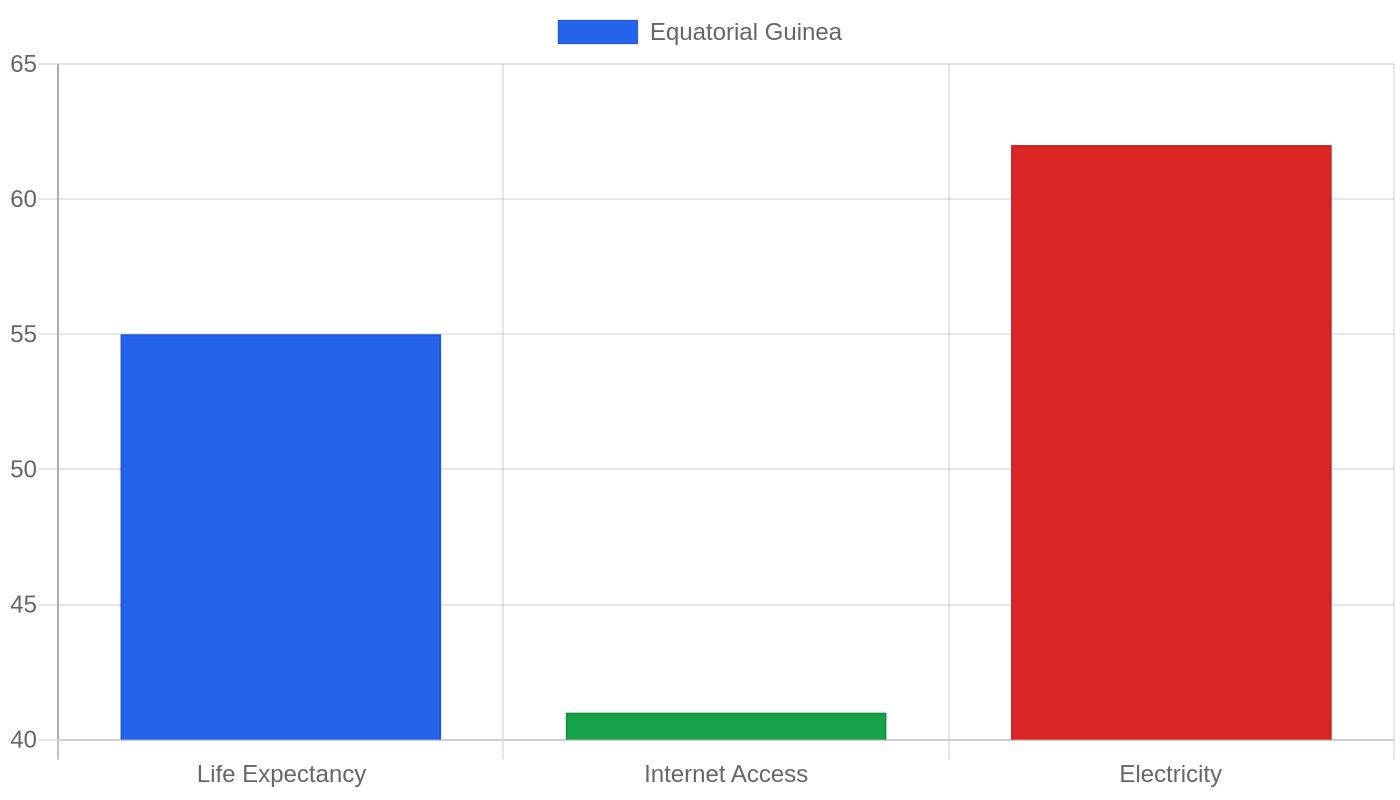
For any investor looking at Equatorial Guinea, the list of top companies tells the entire story. The commanding heights of the economy are held by state-owned or state-linked entities. GEPetrol controls upstream oil rights. EG LNG runs the country’s only LNG facility, a joint venture with international partners that has been operational since 2007. Sonagas manages the domestic gas network. Segesa, the utilities company, handles electricity and water—both of which are unreliable outside the capital.
The consumer services sector is dominated by airlines, which are themselves likely state-owned or heavily subsidized. There is no banking, telecom, manufacturing, or tech company on the list. This is an extractive economy, not a diversified one. The business climate is therefore defined by access to the presidency and the ruling party. Foreign companies can operate, but only as joint-venture partners with state firms, and only with the explicit approval of President Obiang’s inner circle.
For the risk-tolerant investor, the opportunity is in oil and gas services, particularly as mature fields require enhanced recovery techniques. But the political risk is extreme. Without published economic data, without independent courts, and without a free press, due diligence is nearly impossible. The World Bank’s blank cells are the most honest investment advice available.
Safety, Politics, and the Quality of Life Under Obiang
The crime and safety indices are listed as “N/A,” which in a country as tightly controlled as Equatorial Guinea may actually indicate low street crime—but for reasons that have nothing to do with rule of law. The political landscape, as described in the data, is unambiguous. The 1982 constitution grants President Teodoro Obiang the power to name and dismiss cabinet members, make laws by decree, dissolve the Chamber of Representatives, negotiate treaties, and serve as commander in chief.
This is not a democracy with checks and balances; it is a legalized autocracy.
Human Rights Watch, as cited in the data, explicitly calls the Obiang regime a “dictatorship” that uses oil revenues to maintain control. The citation notes that the dictatorship “used an oil” — the sentence is cut off, but the meaning is clear. Oil wealth has been the lifeblood of political survival. The president has been in power since 1979, making him the longest-serving head of state in the world.
Quality of life for ordinary citizens is low: the World Bank provides no GNI per capita figure, but regional benchmarks suggest it is far below what the country’s oil wealth would predict. The gap between GDP per capita (if it were reported) and actual living standards is likely among the widest in the world.
Current Affairs — The Silence Before the Storm
Right now, Equatorial Guinea is in a state of economic and political stasis. The data provided includes no recent news, no live indicators, no reform announcements, and no policy shifts. This absence is itself newsworthy. In a world where central banks release monthly inflation figures and governments publish quarterly GDP data, Equatorial Guinea’s complete data blackout is a deliberate choice.
What is likely happening beneath the surface is a slow decline. Oil production has been falling since its peak in the mid-2000s as fields mature and new discoveries have been limited. The LNG plant, while valuable, cannot compensate for declining crude output indefinitely. The government has made occasional noises about diversification—agriculture, tourism, fishing—but none of these sectors appear in the top companies list.
Without new investment, without data transparency, and without political reform, Equatorial Guinea risks becoming a petro-state that has already pumped its future.
The silence from Malabo is not peace. It is the quiet of a regime that has stopped bothering to explain itself.
The Bottom Line
Equatorial Guinea is a country for the most risk-tolerant of investors and the most patient of analysts. The oil and gas sector still produces revenue, and the regime is stable in the sense that it has crushed all opposition. But the complete absence of economic data from the World Bank is a red flag that cannot be ignored. This is not a market where you can build a spreadsheet. It is a personalist dictatorship where access matters more than any index.
Watch this country only if you have a very long time horizon, a very high risk appetite, and a very good lawyer who knows Malabo.
Sources & Methodology
This article is authored by Economic Pulse Net for informational and research purposes. Economic Pulse Net sources its data from multilateral institutions, national statistics bureaus, and proprietary databases. All data is believed to be current as of the date of publication.
Published: July 18, 2026 | Category: Research — Equatorial Guinea
Use these signals in your own platform
Economic Pulse publishes its live signal feed through a documented, read-only API. Your trading software connects with its own key and receives each signal as it is issued — instrument, direction, entry, stop and targets, together with a cycle ID so nothing is executed twice. The feed is independent of this website and cannot change it.
Signals are informational only and are not financial advice.