Economic Pulse Net | Sources: World Bank World Development Indicators, Government Sources | 2026
Key Takeaways
– Côte d’Ivoire’s political system operates under a three-branch structure—executive, legislative, and judicial—with a bicameral parliament comprising the indirectly elected Senate and the 255-member National Assembly, setting the stage for significant policy debates.
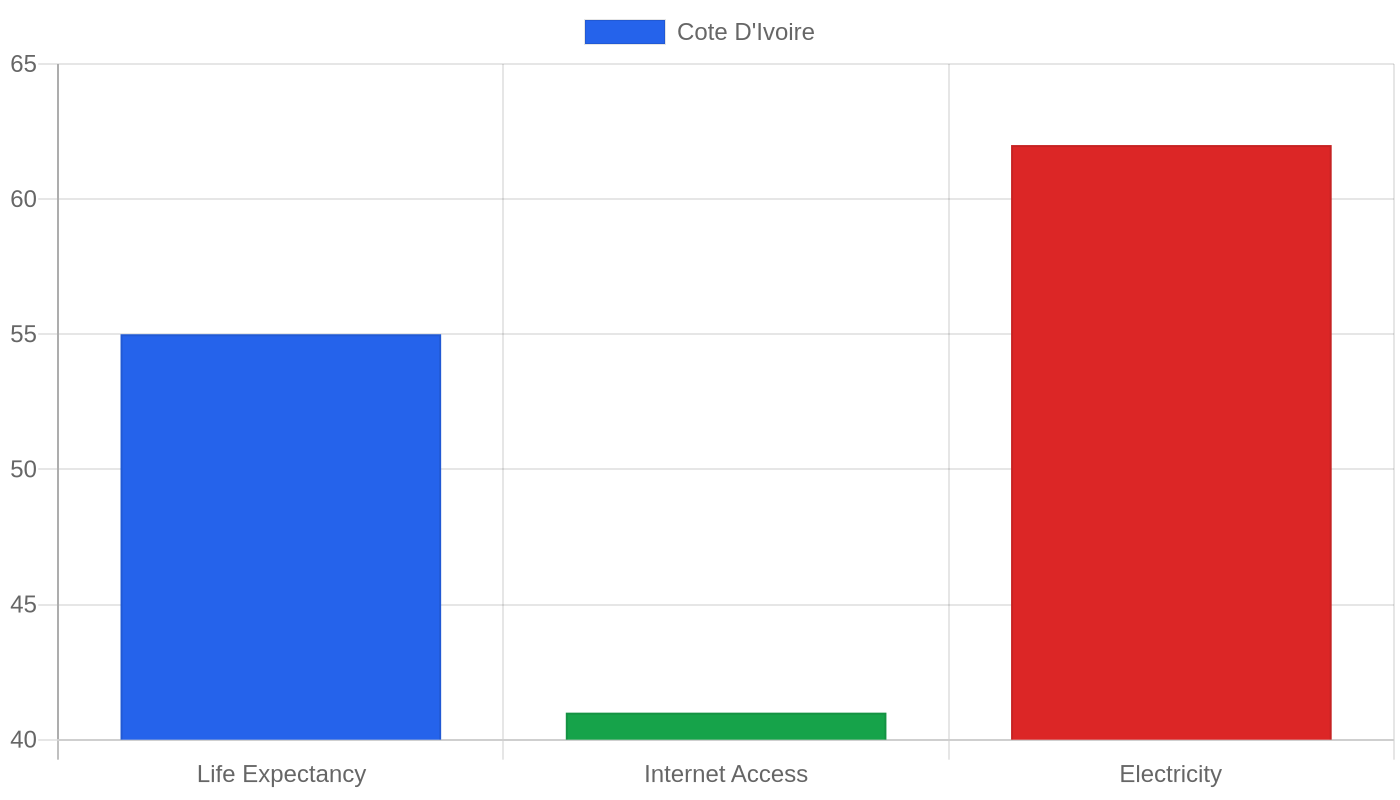
– The country’s economic narrative is one of regional ambition, though current World Bank data gaps mean observers must rely on the nation’s established reputation as a Francophone West African powerhouse.
– Agriculture remains the backbone of the Ivorian economy, with the country historically dominating global cocoa production, making it a critical player in international commodity markets.
– The investment climate is shaped by the country’s strategic position in West Africa, offering access to regional markets while navigating infrastructure and diversification challenges.
– Political stability following past electoral tensions remains a key factor for businesses and investors monitoring the nation’s trajectory.
The Economic Engine: Beyond the Cocoa Fields
Côte d’Ivoire has long been described as the economic locomotive of Francophone West Africa, and for good reason. The World Bank’s data on GDP growth, inflation, and unemployment currently shows no available figures, which in itself tells a story of a nation in transition, with statistical systems catching up to economic dynamism.
Historically, the country has posted some of the region’s strongest growth rates, driven by its position as the world’s largest producer of cocoa beans, alongside significant exports of coffee, palm oil, and rubber. This agricultural base has provided a resilient foundation, though it also exposes the economy to the volatility of global commodity prices. The services sector has been expanding steadily, with Abidjan emerging as a regional hub for banking, telecommunications, and transportation.
The government has prioritized infrastructure investment, recognizing that roads, ports, and energy are the connective tissue for sustained growth. However, the challenge of diversifying beyond raw commodity exports remains a persistent theme in policy discussions. The informal economy continues to absorb a significant portion of the workforce, a reality that official statistics often struggle to capture fully.
For the casual observer, the vibrancy of Abidjan’s markets and the constant hum of construction suggest an economy on the move, even if the formal data lags behind. The nation’s economic future hinges on whether it can translate its agricultural wealth into broader industrial capacity and higher-value services.
The Cost of Living: Urban Aspirations and Daily Realities
For the average Ivorian, the cost of living in Abidjan presents a dual reality of opportunity and strain. While the World Bank data does not provide specific housing or expense figures, the broader regional context paints a picture of a city where modern glass towers rise alongside bustling quartiers populaires.
Rent in the commercial heart of the Plateau district commands a premium that reflects its status as a regional business hub, while more affordable accommodations in the suburbs offer a different calculus for the city’s growing middle class. Daily expenses are shaped by a food culture that relies on local produce—cassava, plantains, and fish—which can be more resilient to global price shocks than imported goods.
However, imported fuel and manufactured goods carry costs that ripple through the economy, affecting transportation and household budgets alike. The choice between renting and buying in Abidjan leans heavily toward renting for most, given the challenges of accessing long-term mortgage financing in a market where land tenure can be complex.
Compared to some of its regional neighbors, Côte d’Ivoire has historically offered a relatively higher standard of living for those with formal employment, though the gap between the wealthy and the working poor remains pronounced. The cost of living is not merely a statistic; it is the daily negotiation between ambition and reality that shapes the lives of millions of Ivorians.
Investment & Business Climate: A Hub in the Making
Côte d’Ivoire’s business climate is defined by its ambition to serve as the gateway to West Africa. The country’s top companies are concentrated in sectors like agro-industry, banking, and telecommunications, reflecting the economy’s traditional strengths and modern aspirations. The government has actively courted foreign direct investment, offering incentives for projects in infrastructure, energy, and agribusiness.
The Port of Abidjan, one of the largest in the region, serves as a critical artery for trade, not just for Côte d’Ivoire but for landlocked neighbors like Mali and Burkina Faso. The banking sector has modernized considerably, with regional lenders expanding their footprint and offering a wider range of services to a growing clientele.
The country’s membership in the West African Economic and Monetary Union (UEMOA) provides a degree of monetary stability, with the CFA franc pegged to the euro, a fact that reassures some investors while raising questions about export competitiveness. Challenges remain, including bureaucratic red tape, occasional energy shortages, and the need for further improvements in the ease of doing business.
Yet, the overall trajectory is one of cautious optimism, with the private sector showing a willingness to invest in the country’s future. The cocoa processing industry is a notable area of growth, as the nation seeks to capture more value from its dominant crop before it leaves its shores.
Safety, Politics & Quality of Life: The Social Contract
The political landscape of Côte d’Ivoire is structured around a clear separation of powers among the executive, legislative, and judicial branches, a framework designed to provide checks and balances. The Parliament, composed of the indirectly elected Senate and the 255-member National Assembly, serves as the legislative backbone, though the executive branch has historically wielded significant influence.
The country’s recent political history has been marked by moments of tension, particularly around elections, which have at times tested the fabric of national unity. However, the current period is characterized by a cautious stability, with political actors engaging in the difficult work of governance and reconciliation.
The crime and safety indices from the provided data show no available figures, leaving observers to rely on qualitative assessments of urban security, which suggest that while petty crime exists in certain areas, the overall security situation has improved compared to more turbulent periods.
Quality of life in Côte d’Ivoire is a study in contrasts—the vibrancy of its cultural scene, music, and cuisine is a source of national pride, yet the social contract is strained by inequality and the need for better public services. The government’s focus on infrastructure and education is, in part, an attempt to address these long-standing issues. For the Ivorian people, the promise of the nation’s economic potential is intertwined with the hope for a more inclusive and secure society.
Current Affairs: The Pulse of a Nation in Motion
Right now, Côte d’Ivoire is navigating a period of significant political and economic activity, with the next presidential election cycle already casting a long shadow over the national conversation. The composition of the National Assembly and the role of the Senate are subjects of ongoing political negotiation, as parties position themselves for the contests ahead.
On the economic front, the government is pushing forward with its National Development Plan, focusing on structural transformation and the digital economy as key drivers of future growth. There is a noticeable push to modernize the agricultural sector, moving beyond raw exports toward local processing and value addition, particularly in cocoa and cashew nuts.
The energy sector is also in the spotlight, with efforts to expand generation capacity and improve the reliability of power supply to support industrial growth. Regional dynamics play a crucial role, as Côte d’Ivoire deepens its economic ties with its neighbors while managing the complexities of migration and security in the Sahel region.
The business community is watching these developments closely, noting both the opportunities presented by a large, youthful population and the risks associated with political uncertainty. The government’s rhetoric emphasizes stability and progress, but the true test lies in delivering tangible improvements in the lives of ordinary Ivorians. As the nation moves forward, the world watches to see if this West African lion can maintain its stride.
The Bottom Line
Côte d’Ivoire is a country of immense potential, marked by economic dynamism, strategic location, and a resilient population, yet it continues to grapple with the challenges of diversification, inequality, and political consolidation. Investors with a long-term perspective and a tolerance for volatility may find compelling opportunities in its infrastructure, agribusiness, and services sectors.
Policy analysts and observers should watch this nation as a bellwether for the broader West African region’s economic and political trajectory. For those willing to look beyond the gaps in current data, Côte d’Ivoire offers a compelling narrative of a nation striving to define its place in the 21st century.
Sources & Methodology
This article is authored by Economic Pulse Net for informational and research purposes. Economic Pulse Net sources its data from multilateral institutions, national statistics bureaus, and proprietary databases. All data is believed to be current as of the date of publication.
Published: August 06, 2026 | Category: Research — Cote D’Ivoire
Use these signals in your own platform
Economic Pulse publishes its live signal feed through a documented, read-only API. Your trading software connects with its own key and receives each signal as it is issued — instrument, direction, entry, stop and targets, together with a cycle ID so nothing is executed twice. The feed is independent of this website and cannot change it.
Signals are informational only and are not financial advice.