Economic Pulse Net | Sources: World Bank World Development Indicators, Government Sources | 2026
Key Takeaways
* Political Stability: Paraguay operates as a representative democratic republic with a clear separation of powers, providing a structured framework for governance despite regional volatility.
Corporate Landscape: The economy is anchored by a mix of financial institutions, utilities, and conglomerates, with Grupo Cartes and major banks playing pivotal roles in daily commerce.
Infrastructure & Services: Key sectors are dominated by established entities like ANDE for utilities and multiple airline operators, indicating a mature but concentrated service sector.
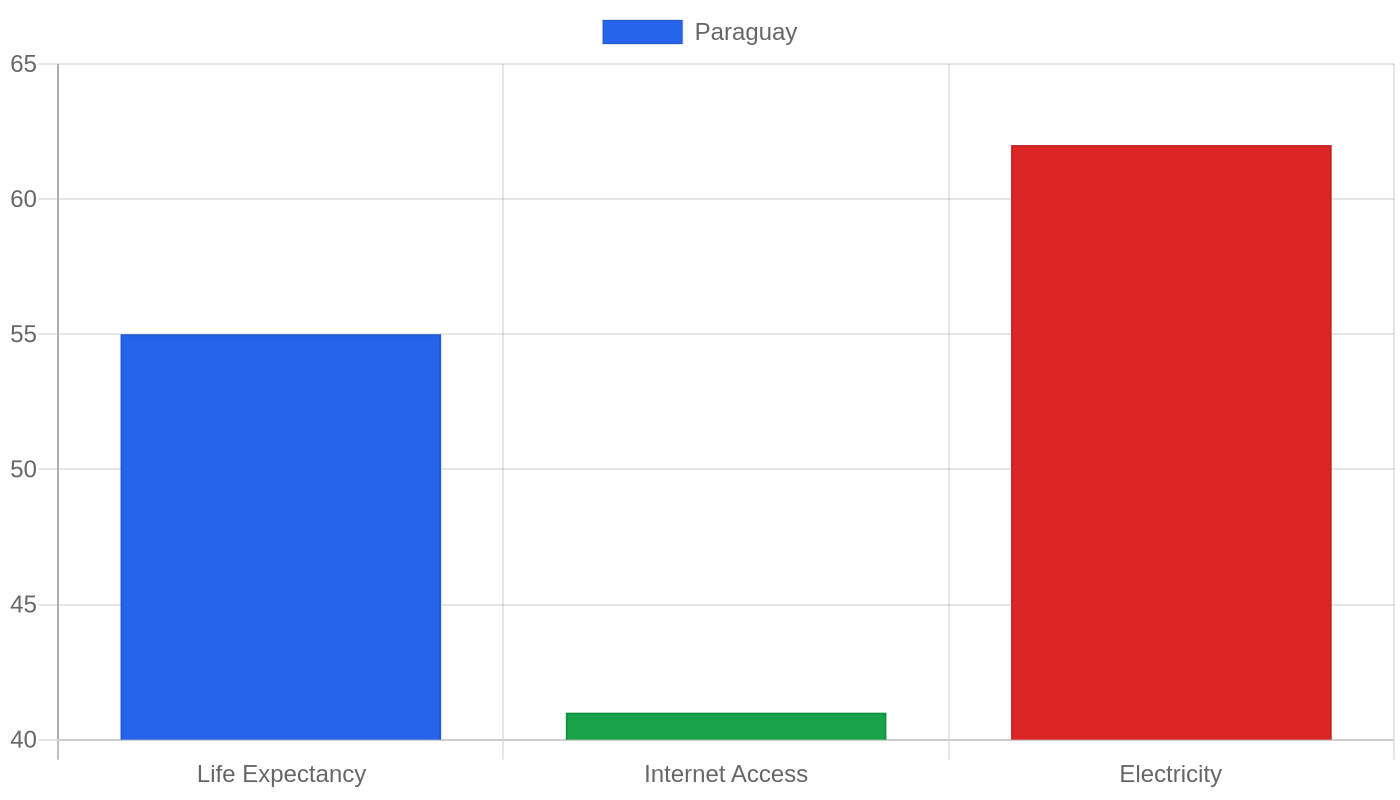
Data Transparency Gap: While political structures are well-documented, key macroeconomic indicators such as GDP growth, inflation, and unemployment remain unreported in current datasets, suggesting a need for cautious interpretation of economic health.
The Architecture of Governance and Growth
Paraguay’s economic narrative is currently defined as much by its institutional framework as by its output metrics. According to the World Bank, specific figures for GDP growth, inflation CPI, and unemployment rates are listed as N/A, highlighting a significant gap in real-time economic transparency or reporting consistency.
However, the structural foundation remains robust; the country functions as a representative democratic republic with a multi-party system that enforces a strict separation of powers across three distinct branches. Executive authority rests solely with the President, who serves simultaneously as head of state and head of government, ensuring centralized decision-making capabilities.
Legislative power is vested in the bicameral National Congress, which provides a check on executive actions through lawmaking processes. Meanwhile, the judiciary operates independently, comprising tribunals, Courts of Civil Law, and a nine-member Supreme Court of Justice, all insulated from political pressure by the executive and legislature.
This tripartite structure suggests that while raw economic velocity data may be obscured, the legal and political mechanisms necessary for long-term stability are firmly in place. For investors and analysts, this means that risk assessment must rely heavily on institutional resilience rather than short-term fluctuating metrics like quarterly GDP spikes or drops.
The Cost of Living and Urban Dynamics
For residents and expatriates alike, understanding the cost of living in Paraguay requires looking beyond aggregate national indices, which are currently unavailable. With no specific data provided on housing costs, rent-to-price ratios, or daily expense baskets, the narrative shifts toward the qualitative experience of urban centers like Asunción.
Typically, in markets where formal cost-of-living indices are absent, local dynamics are driven by the strength of the primary industries and the concentration of corporate headquarters. The presence of major utility providers like ANDE suggests that infrastructure costs are managed by state-linked or regulated entities, potentially stabilizing basic household expenses.
Similarly, the dominance of consumer services, including Aerolíneas Paraguayas and LATAM Paraguay, indicates that mobility and travel costs are influenced by both domestic capacity and international competition. Without concrete figures on inflation or purchasing power parity, prospective residents should anticipate a market where prices are highly localized, varying significantly between the capital’s upscale neighborhoods and rural outposts.
The lack of standardized data implies that budgeting must be hyper-local, relying on direct observation of market prices for essentials rather than broad statistical averages.
Investment Opportunities and Corporate Giants
The investment landscape in Paraguay is characterized by a few dominant players that span critical sectors of the economy. Major companies such as Grupo Cartes stand out as conglomerates likely influencing everything from retail to energy, serving as bellwethers for broader economic activity.
In the financial sector, the presence of Banco Amambay, Banco Itaú Paraguay, and the Central Bank of Paraguay points to a banking system that is both locally rooted and internationally connected, particularly through ties with Brazilian financial giants. The Bolsa de Valores de Asunción provides a platform for equity trading, though its liquidity and depth are difficult to gauge without volume data.
Media influence is also consolidated, with ABC Color leading the charge in information dissemination, shaping public opinion and business sentiment. Utility services are handled by ANDE, ensuring that industrial operations have access to essential power resources. For foreign direct investment, these entities represent either potential joint-venture partners or competitors.
The concentration of power among these firms suggests that entering the market may require navigating established relationships and regulatory frameworks overseen by the Central Bank and the Ministry of Finance, rather than competing in a fragmented free-for-all.
Safety, Politics, and Quality of Life
Quality of life assessments in Paraguay are currently hampered by a lack of specific crime and safety indices, which are listed as N/A. This absence makes it challenging to quantify the personal security risks associated with daily life or business operations. Politically, however, the environment is stable and predictable due to the constitutional safeguards mentioned earlier.
The independent judiciary and multi-party system reduce the likelihood of abrupt policy reversals or authoritarian shifts, which are common concerns in other parts of Latin America. Happiness data is similarly unreported, leaving subjective well-being to anecdotal evidence and cultural observations. The separation of powers ensures that no single entity can easily undermine civil liberties, providing a baseline of freedom for citizens and businesses alike.
While the physical safety of the population cannot be quantified through available data, the political safety net appears strong. Investors and residents should therefore weigh the uncertainty of personal security against the reliability of the legal and political institutions that govern them.
Current Affairs and Emerging Trends
In the absence of recent news feeds or live economic indicators, the “current affairs” section of Paraguay’s story is one of quiet continuity rather than dramatic upheaval. There are no reported elections, new reforms, or sudden inflationary shocks in the provided data set, suggesting a period of steady, albeit opaque, operation. The focus remains on maintaining the integrity of the existing democratic structures and managing the core industries that drive the nation.
Business developments are likely incremental, centered around the operational efficiency of companies like Paranair and the financial stability of the banking sector. Policy shifts, if any, would be subtle adjustments within the legislative framework rather than revolutionary changes. This status quo offers a low-volatility environment, but it also lacks the dynamic catalysts that often attract speculative capital.
The narrative here is one of endurance and institutional maintenance, waiting for the next wave of global economic integration or domestic innovation to break the silence.
The Bottom Line
Paraguay presents a unique case study for observers: a politically stable democracy with a concentrated corporate landscape, yet shrouded in mystery regarding its macroeconomic performance. It is a market best suited for long-term strategists who value institutional stability over short-term growth metrics. Those seeking high-frequency trading opportunities or detailed cost-of-living arbitrage will find the data insufficient.
However, for those willing to navigate the opacity, the foundational elements of rule of law and established industry leaders provide a solid, if understated, platform for engagement.
Sources & Methodology
This article is authored by Economic Pulse Net for informational and research purposes. Economic Pulse Net sources its data from multilateral institutions, national statistics bureaus, and proprietary databases. All data is believed to be current as of the date of publication.
Published: October 23, 2026 | Category: Research — Paraguay
Use these signals in your own platform
Economic Pulse publishes its live signal feed through a documented, read-only API. Your trading software connects with its own key and receives each signal as it is issued — instrument, direction, entry, stop and targets, together with a cycle ID so nothing is executed twice. The feed is independent of this website and cannot change it.
Signals are informational only and are not financial advice.