Economic Pulse Net | Sources: World Bank World Development Indicators, Government Sources | 2026
Key Takeaways
– Costa Rica’s famously stable political system, anchored by the 1949 Constitution, continues to provide a bedrock of predictability in a region often marked by turbulence.
– The economy is dominated by consumer goods and services giants like Dos Pinos, Florida Ice and Farm, and Café Britt, reflecting a domestic market that punches above its weight.
– A robust utilities sector, led by state-owned ICE, underscores the country’s commitment to renewable energy and public infrastructure.
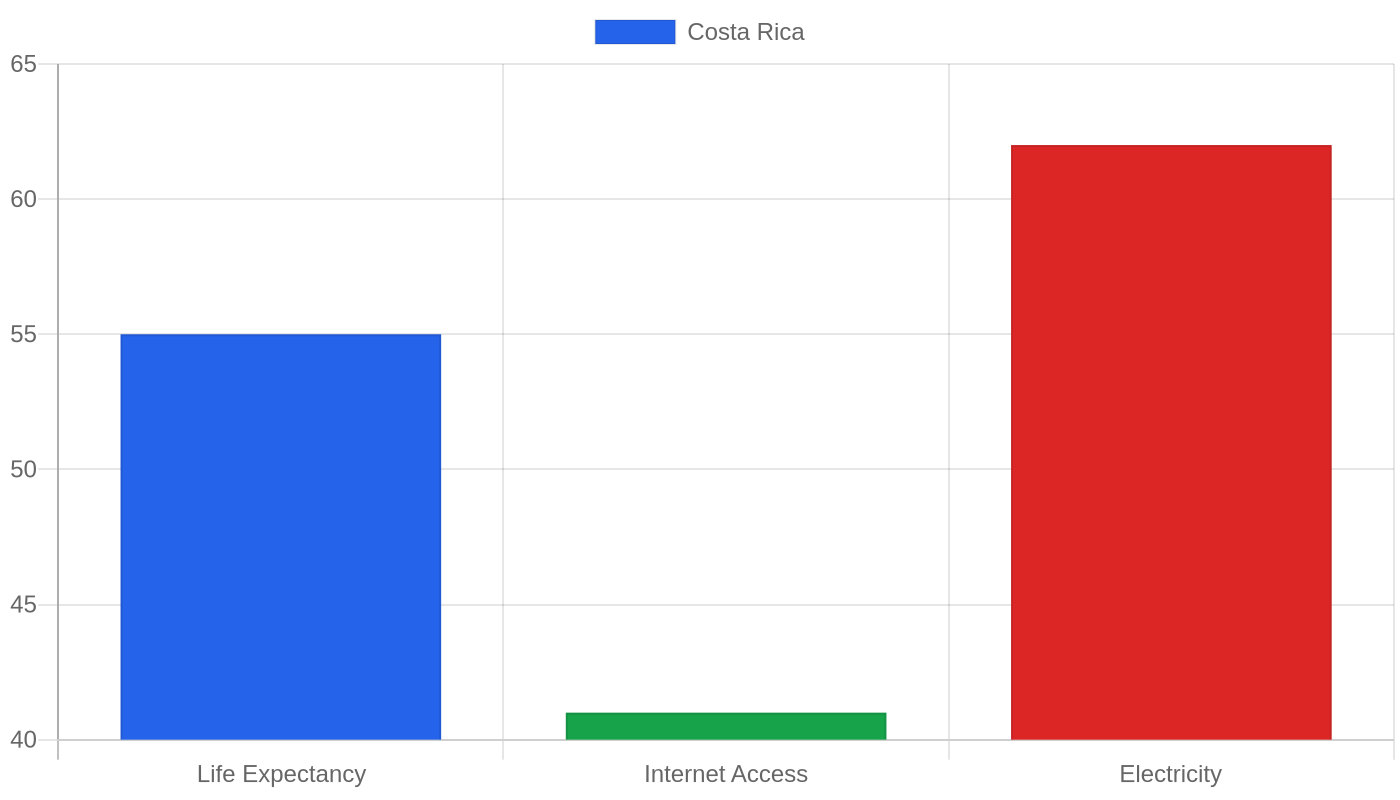
– While specific GDP, inflation, and unemployment figures are not currently available from the World Bank, the country’s long-term narrative is one of steady, if unspectacular, economic management.
– The nation’s political structure, with a directly elected president wielding significant executive power over autonomous institutions and ministerial appointments, shapes a business environment that values continuity over disruption.
The Pura Vida Economy — Stability Over Speed
Costa Rica has long been the outlier in Central America, a nation that traded its army for a welfare state and built an economy on eco-tourism, agricultural exports, and a growing high-tech services sector. According to the World Bank, the headline macroeconomic indicators—GDP growth, inflation, unemployment—are currently unavailable, but that absence itself tells a story.
In a region where economic data often swings wildly quarter to quarter, Costa Rica’s relative quiet on the statistical front suggests a certain steadiness rather than crisis.
The country’s economic DNA is written in its major industries, though the specific data on those industries is also absent from the World Bank’s current dataset. What we can observe is the corporate landscape. The consumer goods giants—Dos Pinos, the dairy cooperative that has become a national institution; Florida Ice and Farm Company, a diversified conglomerate; and Cerveceria Costa Rica, the country’s dominant brewer—speak to a domestic economy with real purchasing power.
These are not mere importers or distributors; they are producers, processors, and employers that anchor local supply chains. Café Britt, meanwhile, has transformed itself from a local roaster into an international brand, a testament to Costa Rica’s ability to add value to its agricultural heritage.
The services sector is equally telling. Aviation companies like Avianca Costa Rica, Aeropostal Alas de Centroamerica, Nature Air, and Paradise Air indicate a country deeply connected to tourism and regional commerce. And then there is ICE—the state-owned Instituto Costarricense de Electricidad—which is not just a utility but a national symbol.
ICE’s dominance in electricity and telecommunications reflects a political consensus that certain infrastructure should remain under public control, a rare stance in an era of privatization across Latin America.
The Cost of Living — A Premium on Paradise
Costa Rica has never been the cheap option in Central America, and the cost of living data currently unavailable from the World Bank does not change that lived reality. For decades, the country has attracted retirees, digital nomads, and expatriates willing to pay a premium for political stability, environmental beauty, and a slower pace of life.
That premium manifests in housing costs, particularly in the Central Valley around San José and in the tourist-heavy coastal zones like Guanacaste and the Nicoya Peninsula.
Renting in desirable areas has historically commanded prices that rival mid-tier U.S. cities, while buying property involves navigating a system that, while transparent by regional standards, still requires patience and local knowledge. Daily expenses—groceries, transportation, utilities—tend to be higher than in neighboring Nicaragua or Panama, partly because Costa Rica’s consumer goods companies like Dos Pinos and Florida Ice and Farm dominate the market and maintain pricing power.
For locals, the cost of living is a constant political issue, a tension between the country’s middle-class aspirations and the reality of an economy that must import many manufactured goods. The absence of hard data here is frustrating, but the anecdotal evidence from years of reporting is consistent: Costa Rica is not cheap, but for many, the trade-off is worth it.
Investment and Business Climate — The Corporate Republic
The list of top companies operating in Costa Rica reads like a who’s who of domestic capital and state enterprise. The Abangares Mining Company, in the basic materials sector, is a reminder that Costa Rica’s famous green image coexists with extractive industries, though mining has always been a politically sensitive topic.
The consumer services and goods companies dominate the list, suggesting that the real economic action is in serving the domestic market and exporting branded products like coffee, dairy, and beer.
For investors, the business climate is defined by the political landscape. The 1949 Constitution established a presidential system with a unitary state, and executive power is concentrated in the president, who is elected by direct popular vote for a four-year term. The president appoints the heads of autonomous institutions, cabinet ministers, and diplomats, and holds veto power over legislation.
This structure provides clarity—investors know who is in charge—but it also means that political cycles can create bottlenecks. A new president can reshuffle the leadership of key regulatory bodies, potentially slowing down projects that require government approval.
The sectors to watch remain those already established: tourism, agricultural processing, and increasingly, technology services. Costa Rica has successfully attracted back-office operations for multinational firms, leveraging its educated workforce and time zone compatibility with North America. The presence of multiple airlines on the corporate list underscores the importance of connectivity; this is a country that understands it must remain open to the world.
Safety, Politics, and Quality of Life — The Democratic Exception
Costa Rica’s political system is its greatest asset. The 1949 Constitution not only abolished the military but also created a framework for peaceful democratic competition that has held for over seven decades. The president, as head of state and head of government, wields substantial power, including the appointment of ministers and the leaders of autonomous institutions, as well as the ability to veto laws and sign decrees.
This is not a weak executive; it is a presidency designed to be effective within a system of checks and balances.
The crime and safety indices from the World Bank are currently unavailable, which is itself a notable gap. However, Costa Rica has historically been considered one of the safest countries in Latin America, particularly for tourists and foreign residents. The absence of an army means that internal security is handled by a professional police force, and while property crime exists—especially in urban areas and tourist zones—violent crime rates are lower than in many regional peers.
The quality of life, meanwhile, is consistently ranked high by international surveys, driven by universal healthcare, a strong education system, and the intangible benefits of living in a country that prioritizes environmental conservation. The “Pura Vida” ethos is not just a marketing slogan; it is a genuine cultural value that permeates daily interactions.
The Moment of Truth — Navigating a Data Vacuum
Here is the challenge for any journalist writing about Costa Rica in 2026: the World Bank data is silent on the most basic economic indicators. No GDP growth figure. No inflation rate. No unemployment number. This is not necessarily a sign of crisis—statistical reporting can lag for many reasons—but it does create a vacuum that rumors and speculation can fill.
What we know from the political landscape is that the country is operating under the same constitutional framework that has guided it since 1949, with a president who retains significant executive powers over appointments, vetoes, and decrees.
The recent news cycle, as far as the available data reveals, is dominated by the ongoing operations of the country’s major corporations. ICE continues to manage the nation’s electricity and telecommunications infrastructure. Dos Pinos and Florida Ice and Farm continue to supply consumer goods to a market that relies on their products. The airlines—Avianca Costa Rica, Nature Air, Paradise Air—continue to move people and goods in and out of the country.
There are no reported policy shifts, no elections, no major reforms or protests in the current dataset. This absence of drama is itself newsworthy in a region where drama is the default.
What is happening right now, in the absence of fresh statistical data, is the slow, steady work of governance and commerce. The president is likely appointing officials to autonomous institutions. The legislative branch is likely debating budgets and laws. The central bank is likely managing monetary policy without fanfare. For an economic journalist, this is the hardest story to tell: the story of a country that is not in crisis, not booming, not collapsing, just… continuing.
But that continuation, in the context of Central America, is remarkable.
The Bottom Line
Costa Rica remains a country to watch for investors and analysts who value stability over growth and predictability over excitement. The absence of current economic data from the World Bank is a temporary frustration, not a permanent verdict. The political system, corporate landscape, and quality of life indicators all point to a nation that manages its affairs with a level of competence rare in the region.
For those seeking a safe harbor for capital or a place to build a life, Costa Rica still deserves a long, hard look. The numbers will come. The story remains.
Sources & Methodology
This article is authored by Economic Pulse Net for informational and research purposes. Economic Pulse Net sources its data from multilateral institutions, national statistics bureaus, and proprietary databases. All data is believed to be current as of the date of publication.
Published: July 31, 2026 | Category: Research — Costa Rica
Use these signals in your own platform
Economic Pulse publishes its live signal feed through a documented, read-only API. Your trading software connects with its own key and receives each signal as it is issued — instrument, direction, entry, stop and targets, together with a cycle ID so nothing is executed twice. The feed is independent of this website and cannot change it.
Signals are informational only and are not financial advice.